
Option Greeks · Glossary
Vega in Options Trading: Meaning, IV Crush and Vega Risk
Founder of OptionsApp, active in the markets for 20+ years.
Vega is the option metric that tells you by how much the theoretical price of an option changes when the implied volatility (IV) of the underlying rises or falls by one percentage point (all else equal). Vega belongs to the option Greeks and is a first-order Greek, the first derivative of the option price with respect to volatility. It affects only the time value (the extrinsic value), is highest for options at the money and with long time to expiration, and carries a positive sign for long positions and a negative sign for short positions.
What this article means by vega
This article covers vega as an option Greek, i.e. a measure of the option price sensitivity to implied volatility. It is not about the star Vega in the constellation Lyra, car brands and software products carrying "Vega" in their name, or Vega as a first name.
Vega at a glance
- Vega is the price change per 1 IV point. Vega 0.10 means about 10 USD of price change per standard contract (factor 100).
- Vega is quoted as a positive amount; the position sign comes from long (+) or short (-).
- Highest at the money (ATM) and with long time to expiration, near 0 deep ITM, deep OTM and close to expiration.
- Vega acts only on the time value, never on the intrinsic value.
- Vega is a first-order Greek, sitting alongside delta, theta and rho, not alongside gamma, the only second-order Greek of the five.
- IV rank supplies the context of whether current IV is high or low; vega itself says nothing about it.
- Vega is the only standard Greek whose name is not a genuine Greek letter (symbol nu, ν).
Symbol
ν
Greek letter nu; vega itself is not a genuine Greek letter
Long vega
positive (+)
gains from rising IV
Maximum at
ATM + long maturity
toward 0 deep ITM/OTM
What is vega in options?
Vega in options is the metric from the family of option Greeks that measures how strongly the theoretical option price responds to a change in implied volatility. Specifically it is the price change per one percentage point of IV. Vega is a first-order Greek and acts only on the time value.
Mathematically vega is the first partial derivative of the option price with respect to implied volatility. In the Black-Scholes-Merton model (BSM), which produces the theoretical option price, vega is a model output, not a directly observed market value. One percentage point here means a move of IV from about 20 to 21 percent, not one percent of the option value. Because only the time value of an option reacts to volatility, while the intrinsic value depends solely on the distance between underlying price and strike, vega acts only on the extrinsic part of the price.
The order of the metric is decisive for classification. Like delta, theta and rho, vega is a first-order Greek, a first derivative of the option price. Only gamma is a second-order Greek among the five standard Greeks, because it describes the derivative of delta. This systematics helps avoid confusing vega with gamma.
Vega and implied volatility: where the difference lies
Vega and implied volatility are related but not the same. Implied volatility is the market's expected future range of movement of the underlying. Vega is the sensitivity of the option price to a change in that expectation. IV is the input, vega is the price reaction to it.
The distinction from historical volatility matters. Implied volatility describes the future expectation derived from option prices, expressed in annualised percent, while historical volatility measures the already realised movement of the past. Market barometers such as the VIX or the VSTOXX reflect this risk-neutral implied volatility, including a volatility risk premium. They are therefore not an oracle for the movement that actually occurs, but the currently priced expectation. Vega translates every move of that expectation into a concrete change in the option price.
When is the vega of an option highest?
The vega of an option is highest when it sits at the money. Deep in the money and deep out of the money vega falls toward zero. The reason: only at the money does the price carry its maximum time value, the only part volatility can act on.
At the money (ATM, At the Money) the strike sits near the underlying price, i.e. the price of the underlying instrument. Out of the money (OTM, Out of the Money) and in the money (ITM, In the Money) the time-value share shrinks, and with it vega. The profile against moneyness forms a bell-shaped curve with its maximum at the money, decaying roughly symmetrically on both sides. A deep in-the-money option behaves almost like the underlying itself and barely reacts to volatility; a far out-of-the-money option carries so little time value that little vega remains there either.
The second curve in the chart also shows the maturity effect: with long time to expiration the whole bell is higher and wider than with a short one. The difference is largest at the money, where time value and hence volatility sensitivity are most pronounced.
How does vega change with time to expiration?
Vega rises with time to expiration. A long-dated option carries a much higher vega than a short-dated one, because more time leaves more room for volatility to act. The relationship follows roughly the square root of the remaining time.
The formula contains the factor of the square root of the time to expiry in years. Viewed over days to expiration (DTE, Days to Expiration) this means: from 30 to 120 DTE vega roughly doubles, while close to expiration it drops steeply toward zero. In practice the non-linearity means a short-dated option needs about two to three times the IV move to achieve the same price gain as a long-dated one. Long-dated options such as LEAPS (Long-term Equity AnticiPation Securities) therefore carry the highest vega and react most strongly to volatility swings.
Vega sign across option strategies
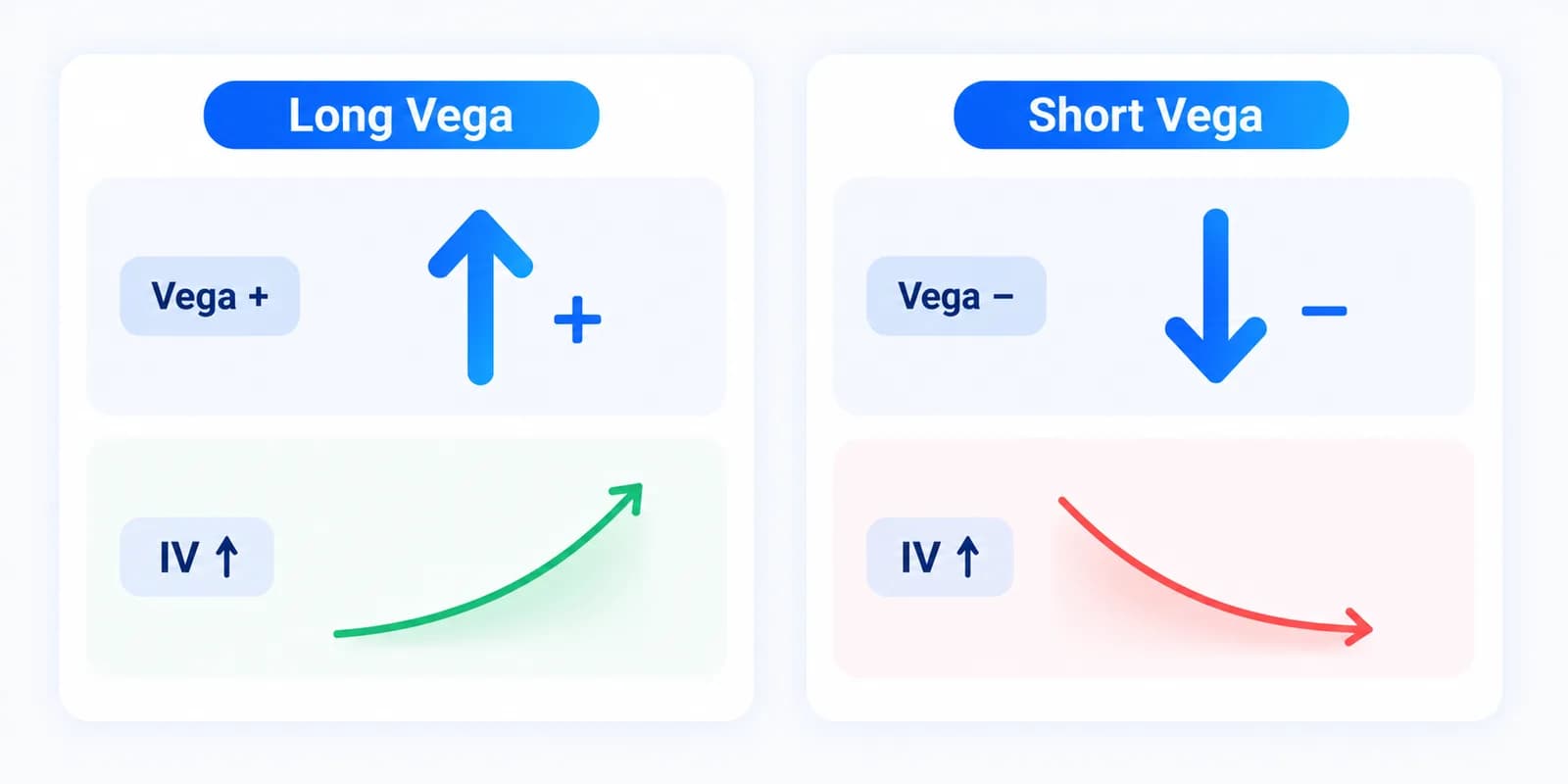
Long positions carry positive vega, short positions negative. A buyer gains from rising implied volatility; a seller loses when IV rises. Vega is usually quoted as a positive amount, and the sign comes from the position.
| Position | Vega | Effect when IV rises |
|---|---|---|
| Long call | + | gains |
| Long put | + | gains |
| Short call | - | loses |
| Short put | - | loses |
| Long straddle | strongly + | gains markedly |
| Iron Condor | - (net short vega) | loses |
| Calendar spread | + (net long vega) | gains |
Aggregating the legs yields the net vega of a strategy. An Iron Condor is net short vega by construction and thus gains from falling IV; a calendar spread is net long vega, because the long-dated leg carries more vega than the short-dated one. When the sum of all vega values sits near zero, the position is called vega-neutral. It barely reacts to IV changes but stays exposed to delta, gamma and theta.
Vega in market context: IV rank, VIX and VSTOXX
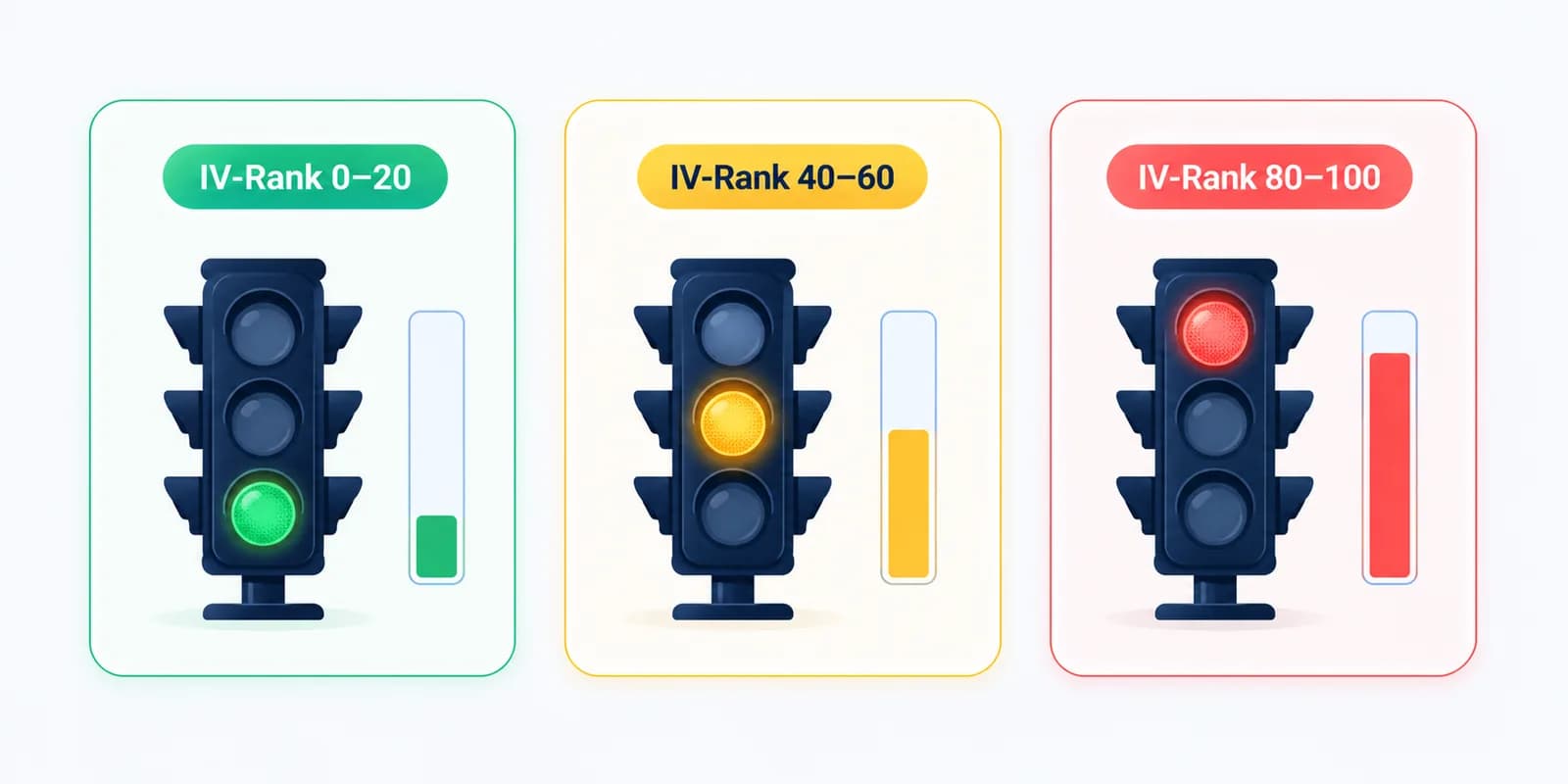
Vega alone says nothing about whether implied volatility is currently high or low. That context is supplied by IV rank, which places current IV within its own 52-week history. Vega is the lever, IV rank the context.
The macro picture comes from volatility indices. The VIX is the US volatility barometer and measures the 30-day expected implied volatility of the S&P 500. The VSTOXX is the European counterpart, referencing the EURO STOXX 50; in mid-July 2026 it stood on the order of about 20 points (V2TX around 20.6 on 2026-07-10). Both show the currently priced expectation, not a forecast of realised movement. For a position with high vega, whether this environment is expensive or cheap right now is decisive.
| IV-Rank | Classification | Rough meaning for vega |
|---|---|---|
| 0 bis 20 | low | IV historically low, long vega tends to be cheaper |
| 40 bis 60 | medium | IV in the normal range, no clear tendency |
| 80 bis 100 | high | IV historically high, short vega collects more premium |
The table is for orientation. Which variant fits an individual account depends on risk profile, experience and objective and must be decided by each person alone.
What happens to vega during an IV crush after earnings?
In an IV crush implied volatility drops sharply after a scheduled event such as an earnings date. Through vega this drop feeds straight into the option price, even if the underlying price stands still. Long-vega positions lose time value in the process.
Ahead of a scheduled event IV often rises because the market prices in a large move. Buying positive-vega options in that phase, for instance a long straddle into earnings, means paying for that high expectation. Once the event is over, uncertainty disappears, IV falls back, and time value melts away through vega. Even a correctly predicted price move then often fails to offset the IV loss. This is the classic long-vega trap around earnings.
Example: IV crush through vega
- Starting point: Stock at 100 USD, ATM call into earnings, IV 40 percent, vega 0.15.
- Path: Earnings over, IV drops to 25 percent (minus 15 points), the price stands almost still.
- Result: Vega effect about 0.15 · 15 = 2.25 USD per share, roughly 225 USD loss per contract, despite the underlying standing still.
- Analogy: Like storm insurance whose premium suddenly gets cheaper the day after the weather warning passes.
Vega calculator (IV impact)
Per share
−2.25 USD
Per contract (×100)
−225 USD
Total
−225 USD
Linear approximation per 1 IV point. Long gains when IV rises and loses on an IV crush, short is the mirror image. Large IV jumps add vega convexity (volga). Not investment advice.
Vega risk for premium sellers: understanding negative vega
For premium sellers, i.e. option writers, negative vega is a risk in its own right. When implied volatility rises, a short position loses value even if the underlying price stays unchanged. This vega risk acts on top of the directional risk.
An example makes this tangible: a premium seller writes a put and collects the premium. If IV jumps the next day because the market turns nervous, the option price rises through negative vega, and the short position shows a book loss even though the price barely moved. Important for risk classification: a short put or a risk-defined spread has a limited maximum risk, whereas a naked short call has a theoretically unlimited loss potential because the underlying can rise without bound. A rise in IV additionally aggravates that position through vega.
In practice vega risk spreads across many open positions and is hard to keep in view one by one. Rule-based premium sellers therefore cap net vega up front through structure choice and position sizing, rather than tallying it after the fact. Whether the vega risk fits the personal rulebook remains the trader's decision.
Vega interacting with theta and gamma
Vega rarely stands alone. For premium sellers the trade-off between vega and theta, the time decay, is central. A long-dated option brings theta income only over time but carries higher vega risk. A short-dated option has less vega but a faster decay of time value.
Beyond the five standard Greeks there are second-order metrics tied directly to vega. Vanna describes how vega changes on a price move (and, mirrored, how delta changes on an IV move). Vomma, also called volga, is the volatility gamma and measures how much vega itself changes on an IV move, analogous to how gamma describes the change in delta. These second-order metrics are used mainly in professional volatility trading and are not strictly needed for the basic definition of vega.
Calculating vega: a worked example
In practice vega is read directly from the broker's option chain. Computing it yourself via the Black-Scholes-Merton model only serves as a plausibility check. The following example shows how vega translates into the price change at one percentage point of IV.
The formula below is aimed at readers with a mathematical-statistical background. Anyone who does not need it can skip the block. For practice it is enough to know: vega times the number of IV points gained or lost gives the price change per share.
- S
- underlying price
- φ(d1)
- standard normal density at d1
- T
- time to expiry in years
Vega = S · φ(d1) · √T / 100- Vega (per 1 point)
- 0.10
- ΔIV
- +1 point20% to 21%
- per share
- 0.10 · 1 = 0.10 USD
- per contract
- 0.10 · 100 = 10 USDmultiplier 100
ΔOption price ≈ Vega · ΔIVThe factor 100 comes from the contract multiplier: a standard equity option covers 100 shares, so a vega of 0.10 corresponds to roughly 10 USD of price change per contract and per IV point. The broker streams vega from its pricing engine, which additionally accounts for skew and live market data. Computing it from the formula is therefore an edge case for control, not for daily trading.
Common misconceptions about vega
- Vega is a Greek letter. Wrong. There is no Greek letter named vega. The symbol is the lowercase nu (ν), which resembles the Latin v. Vega is the only one of the five standard Greeks whose name is not a genuine Greek letter (documented by Wikipedia and Investopedia).
- Vega is volatility. Wrong. Vega is the sensitivity of the price to changes in implied volatility, not volatility itself.
- Implied equals historical volatility. Wrong. Implied volatility is the market's expected future movement, historical volatility the already realised movement of the past.
- High vega is always good. Context-dependent. Long gains from rising IV and loses in an IV crush, short behaves the opposite way. Without the context of IV rank there is no way to judge it.
- Vega is second-order like gamma. Wrong. Vega is a first-order Greek, the first derivative of the price with respect to IV. Only gamma is a second-order Greek among the five standard Greeks.
Vega in trading practice
In practice vega tends to be used above all as a risk sensor, not a yield promise. How to apply vega concretely depends on the individual rulebook and does not replace an individual investment decision. Three observations recur:
- Net vega at portfolio level says more than single-position vega, because opposing long and short vega positions only reveal themselves in the sum.
- Around scheduled events such as earnings, vega risk tends to be far more visible than in a calm market, because IV swings most there.
- A useful habit is to check for every new position whether the net vega carries the intended orientation or is only a by-product of strike selection.
Vega FAQ
What does vega mean in options?
Vega tells you how much the theoretical price of an option changes when the implied volatility of the underlying rises or falls by one percentage point. A vega of 0.10 means the option price reacts by about 0.10 USD per share, so for a standard contract covering 100 shares roughly 10 USD per contract. Vega is a first-order Greek and affects only the time value.
When is the vega of an option highest?
Vega is highest for options at the money (ATM) and with long time to expiration. Deep in the money and deep out of the money vega runs toward zero, because little time value remains for volatility to act on. Close to expiration vega also drops sharply, since the square-root-of-time term goes to zero. A long-dated ATM option can carry several times the vega of a short-dated one.
Is a high vega good or bad?
It depends on the position and the market context. A long position with positive vega gains from rising implied volatility and loses when IV falls. A short position with negative vega behaves the opposite way. Without the context of IV rank, which places current IV within its own history, there is no way to say whether a high vega is favourable.
What is the difference between vega and implied volatility?
Implied volatility is the market's expected future range of movement of the underlying, expressed in annualised percent. Vega is the sensitivity of the option price to a change in that implied volatility. IV is the input, vega is the price reaction to it. Vega is not volatility itself; it only measures how strongly the price responds to its movement.
What happens to vega during an IV crush after earnings?
In an IV crush, implied volatility drops sharply after a scheduled event such as an earnings date. Through vega this drop in IV feeds straight into the option price. A long position loses time value even if the underlying price stands still. Anyone holding positive-vega positions into earnings carries this risk especially clearly.
What does a vega-neutral position mean?
Vega-neutral means the sum of the vega values of all legs of a position or portfolio is near zero. Such a position reacts little to changes in implied volatility but stays exposed to delta, gamma and theta. Calendar spreads and certain ratio structures are used to steer the net vega deliberately in the desired direction.
Is vega a Greek letter?
No. There is no Greek letter named vega. The symbol used is the lowercase nu (ν), which resembles the Latin v. Vega is therefore the only one of the five standard Greeks whose name is not a genuine Greek letter. Delta, gamma, theta and rho, by contrast, are real Greek letters.
Sources
- Options Industry Council (OIC), Vega. optionseducation.org
- CBOE Education, Options Greeks. cboe.com
- Investopedia, Vega Definition. investopedia.com
- Wikipedia, Greeks (finance) #Vega. en.wikipedia.org/wiki/Greeks_(finance)#Vega
- tastylive, Extrinsic Value, IV Crush and IV Rank. tastylive.com
Risk disclaimer
Options are leveraged derivatives. Trading options can lead to total loss and, on short positions, to losses exceeding the capital invested, theoretically unlimited for naked short calls. Greeks like vega are model outputs and describe reality only approximately. Worked examples in this article are hypothetical and no promise of future gains. This content is not individual investment advice.
Greeks aggregation in OptionsApp
OptionsApp opens options strategies automatically by a stored rule set, for instance selecting strikes via a target delta or a target premium. Profit target, stop loss and delta exit run mechanically by your defined values. Strategy choice, sizing and market view remain the trader's call.
More in the automated premium-selling guide.