
Option Greeks · Glossary
Gamma: How an Option's Delta Changes
Founder of OptionsApp, active in the markets for 20+ years.
This page covers gamma in options trading. The Greek letter as a mathematical symbol, the gamma distribution in statistics and gamma radiation in physics are not covered here.
Gamma is the second-order sensitivity in the options model. It measures by how much an option's delta changes when the underlying moves by one unit. Mathematically, gamma is the second partial derivative of the option price with respect to spot, and it peaks at the money near expiration.
Gamma at a glance
- Gamma value measures the change in delta per unit move of the underlying.
- Peaks at the money and near expiration, falls toward zero far from the strike.
- Long options carry positive gamma, short options negative. Iron condors and credit spreads are short gamma.
- Gamma and theta interact directly: premium sellers pay gamma risk for theta income.
- Gamma squeeze and gamma exposure describe market phenomena driven by aggregated hedging flows.
Order
2
Second-order sensitivity
Maximum
ATM
at the money, near expiration
Sign
+ / −
Long positive, short negative
What is gamma?
Gamma is one of the core option Greeks. It describes how an option's delta changes when the underlying moves by one unit. Where delta states how much the option price reacts to a price change, gamma states the rate of change of that reaction. In the simplest analogy delta is the speed of a vehicle and gamma is its acceleration.
Mathematically, gamma is the second partial derivative of the option price with respect to spot. In the Black-Scholes framework, published in 1973 in the Journal of Political Economy, gamma equals Phi(d1) divided by the product of spot, volatility and the square root of time to expiration. Phi is the standard normal density. In practice gamma is read from the broker option chain, where the underlying pricing model recalculates the value continuously.
For orientation: delta sits between 0 and 1 for calls, between −1 and 0 for puts. Gamma is always positive for long options and negative for short options because the sign flips on sale. Greeks overall are model outputs, not market observations. They change continuously with spot, volatility and remaining time.
How does gamma change with spot?
Gamma peaks at the money and falls toward zero on both sides in a near-symmetric bell curve. This is the single most important qualitative feature of gamma: a deep OTM or deep ITM option barely reacts to further moves because delta is stuck at zero or at one (minus one for puts). Only near the strike is delta in motion, and that is exactly where gamma is highest.
Selling an option flips the sign. A short call mirrors the long call across the zero line. Anyone short an ATM option sits at the most negative gamma point on the entire chain. That is why narrow strike distances and short tenors are considered especially sensitive in premium-selling setups.
How does gamma change with time to expiration?
As expiration approaches, the bell curve at the money narrows and grows taller. A 45-DTE option shows a wide, flat gamma profile. At 14 DTE the curve becomes noticeably tighter and higher. On expiration day itself the option's probability mass collapses to a narrow band around the strike and the at-the-money gamma reaches an almost vertical peak. This behaviour follows directly from Black-Scholes: Phi(d1) grows, T shrinks, and the square root in the denominator drives the characteristic exponential rise.
In practice this has one concrete consequence. Anyone writing options and holding them close to expiration carries the highest gamma risk of the entire option cycle. A 45-DTE iron condor shows a comparatively tame risk profile; the same iron condor with seven days left reacts to every larger move with a far bigger mark-to-market swing.
Gamma sign across option strategies
The sign logic is mechanical: long positions are long gamma, short positions short gamma. At strategy level the Greek contributions of each leg add up. A long straddle combines two positive gammas; an iron condor combines two positive and two negative ones, with the shorts sitting closer to spot and dominating in absolute terms.
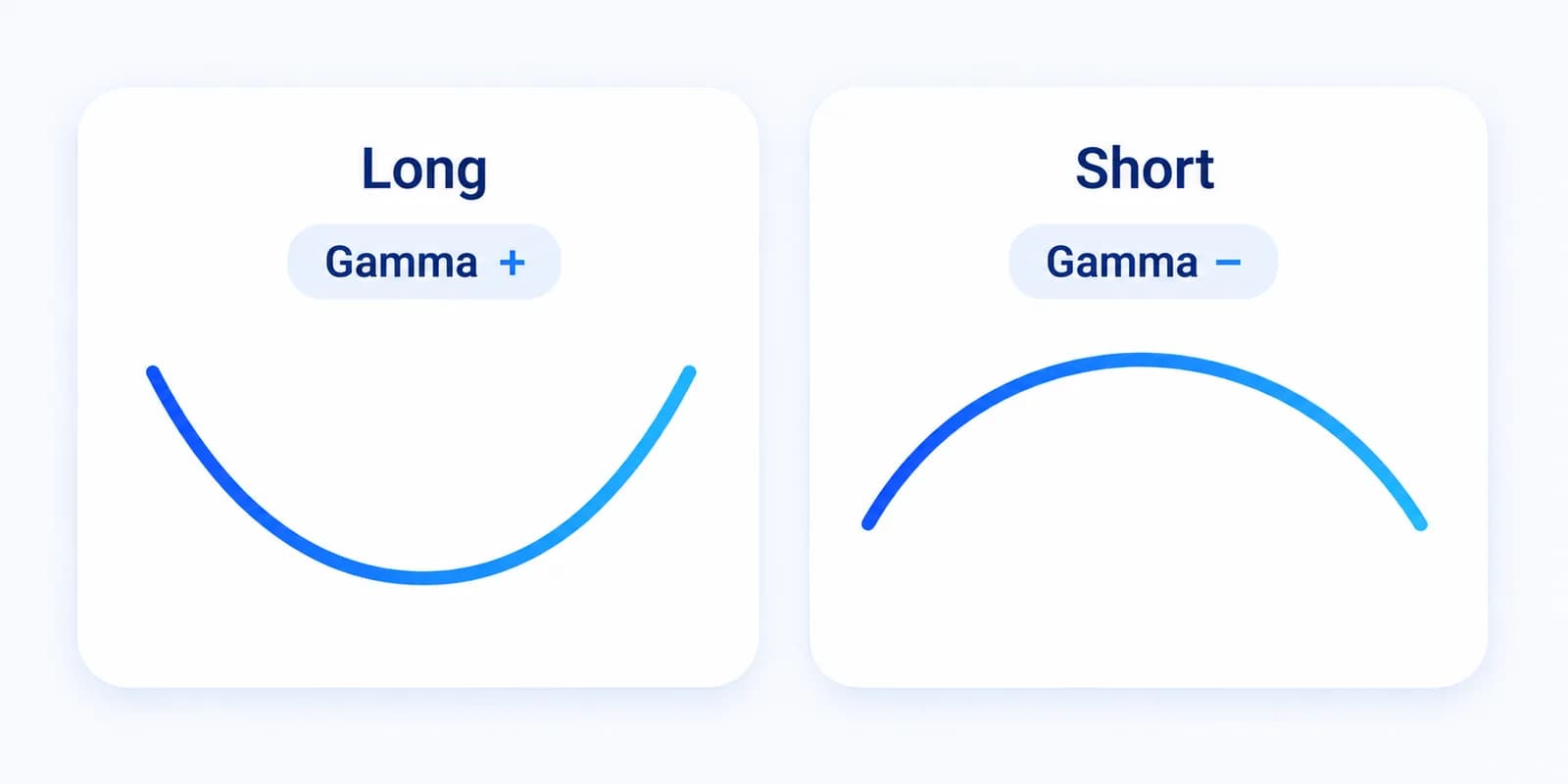
| Strategy | Gamma | Practical meaning |
|---|---|---|
| Long Call | + | Profits accelerate as spot rises. |
| Long Put | + | Profits accelerate as spot falls. |
| Short Call | − | Losses accelerate as spot rises. |
| Short Put | − | Losses accelerate as spot falls. |
| Long Straddle | ++ | Profits from large moves in either direction. |
| Short Strangle | −− | Theoretically unlimited loss; not risk-defined. |
| Iron Condor | − | Short gamma, capped by long wings. |
| Credit Spread | − | Short gamma on one side, risk capped by long leg. |
The table is for orientation only. Which strategy fits a personal account depends on risk profile, experience and goals and is an individual decision. In particular, a short strangle is not a direct substitute for an iron condor because its loss is theoretically unlimited.
Gamma risk on short-dated options
Gamma risk is the disproportionate reaction of an option position to price moves once time to expiration is short. The effect is especially pronounced on daily-expiring index options. According to CBOE Volatility Insights, in 2024 roughly 59 percent of total SPX option volume was traded in options with zero days to expiration. This structural shift pushed 0DTE into the mainstream and sharpened the gamma debate.
Concretely: a premium-selling position close to expiration reacts to every headline, every CPI print and every unexpected sector rotation because delta can quickly drift toward 1 or 0 in either direction. The mark-to-market of the position jumps accordingly. On quiet days the position collects rich theta. On busy days losses can devour days or weeks of premium. This asymmetry is the price of the theta yield, not a bug.
0DTE options are not a beginner product. Anyone running premium-selling positions on expiration day should be aware of the extreme gamma risk and plan a clear position review before the close. This is not investment advice.
In practice, the range of mark-to-market swings on premium-selling trades widens noticeably close to expiration. A position-review trigger and strict sizing caps can be defined through automated rule sets. How an individual handles that depends on the personal rulebook.
What is gamma exposure (GEX)?
Gamma exposure is the aggregated gamma position of all market participants in an underlying, weighted by open interest and lots. The concept emerged from the question of how market makers hedge their option books against price moves. The core logic: market makers usually trade the other side of retail flow, so their net sign opposes the public's. That book has to be hedged continuously.
If dealers are net long gamma, they buy shares as prices fall and sell as prices rise because they rebalance delta hedges against the move. That dampens volatility. If dealers are net short gamma, the sign flips: hedges trade with the move, upticks are amplified by share buying, downticks by selling. GEX data is estimated by specialised providers such as SpotGamma or Squeezemetrics; there is no single official source.
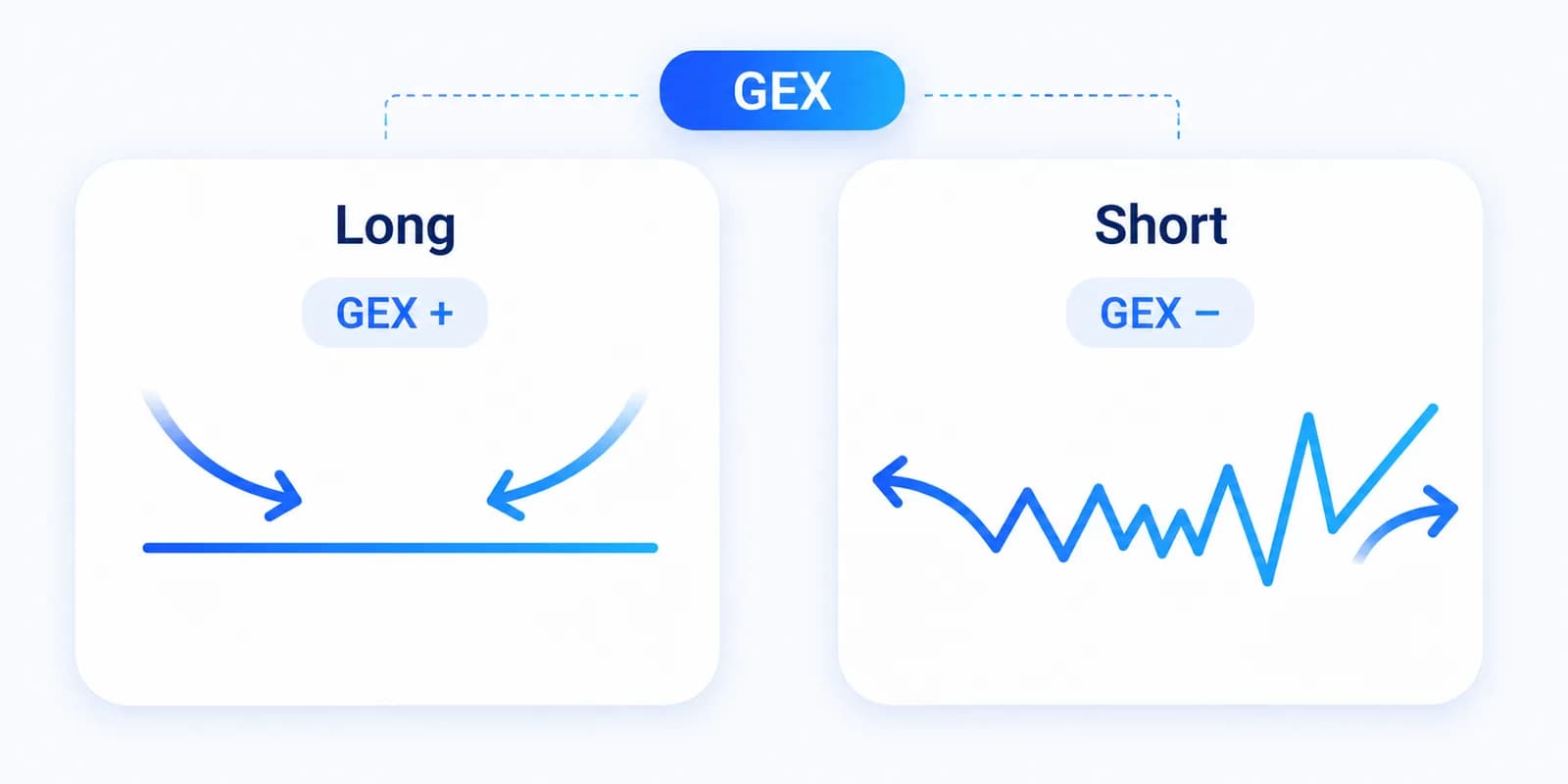
The concept does not translate into a direct trading recommendation. GEX is a market-structure metric with explanatory value, not a signal generator.
What is a gamma squeeze?
A gamma squeeze is a market phenomenon in which heavy call buying triggers a self-reinforcing upward trend. The mechanics break down into three steps.
- Call buying pressure builds. Retail traders or funds aggressively buy OTM calls on an underlying. The dealer writing those calls is net short gamma and short delta.
- Dealer hedging kicks in. To neutralise the short, the dealer buys shares of the underlying. As the price rises, call deltas grow rapidly because gamma at the money is high. Dealers have to buy more shares to stay neutral.
- Self-reinforcing loop. Mechanical share buying drives the price higher, pulling more calls into the money and triggering further hedge buys. The loop persists until call buying flips or enough long inventory is available.
The most prominent historical example is the GameStop move in January 2021, when aggressive call buying combined with a stock-side short squeeze multiplied the price within days. CBOE Research documented the mechanics in the study "Gamma Squeezes" (cdn.cboe.com).
This is a mechanics explanation, not a trading recipe. Gamma squeezes are rare, hard-to-predict phenomena. Anyone trying to anticipate them carries substantial total-loss risk.
What is gamma scalping?
Gamma scalping is a professional technique that systematically monetises a long-gamma position. A trader holds, for example, a long straddle and continuously offsets the delta changes from spot moves by trading shares against the direction: selling on rallies, buying on dips. Ideally the proceeds cover the theta decay of the options and leave a surplus.
The technique requires high trade frequency, low transaction costs and a clear grasp of the interplay between realised and implied volatility. In retail, gamma scalping is hard to implement cleanly because of cost structure. Those who want to approximate the concept via automated rule sets can find related approaches in the automated trading section.
Gamma combined with delta and theta
Gamma interacts directly with delta and theta. The link to delta is definitional: gamma is the change in delta. The link to theta is economic: positive theta is paid for by negative gamma.
This interaction is the conceptual core of any premium-selling strategy. Theta income is not a gift but a premium for accepting move risk. When implied volatility rises sharply, both vega and gamma risk become more expensive. When implied volatility drops, the position can breathe because mark-to-market swings shrink. Anyone running a premium-selling book without grasping this three-way link is trading blind.
Worked example for gamma
Assume an SPX call with 30 DTE and an at-the-money strike shows delta 0.50 and gamma 0.04 in the option chain. SPX spot moves from 5,000 to 5,010, ten points up. The approximate delta change is gamma times the spot move, 0.04 x 10 = 0.40. After the move delta sits around 0.90.
For dollar context: US stock and index options settle on a multiplier of 100. A delta change of 0.40 corresponds to 0.40 x 100 = 40 USD per one-point move of the underlying per contract. Over the ten-point move the mark-to-market shift adds up to the order of 250 USD per contract because the move also changes the option price itself. The figure is illustrative and non-linear because delta itself drifts along.
This is a linear approximation and only holds cleanly for small moves. Gamma itself falls on the up move because the initially at-the-money option runs into the money, where gamma declines (gamma peaks at the money). Across the ten points that barely matters, but for larger moves the linear approximation clearly overstates the delta gain, so the real new delta then sits a little below the linear figure. Exact values come from the broker option chain in real time, and for tighter work a Black-Scholes calculator beats a static constant.
Common misconceptions about gamma
- Gamma is not leverage. Gamma measures the change in delta, not the option's leverage. Leverage concepts like omega or lambda are separate metrics.
- Gamma is not stable. Gamma changes with every spot move, every vol shift and every passing day. A value noted in the trade plan is outdated within hours.
- Gamma sign flips on the sell side. Closing a long and shorting the same strike does not zero out gamma, it puts you on negative gamma.
- Gamma is a model output. The value comes from a pricing model, typically Black-Scholes or a variant. There is no market price for gamma; what shows on screen is the broker's estimate.
Gamma FAQ
What is a gamma squeeze?
A gamma squeeze describes a market phase in which market makers are forced by heavy call buying and rising prices to buy more shares of the underlying to rebalance their delta hedges. These mechanical buys reinforce the upward trend. The GameStop episode in January 2021 is the best-known historical reference.
How is gamma calculated?
Gamma is the second partial derivative of the option price with respect to spot, i.e. the change in delta per unit change in the underlying. In Black-Scholes gamma equals Phi(d1) divided by (S times sigma times square-root of T), where Phi is the standard normal density, S is spot, sigma volatility and T time to expiration. In practice gamma is read from the broker option chain.
What does high gamma exposure mean?
High aggregate gamma exposure means the entire option market reacts strongly to underlying moves. Positive aggregate GEX (dealers long gamma) tends to dampen volatility because hedges trade against the move. Negative GEX (dealers short gamma) amplifies moves because hedges trade with the move. Aggregate GEX data is published by specialised providers such as SpotGamma and Squeezemetrics.
What is gamma scalping?
Gamma scalping is a professional technique that keeps a long-gamma position (such as a long straddle) delta-neutral by trading shares against each move of the underlying. Theta decay is the price paid for the right to monetise these moves. In practice this requires high trading frequency and very low transaction costs.
Why is gamma so high on 0DTE options?
As expiration approaches the probability mass of an option concentrates in a narrow band around the strike. Small spot moves then change delta drastically because an ATM option can swing between delta 0 and delta 1 within hours. This exponential peak of gamma on the day of expiration makes 0DTE positions extremely reactive.
What is long gamma vs. short gamma?
Long gamma means the position benefits from realised moves: long calls, long puts, long straddles and long strangles all carry positive gamma. Short gamma is the mirror case: short calls, short puts, iron condors and credit spreads carry negative gamma and lose disproportionately during strong moves.
What is a normal gamma value?
There is no normal value because gamma depends heavily on strike, time and volatility. Industry-typical ballpark figures for ATM options: at 30 DTE gamma often sits around 0.04 to 0.06, at 7 DTE around 0.15 to 0.25, at 1 DTE 0.30 or higher. These are snapshot model outputs, not constants.
Is gamma a risk or an opportunity for premium sellers?
For premium sellers gamma is mainly a risk factor because short options carry negative gamma. A move against the position is accelerated by that negative gamma. In return positive theta compensates the seller: gamma risk is the price paid for the time value collected. Anyone who cannot accept that trade-off should not run premium-selling strategies.
Sources
- CBOE Volatility Insights, Evaluating the Market Impact of SPX 0DTE Options. cboe.com/insights
- CBOE Research, Gamma Squeezes (PDF). cdn.cboe.com
- Options Industry Council, Understanding Option Greeks. optionseducation.org
- Wikipedia, Greeks (finance), Section Gamma. en.wikipedia.org
- Black, F. and Scholes, M. (1973). The Pricing of Options and Corporate Liabilities. Journal of Political Economy 81(3), 637-654.
Risk disclaimer
Options are leveraged derivatives. Greeks like gamma are model outputs, not market observations, and change continuously. Example values and mechanics in this article are not investment advice and not a recommendation for any particular strategy. Capital, margin and personal risk tolerance should be reviewed before any trade.
Execute your gamma rulebook automatically
Profit target, stop loss and sizing limits run inside OptionsApp automatically based on your own trade templates. When a threshold is hit, the app submits the stored closing order; whether and at what price it fills depends on the market. Strategy choice and monitoring remain the trader's job.
More in automated trading section.