
Options strategies · Glossary
Iron Condor: Strategy, Structure and Example for Premium Sellers [2026]
Founder of OptionsApp, active in the markets for 20+ years.
The Iron Condor is a neutral options strategy built from 4 legs sharing the same expiration: a short put, a long put, a short call and a long call. One sells a put and a call and buys a further put and call as outer protection, collecting a net credit. Max profit and max loss are both fixed at entry. Profitable as long as the underlying stays between the two short strikes through expiration.
Iron Condor at a glance
- Iron Condor = bull put spread below + bear call spread above, same expiration, net credit collected.
- Both sides are commonly OTM but do not have to be. ITM variants exist as a special case.
- Max profit = net credit x 100 ($485 in the SPX example). Max loss = (wing width − credit) x 100 ($2,015). Risk defined at entry. Public tastylive backtests show win rates of 70 to 83 percent with short strikes around delta 16 and a 50 percent profit target.
- Theta-positive, vega-negative. Delta usually close to 0 on a symmetric setup, asymmetric Iron Condors are also possible. Matches a range-bound outlook for the underlying.
- Capital requirement scales with wing width and underlying. See the SPX worked example below for concrete numbers.
- The 0DTE variant of the Iron Condor on SPX has gained massive popularity since 2023.
Legs
4
2 puts + 2 calls, usually all OTM
Outlook
Range-bound
Range-bound outlook
Risk
Defined
Capped profit, capped loss
What is an Iron Condor?
An Iron Condor is a neutral options strategy built from four options on the same underlying with identical expiration. You simultaneously open a bull put spread below spot and a bear call spread above. You collect a net credit at entry, profit from sideways movement and cap risk at wing width minus credit.
The name comes from the payoff shape: the wide profit plateau in the middle resembles the outstretched wings of a condor. The prefix "Iron" signals that the position mixes calls and puts, unlike a plain long condor that uses calls or puts only.
The Iron Condor is typically traded on liquid indices (SPX, RUT, NDX), their ETFs (SPY, QQQ, IWM) and large caps with deep options volume. For European retail traders SPX is attractive due to cash settlement and no assignment risk, IWM works well as a small-account entry vehicle.
How does an Iron Condor work?
An Iron Condor works by selling options on both sides of the current price. You short the inner put and call closer to spot and buy the outer put and call as insurance. At expiration you keep the full credit as long as the underlying stays between the short strikes.
The primary income driver is time decay. Every quiet day the four options lose value, and since your shorts decay faster than your longs you net positive theta. A 45-DTE SPX Iron Condor typically shows 8 to 15 USD of daily theta per contract at entry, accelerating near expiration.
The counterweight is negative vega. If implied volatility rises after entry the position marks down regardless of price. This is why professionals prefer to open Iron Condors when IV rank is elevated: premium is rich, vega headwind is capped and volatility mean-reversion works in your favor.
Iron Condor structure: the four legs
An Iron Condor always has four legs with the same underlying and expiration. They differ in type (call or put), direction (long or short) and strike. From low to high the order is always: long put, short put, spot, short call, long call.
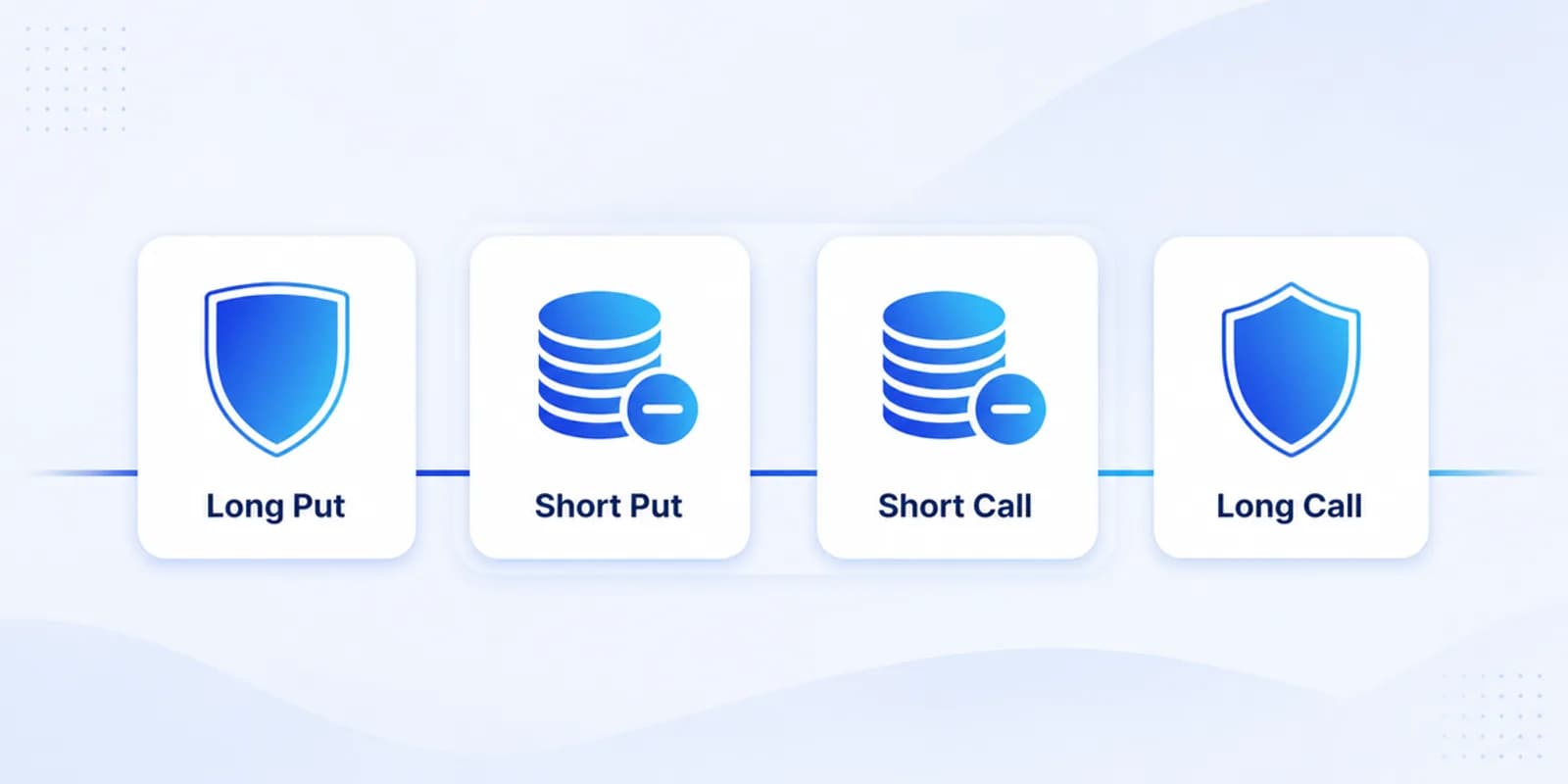
| Leg | Type | Direction | Strike (SPX) | Delta | Premium |
|---|---|---|---|---|---|
| 1 | Put | Long | 4.900 | −0,08 | −3,20 $ |
| 2 | Put | Short | 4.925 | −0,16 | +5,60 $ |
| 3 | Call | Short | 5.075 | +0,16 | +5,45 $ |
| 4 | Call | Long | 5.100 | +0,08 | −3,00 $ |
| Σ | Net | Credit | 25-pt wings | ≈ 0 | +4,85 $ |
Wing width here is 25 points per side, distance between short strikes is 150 points. This symmetric build keeps the Iron Condor delta-neutral. An asymmetric version with a wider call side is sometimes used to add a slight bullish bias.
Maximum profit, maximum loss and break-even of the Iron Condor
For an Iron Condor, max profit, max loss and both break-even points are fully known at entry. That is what makes the strategy attractive from a risk-management angle. All four values derive from the net credit, the wing width and the two short strikes.
Max profit = Netto-Credit x 100
Max loss = (Spreadweite − Netto-Credit) x 100
Break-even lower = Short Put − Netto-Credit
Break-even upper = Short Call + Netto-Credit
For the example above: max profit $485, max loss $2,015, lower break-even 4,920.15 and upper break-even 5,079.85. Risk/reward is 1 to 4.15. The break-even hit rate is about 81 percent (2,015 of 2,500 USD total risk); at a model-dependent POP around 70 percent the raw hold-to-expiry expectancy before management is therefore slightly negative. Active management is precisely the lever.
Worth noting: the 1:4 ratio looks bad in isolation but is offset by probability. At a model-dependent POP around 70 percent and 1:4 the raw expectancy is 0.70 x 485 − 0.30 x 2,015 = 339.50 − 604.50 = −265 USD before management. That is why many experienced traders use an early exit instead of holding to expiration. Active management can substantially improve expectancy. The exact profit threshold or DTE level is part of the individual rulebook. Tastylive data shows 50-percent profit management materially lifts win rate and cuts average loss.
Iron Condor example with real numbers (SPX, 45 DTE)
The following trade is a typical SPX example setup. SPX at 5,000, IV rank 38, 45 days to expiration. You sell a 16-delta Iron Condor with 25-point wings and target a close at 50 percent of max profit.
| Metric | Value |
|---|---|
| Underlying | SPX @ 5.000 |
| IV-Rank | 38 |
| DTE | 45 |
| Strikes | 4.900 / 4.925 / 5.075 / 5.100 |
| Net credit | 4,85 $ x 100 = 485 $ |
| Max loss | 2.015 $ |
| Break-even range | 4.920,15 - 5.079,85 |
| Buying power Reg-T | 2.015 $ |
| Profit target (50%) | 242,50 $ |
| ROI on target | 12,0 % on buying power |
| Theta day 1 | ≈ +11 $ |
| Vega | ≈ −18 $ |
Over the next 20 trading days SPX drifts between 4,970 and 5,040. The Iron Condor builds 235 USD of profit and is closed at 242 USD buy-to-close. In this example case, i.e. if the underlying actually stays between the short strikes, that is 11.7 percent return on the 2,015 USD capital in three weeks. Such returns only occur in this specific positive case and are not an expectancy claim.
Illustrative example derived from past trades. No guarantee of future results.
A smaller version on IWM uses 5-point wings with the same 16-delta structure. At IWM 220 strikes are typically 212 / 217 / 223 / 228, credit around $1.05, max loss $395. Fits accounts starting at 5,000 EUR without portfolio margin. The same logic runs as the 0DTE variant of the Iron Condor on SPX, with significantly higher gamma sensitivity and tighter management rules.
Iron condor payoff calculator
Max profit
+485 USD
Max loss
−2,015 USD
Break-even range
4,920.15 - 5,079.85
P&L at expiration, excluding fees and the path during the trade. A pure illustration of the defined structure, not a signal and not investment advice.
Iron Condor Greeks: theta, vega, delta, gamma
The Iron Condor is theta-positive, vega-negative, delta-neutral and gamma-negative. Translated: you earn from time decay, lose when volatility expands, become price-sensitive near the shorts and are exposed to fast moves. The table below shows each leg contribution.
| Leg | Delta | Gamma | Theta | Vega |
|---|---|---|---|---|
| Long Put 4900 | − | + | − | + |
| Short Put 4925 | + | − | + | − |
| Short Call 5075 | − | − | + | − |
| Long Call 5100 | + | + | − | + |
| Net | ≈ 0 | − | + (11 $) | − (18 $) |
The most dangerous sensitivity metric in an Iron Condor is gamma. As long as spot stays centered, gamma is small and the position is stable. Once SPX approaches a short strike, gamma on that leg explodes, delta drifts away, and small moves produce outsized P/L swings. This gamma effect is why many traders avoid the last weeks before expiration, closing early or rolling into a later expiration. Where exactly that threshold lies (around 21 days is often discussed) depends on the rulebook.
When does an Iron Condor make sense?
An Iron Condor works when three conditions line up: elevated implied volatility, expected sideways move and enough time to expiration. A common rule of thumb among systematic sellers is IV rank above 30, ideally 30 to 60 DTE, on a chart that shows no clean trend.
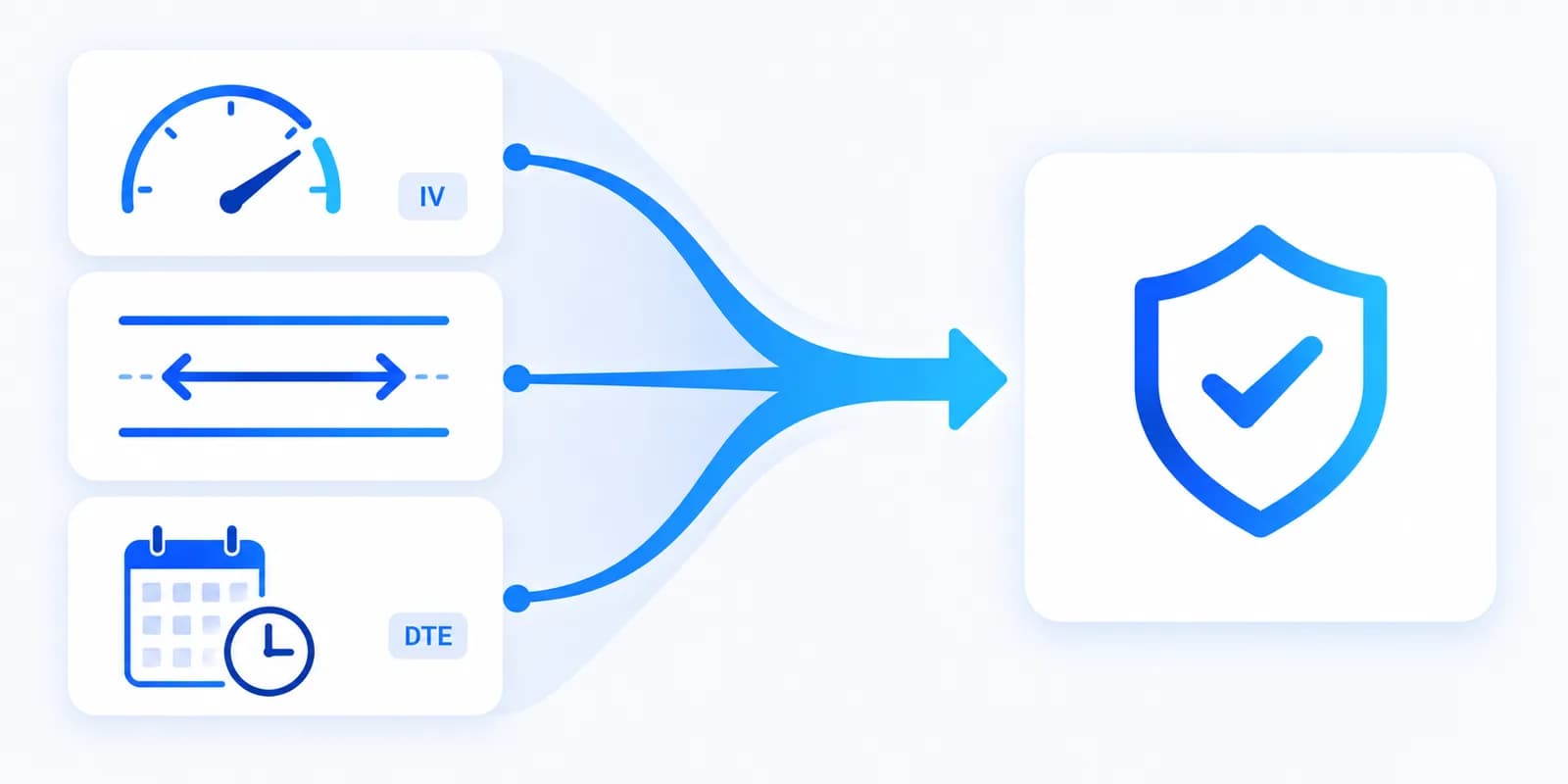
IV rank quantifies where current IV sits in the 52-week range. At IV rank 0 it is at the yearly low, at 100 at the high. Lower IV rank means thinner premium, higher IV rank means richer premium but also elevated volatility risk. Where the personal sweet spot lies depends on the individual rulebook and risk profile and must be determined per trader. Important: a short strangle without long wings carries theoretically unlimited loss and is not a direct alternative to the defined-risk Iron Condor.
Iron Condors struggle in clear trends, right before major earnings (unless you run a vega-crush earnings play) and periods with FOMC, CPI or NFP inside the expiry. In 0DTE SPX this term premium drops out but gamma surges, which needs its own rulebook.
Example: iron condor in OptionsApp
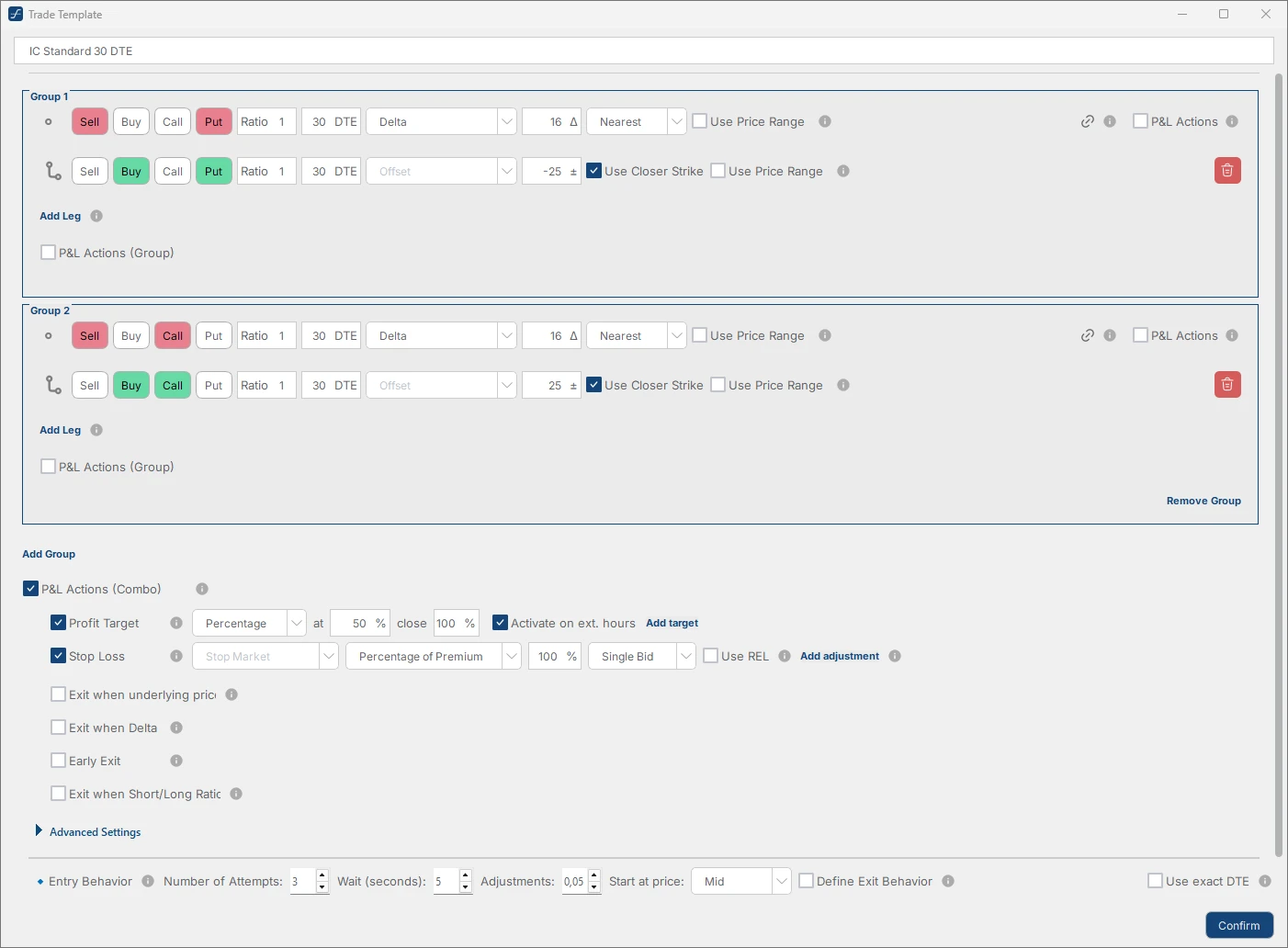
An example template 'IC Standard 30 DTE' with 30 DTE, short strikes at 0.16 delta and wings 25 points wide per side.
 Click to enlarge
Trade template
Template name: IC Standard 30 DTE. Four legs in two groups, multiplier 100. Use-exact-DTE stays off in this example: OptionsApp takes the specified 30-day duration and, if no exact 30-DTE option chain is available for the chosen underlying, automatically steps up to the next higher expiry until a tradable chain is found.
Legs and search criteria
- Group 1 put side: sell put 30 DTE at delta 0.16 (nearest), buy put 30 DTE with offset −25 points relative to the short strike (use-closer-strike enabled).
- Group 2 call side: sell call 30 DTE at delta 0.16 (nearest), buy call 30 DTE with offset +25 points relative to the short strike (use-closer-strike enabled).
- Wing width: 25 points per side. On index options like SPX this gives roughly a 1:4 risk-reward ratio at the typical 5 USD entry credit.
Entry behaviour
Number of attempts 3, wait 5 seconds between retries, start at price mid, adjustments 0.05 USD per retry. If no execution comes after 3 attempts, OptionsApp searches the contracts again based on the search criteria and then attempts another price adjustment.
Exit rules (P&L actions combo)
- Profit target 50 percent: the full position closes once 50 percent of the entry credit is captured. Activate-on-ext-hours is on so pre-market moves can trigger the target.
- Stop loss 100 percent of entry credit: stop-market order, percentage-of-premium = 100 percent, trigger on single bid. If the combo option price doubles relative to entry, OptionsApp closes the position automatically.
- Optional toggles: exit-when-underlying-price, exit-when-delta, early exit, exit-when-short/long-ratio. Off in the standard template because the 50-percent-profit / 100-percent-stop pair already covers most market regimes.
Typical setup mistakes
The following values are widespread orientation points in practice, not a recommendation. Which parameters go into your trade template is your call.
- Wing width too tight (5-10 points): entry credit shrinks proportionally, risk-reward worsens and the stop loss triggers on small moves.
- Use-closer-strike disabled: with the flag enabled, OptionsApp checks whether a long closer to the short is available at the same price. If yes, the closer long is taken because at identical cost the narrower wing width reduces risk. Without the flag the setup loses this risk optimisation while entry credit stays the same.
- Profit target above 50 percent: higher targets reduce win rate disproportionally because iron condors release the last 20 percent of theta only just before expiry, where gamma risk is highest.
- Stop loss tighter than 100 percent of credit: stops that are too tight cause many unnecessary closes with small losses in volatile phases instead of allowing time for reversion.
More detail on trade templates and automated setup: automated premium-selling guide.
When does an Iron Condor fail?
Three market constellations regularly break an iron condor. Knowing them lets you filter, hedge or simply skip the entry.
1. Volatility spike: VIX jumping 10+ points
If VIX jumps from 15 to 25 or higher within days, vega on both short options explodes. An iron condor with 1.30 USD entry credit can move to a 3.00-4.50 USD loss before the underlying touches any strike. Example: SPX iron condors during the August 2024 volatility spike (VIX from 16 to 38 in 48 hours) lost 70-80 percent of max loss in a typical 30-DTE 16-delta setup with the spot barely moving. Hedge options: a 5-delta long put backstop below the short put wing or an early-close VIX trigger in the rulebook.
2. Two-sided tail events inside the expiry window
Macro events (FOMC, CPI, NFP, ECB) often produce asymmetric reactions that punch through one strike, retrace, then test the opposite strike. Adjustments typically lag in those phases and add slippage costs. Classic case: an SPY iron condor with FOMC inside the next 5 days has materially worse expectancy than the same setup outside macro weeks. Commonly discussed reaction: do not reflex-roll on a strike touch, halving the position or closing is often the more robust response. Whether that fits your rulebook is your call.
3. Earnings event on a single-stock position
Iron condors on single stocks (TSLA, NVDA, AAPL) with earnings inside the duration carry a fundamentally different risk profile than index condors. Earnings-stock implied move often sits at 5-10 percent, which jumps standard 16-delta wings on a 3-week expiry within hours. Single-stock iron condors are therefore typically traded only outside earnings windows or as a deliberate vega-crush earnings play with its own rulebook and tighter strikes. Beginners should stay on index iron condors.
What is the probability of profit of an Iron Condor?
Iron Condor POP (probability of profit) can be approximated from the short-strike deltas. Delta in the Black-Scholes model is the approximate probability the option finishes ITM (in the money). A delta-16 short put has about 16 percent ITM probability, same for the delta-16 short call. Relative to the short strikes the price therefore stays between them with roughly 100 minus 16 minus 16 = 68 percent. Because the Iron Condor stays profitable out to the break-even points beyond the short strikes, the actual POP is somewhat higher, broadly 68 to 72 percent. These are model-dependent approximations, not guaranteed hit rates.
| Short delta | POP | Relative credit | Win rate in tastylive backtest (historical)¹ |
|---|---|---|---|
| 10 Δ | ~ 80 % | low | 80-88 % |
| 16 Δ | ~ 72 % | balanced | 70-83 % |
| 20 Δ | ~ 64 % | high | 63-75 % |
| 30 Δ | ~ 48 % | very high | 50-60 % |
Publicly available tastylive long-term backtests on SPY and SPX (multi-year periods, details per study on tastylive.com) show win rates between 70 and 83 percent for a setup with 16-delta shorts, around 45 DTE and an early profit target near 50 percent.¹ An early exit instead of holding to expiration is an important performance lever in these backtests. Backtest results include no fees or slippage and allow no inference about future results. The exact thresholds (profit target, DTE trigger, stop loss) for an individual setup are part of the personal rulebook and should be tested individually.
How much capital does an Iron Condor require?
Iron Condor capital equals max loss, i.e. wing width times 100 minus credit times 100. Reg-T accounts block exactly that as buying power reduction. Portfolio-margin accounts often need 20 to 40 percent less because the correlation model nets shorts against the vol index.
| Underlying | Wing width | Credit (45 DTE, 16 Δ) | Capital Reg-T | Fit for |
|---|---|---|---|---|
| SPX | 25 Pkt | 4,85 $ | 2.015 $ | Pro |
| RUT | 20 Pkt | 3,90 $ | 1.610 $ | Pro |
| IWM (ETF) | 5 Pkt | 1,05 $ | 395 $ | Beginner |
| SPY (ETF) | 2 Pkt | 0,36 $ | 164 $ | Beginner |
The table above serves orientation only. Which underlying and wing width fits a given account depends on individual risk budget, experience and strategy and must be decided by each trader. As rough orientation, common practice patterns include: SPY with 2-point wings for very small accounts, IWM with 5-point wings in the middle range, SPX with 25-point wings and cash settlement for larger accounts. With portfolio margin (IBKR from $125,000 NLV) the buying-power reduction for the same SPX Iron Condor drops to around $1,400.
Iron Condor vs. short strangle and butterfly spread
Iron Condor, short strangle and butterfly spread are the three classical neutral strategies. They differ in premium, capital, risk profile and profit zone. Choice depends on account size, volatility and market thesis.
| Criterion | Iron Condor | Short Strangle | Butterfly |
|---|---|---|---|
| Legs | 4 | 2 | 3 (Call oder Put) |
| Risk | defined | undefined | defined |
| Premium | medium | high | low |
| Margin (SPX) | 2.015 $ | ~ 22.000 $ | ~ 300 $ |
| POP (16 Δ) | ~ 72 % | ~ 72 % | ~ 25 % |
| Max profit | 485 $ | ~ 950 $ | very high, narrow |
| Profit zone | wide | wide | pinpoint |
Quick read: for Reg-T accounts under $125,000 the Iron Condor is often the more practical structure because it needs no portfolio margin. Short strangle yields more per trade but needs portfolio margin and hard discipline. The butterfly is precise and capital-light, fit for traders with an exact price thesis. Which structure fits is a call for your own rulebook.
Iron Condor adjustment: roll, close, widen
When an Iron Condor comes under pressure, several maneuvers are used in practice. The list below shows five common options as orientation. Which one fits a given setup depends on the individual rulebook, risk budget and experience level and must be decided per trader. None of this is a recommendation; it describes typical patterns and how a rulebook might look.
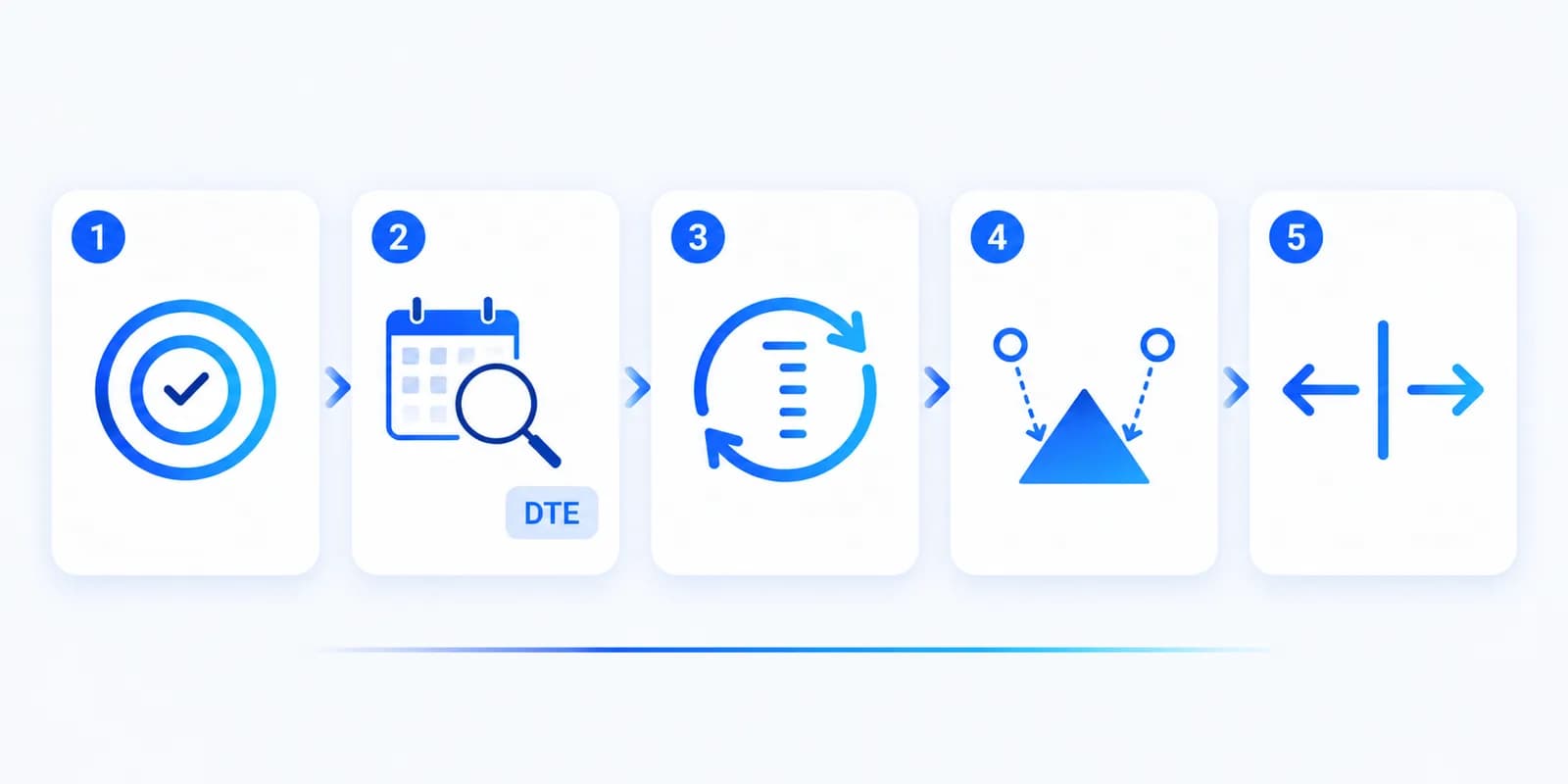
- 1Profit target 50%: close
A common pattern: once the Iron Condor reaches 50 percent of max profit, it can be closed with a GTC order. In the SPX example above this would be at $242.50. Publicly available tastylive backtests show this management approach reduces average loss and smooths the equity curve.
- 2Early position review (early exit or roll)
As remaining duration shrinks, gamma risk increases significantly. At a defined trigger point the position is typically re-evaluated: closing, rolling into a later expiration, or deliberately holding on are all options. Many traders use triggers between 14 and 28 DTE; 21 DTE is a frequently discussed value. Which value fits the personal setup belongs in the rulebook.
- 3Roll the tested side
If a short strike is tested, one option is to roll the tested side into a later expiration, typically 30 to 45 days out, at the same or slightly wider strike. The goal can be additional credit to shift the break-even. Rolling within the same expiration rarely works in practice because credit is lacking.
- 4Straddle conversion
In a trending market with a deeply tested side, one option is to convert the tested side into a short straddle at current spot. This can significantly increase credit but gives up the defined risk on that side. In practice this conversion is almost exclusively used in portfolio-margin accounts with a clear risk budget.
- 5Widen the wings
In a volatility-expansion regime, one option is to widen the wings instead of closing. The additional credit can absorb part of the mark-to-market drawdown. This variant has comparatively moderate downside because max risk rises only slightly.
Experienced Iron Condor traders consistently see that combining an early profit target with a clear pre-expiration review trigger (moves 1 and 2) produces much steadier equity curves than case-by-case decisions. The reason is plain: a predefined rulebook removes the emotional layer.
Automate Iron Condors with OptionsApp
OptionsApp encodes profit target, early-exit trigger and roll logic as an individually configurable rule set. Once configured, your rulebook is applied to every position; an execution can fail to occur due to market conditions or technical disruptions. Strategy choice, sizing and monitoring remain the trader's job.
See the features6 common Iron Condor mistakes
Common Iron Condor mistakes are not strategic but operational: bad timing, tight strikes, sloppy fills, blocked management. The table below lists the six most frequent plus consequence and commonly discussed alternative. The values shown are widespread orientation points, not a recommendation; which parameters go into your trade template is your call. Notable: almost all of these stem from manual trading under time pressure or emotion. A fixed rulebook makes these errors far less frequent. Slippage and fees arise on the market side and remain even with automated execution.
| Mistake | Consequence | Commonly discussed alternative |
|---|---|---|
| Iron Condor at IV rank below 20 | Thin premium, bad RRR | IV rank filter at 30+ |
| 30+ delta shorts | Low POP, many tests | Default to 16-delta shorts |
| Market order on 4-leg trade | Slippage $0.20 to $0.60 | Always limit at mid |
| Hold to expiry | Gamma spike, pin risk | Profit target or early exit |
| Too many parallel SPX Iron Condors | Concentration risk, margin call | Set a percentage cap of net liquidation value per trade |
| Ignoring assignment risk | Early exercise near dividends | Index options with cash settlement |
Pros
- Defined max loss at entry
- High POP with 16-delta shorts
- Manageable capital
- Theta-positive, earns in sideways
- Clear rules, easy to automate
Cons
- Bad single-trade RRR (1:4)
- Gamma risk near expiry
- Vega-negative: loses on vol spike
- 4 legs, 4 fees per trade
- No protection against tail events
- Manual execution typically introduces errors and breaks the rule-based consistency
Implementation note: Several of the cons above (4-leg slippage, missed profit target, forgotten position review, emotional adjustments under pressure) are not strategy weaknesses but consequences of manual execution. With a fixed rulebook, the operational part can be executed via automation, restoring consistency and making typical discipline errors far less frequent. Slippage and fees arise on the market side and remain even with automated execution.
Tax treatment of the Iron Condor in Germany
Important note: Tax matters are always individual and depend on the personal situation of the taxpayer (tax class, church tax, residence, broker domicile, other income, loss carryforwards). The following overview is not tax advice. Before any relevant trading decision, individual clarification with a qualified tax advisor is strongly recommended.
In Germany Iron Condor gains are typically treated as capital income and taxed at 25 percent Abgeltungsteuer plus solidarity surcharge (5.5 percent of the tax) and church tax if applicable. Classification follows § 20 Abs. 2 Nr. 3 EStG (derivative transaction).
Losses flow into the special derivatives loss bucket under § 20 Abs. 6 Satz 5 EStG. The formerly discussed annual offset cap of 20,000 euro against derivatives gains was abolished retroactively from 2020 by the Annual Tax Act 2024 (Jahressteuergesetz 2024).² Losses from derivatives are therefore again fully offsettable against gains from derivatives without limit.
Foreign brokers like Interactive Brokers and CapTrader do not withhold German Abgeltungsteuer. Income is declared via Anlage KAP of the income tax return. LYNX as a CapTrader white-label works identically. German brokers with withholding currently offer only limited options coverage for strategies like the Iron Condor.
This overview describes general tax conditions for German retail investors. It is neither tax advice nor a recommendation regarding any specific tax structure. Individual tax treatment can differ significantly depending on personal circumstances and should be discussed with a qualified tax advisor.
Broker context: IBKR, CapTrader, LYNX compared
Three brokers dominate the Iron Condor space for German residents: Interactive Brokers direct, CapTrader as IB introducing broker, and LYNX on the same IB back-end. Differences are fees, service and reporting.
| Broker | Fee per option | Round trip 4 legs | German support |
|---|---|---|---|
| Interactive Brokers | 0,35-0,70 $ | 2,80-5,60 $ | English only |
| CapTrader | 2,00 $ | 16,00 $ | German |
| LYNX | 2,50 $ | 20,00 $ | German |
A 45-DTE SPX Iron Condor at $485 credit costs 3.3 percent of premium at CapTrader (16.00 USD), 4.1 at LYNX (20.00 USD), and 0.6 to 1.2 at IBKR direct (2.80 to 5.60 USD). Over 50 trades a year the difference adds up to several hundred euros. In practice IBKR direct can be connected via API into OptionsApp so the same rule set runs regardless of broker.
Iron Condor on SPX in practice since 2023
The 45-DTE setup on SPX with short strikes at delta 16 has been traded systematically since 2023, initially manual, since mid-2024 via OptionsApp rule sets. In practice the results of this approach sit in the same ballpark as the published tastylive data, which shows win rates between 70 and 83 percent for 16-delta shorts near 45 DTE. Proprietary, externally unverifiable backtest numbers are deliberately omitted here because glossary content should only cite verifiable data.
Three operational points hold in practice. A mechanical profit target at 50 percent reduces emotional errors. A clear pre-expiration review trigger (21 DTE is often discussed) helps avoid the worst trades because the position overreacts to any news near expiry due to high gamma. And sizing shapes survival: a percentage cap of net liquidation value per trade, around 3 to 5 percent, can keep maximum drawdown manageable. Which thresholds (profit target percentage, DTE trigger, sizing share) fit a personal setup belongs in the individual rulebook.
Illustrative example derived from past trades. No guarantee of future results.
Iron Condor FAQ
What is an Iron Condor in simple terms?
An Iron Condor is an options strategy built from four options with the same expiration. You sell an out-of-the-money put and call and buy a further put and call as a hedge. You collect a net credit and hope the underlying stays between the two short strikes through expiration.
What is the maximum loss on an Iron Condor?
Max loss equals the wing width minus net credit, times 100. With 25-point wings and a $4.85 credit that is $2,015 per contract. Loss is triggered if the underlying expires below the long put or above the long call strike.
When is an Iron Condor a good trade?
Iron Condors work best in calm, range-bound markets with elevated implied volatility. A common setup is IV rank above 30, 45 days to expiration and 16-delta shorts. This mix balances theta income against gamma risk.
What is the probability of profit of an Iron Condor?
With 16-delta shorts each side expires worthless with roughly 84 percent probability. The combined probability of profit (POP) is a model-dependent approximation and sits broadly around 68 to 72 percent, because the Iron Condor stays profitable out to the break-even points beyond the short strikes; it is not a guaranteed hit rate. The publicly cited tastylive long-term backtest (multi-year periods on SPY and SPX, details per study on tastylive.com) with 50 percent profit management shows a 70 to 83 percent win rate depending on underlying and period. Historical backtest results are no indicator of future results.
How much capital does an Iron Condor need?
Capital equals max loss: wing width times 100 minus credit times 100. An SPX Iron Condor with 25-point wings and $4.85 credit ties up $2,015 per contract. On IWM with 5-point wings you need $350 to $420, on SPY with 2-point wings often under $180.
Iron Condor vs. Short Strangle: which is better?
A short strangle collects more premium with a higher POP but has theoretically unlimited loss. The Iron Condor caps risk with two long wings, uses far less margin and fits a Reg-T account. For Reg-T accounts under $125,000 (no portfolio margin) the Iron Condor is therefore often the more practical structure; which variant fits depends on your own rulebook and risk capacity.
How is an Iron Condor typically rolled?
Rolling the tested side out in the same expiration rarely works because there is no credit left. The better move is rolling to a later expiration, 21 to 45 days out, optionally as a straddle if the market trends. The untested side can be tightened to add credit.
How are Iron Condor gains taxed in Germany?
Gains fall under German Abgeltungsteuer at 25 percent plus solidarity surcharge and church tax if applicable. Losses enter the derivatives loss pot under § 20 Abs. 6 EStG. The former 20,000 euro annual cap was abolished retroactively from 2020 by the Annual Tax Act 2024; derivatives losses are again fully offsettable against derivatives gains. Check the current status with your tax advisor.
Sources
- tastylive, Iron Condor Backtests and Management Studies (public). tastylive.com
- Jahressteuergesetz 2024 (Abschaffung der Verlustverrechnungsbeschränkung für Termingeschäfte nach § 20 Abs. 6 EStG, rückwirkend ab 2020), BGBl. 2024 I Nr. 387. Vgl. BMF-Schreiben zur einkommensteuerlichen Behandlung von Termingeschäften.
- Wikipedia, Iron Condor. en.wikipedia.org/wiki/Iron_condor
- Macroption, Iron Condor Payoff & Break-Even. macroption.com
- OptionAlpha, Iron Condor Strategy Guide. optionalpha.com
- Interactive Brokers, Options Commissions Schedule 2026.
Risk disclaimer
Options are leveraged derivatives. An Iron Condor can lose up to wing width minus net credit. Historical backtests, win rates and examples in this article are no promise of future gains. Always check capital, margin and tax situation before trading. This content is not individual investment advice.
Automate Iron Condors with OptionsApp
Define rule set, connect broker, workflow runs. OptionsApp executes entry filters, profit target, position review and rolls automatically based on your own configured values. Strategy choice, sizing and market view remain the trader's job. Free 14-day trial.
More in automated options trading guide.