
Volatility · Glossary
IV Crush: Implied Volatility After Earnings Explained
Founder of OptionsApp, active in the markets for 20+ years.
This page covers IV crush in options trading (implied volatility). Other meanings of IV such as the roman numeral or intravenous are not covered here.
IV crush in 30 seconds
IV crush is the abrupt drop in implied volatility (IV, the market-expected price range of the underlying, the option's base asset, derived from option prices) after a scheduled event like earnings (a company's quarterly report), when the uncertainty premium disappears from option prices at once.
For option buyers the IV crush is a trap: the premium melts away even if price moves in the right direction. For premium sellers, that same drop is the source of income.
The IV crush only hits extrinsic value (time value); intrinsic value stays untouched. Being right on direction does not protect against the Vega loss. Options are complex derivatives with total-loss risk. This article is not investment advice.
Key takeaways at a glance
- Front-month IV falls after earnings by 30 to 60 percent for liquid large caps, with overnight drops of 30 to 70 percent possible.
- IV peaks on the trading day before the announcement, and the crush shows up in the first session afterward.
- The IV crush hits only extrinsic value (time value), never the intrinsic value of the option.
- Long options carry positive Vega and negative Theta: in a crush the Vega loss and time decay hit at the same time.
- An IV rank above 70 is treated by many traders as a warning sign of a likely expensive premium before an event.
- An IV crush is not limited to earnings: it occurs at any scheduled binary event like a Fed meeting, FDA decision or CPI data.
Affected
Extrinsic value
intrinsic stays
Magnitude
30-60 %
IV drop, large cap
Timing
First session
overnight after event
Market side
Buyer vs. seller
loss vs. income
On this page
- What is an IV crush?
- Why does an IV crush happen after earnings?
- When does an IV crush hit and how long does it last?
- How much does implied volatility fall?
- IV crush and option price: the role of Vega
- IV crush example: long call down despite a rising stock
- IV crush vs. theta decay: what is the difference?
- How can you avoid an IV crush?
- Profiting from an IV crush: strategies for sellers
- FAQ
What is an IV crush?
An IV crush is the rapid drop in implied volatility once an expected event is over. Before the date the market prices an uncertainty premium into options because nobody knows the outcome. After the announcement the uncertainty resolves, the premium is no longer needed and disappears. This move affects only the extrinsic value of the option.
The second common label is volatility crush, also implied volatility crush. Both mean the same thing, with no substantive distinction. The key is the perspective: an IV crush is not a price move, it is a move in implied volatility. The stock can rise, fall or stay flat while IV collapses. If you want to understand the measurement of volatility first, the fundamentals live on the linked implied volatility page; this page goes deeper into the drop with a Vega formula and a worked example.
The intrinsic value of an option comes purely from where price sits relative to the strike. Extrinsic value, by contrast, is the price of time and uncertainty. That is exactly the part the IV crush devalues. This is why a position can lose even when direction was right: the gain from the price move is overwhelmed by the loss of time and uncertainty value.
Why does an IV crush happen after earnings?
An IV crush after earnings arises because a quarterly report is a binary event with an unknown outcome. Before the release, demand for hedges and speculative options rises, premiums get more expensive and IV climbs. With the release the central question is answered, uncertainty drops away and the priced-in event risk premium unwinds.
The causal chain is stable: hedging demand before the event pushes IV up, the event resolves the uncertainty, and IV then collapses. That IV is systematically inflated ahead of events was described early in the options literature, for example by Patell and Wolfson (1979) in the Journal of Accounting and Economics. The same volatility risk premium underlies the methodology of volatility indices, as documented by CBOE.
Earnings are the best-known but not the only trigger. An IV crush occurs at any scheduled binary event the market prices a premium into: US central bank meetings, FDA drug decisions on biotech names, or inflation data like the CPI. What they share is a fixed date and an outcome that ends the uncertainty from one moment to the next.
When does an IV crush hit and how long does it last?
Implied volatility peaks on the last trading day before the announcement. The crush itself happens overnight: between the close before the event and the first session afterward, IV falls the most. Most of the move is done within a few hours. The subsequent drift back to a normal level takes a few days.
The chart below shows the typical path around an earnings date. IV builds up during the run-up over the days before the report and drops vertically in the first session afterward. The option's extrinsic value tracks IV in parallel: when IV rises the premium gets more expensive, and when IV falls the premium loses value regardless of price direction.
The return to a normal level is called mean reversion: after the downward jump IV drifts back toward its longer-run average, usually over several trading days. For option buyers the critical point is not the slow return, though, but the one-off hard break overnight that cannot be sat out.
How much does implied volatility fall in an IV crush?
For liquid large caps front-month IV typically falls by 30 to 60 percent after earnings. Overnight drops of 30 to 70 percent are possible depending on expectations and the actual result. The nearest expiration reacts the most because that is where the event share of remaining life is largest.
| Situation | Typical IV drop | Timing |
|---|---|---|
| Large cap, front month | 30 bis 60 % | first session after event |
| Overnight, ATM | 30 bis 70 % | prior close to next open |
| Example ATM IV | 55 % to 25 to 30 % | despite 5 to 10 % price move |
| Peak timing | IV maximum | trading day before release |
Values are typical ranges, not a fixed expectation. The actual drop depends on the underlying, liquidity and the result.
How much movement the market expects at all can be read from the expected move (the expected price move to expiration derived from the ATM straddle price). The ATM straddle (at the money) is the simultaneous purchase of a call and a put at the strike closest to the current price. As a rough approximation: expected move in percent equals the ATM straddle price divided by the underlying price. For a one-sigma window the straddle price is often multiplied by 0.85.
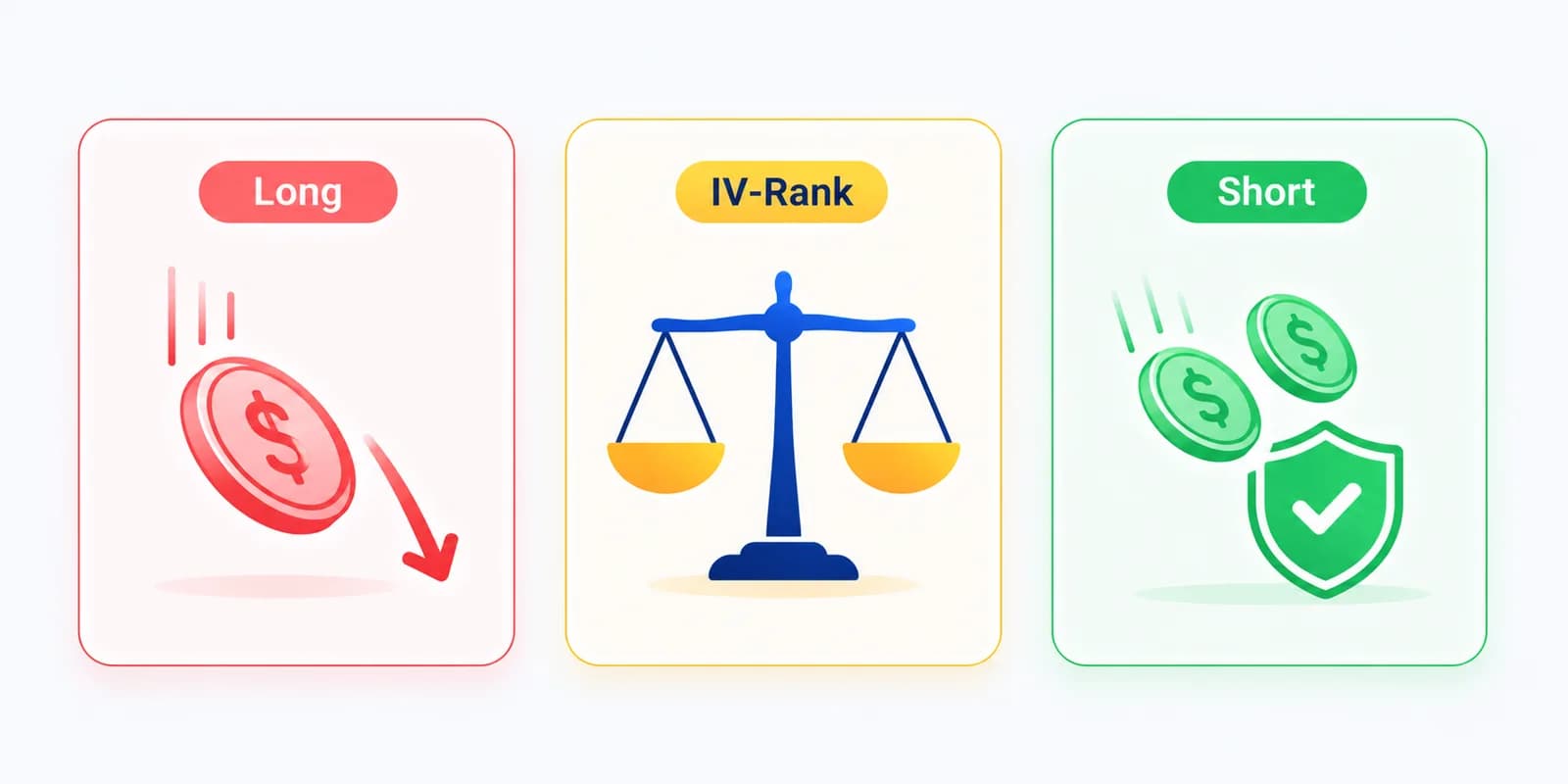
Whether a premium is expensive before the event is placed in context by IV rank, the ranking of current IV within its 52-week range from 0 to 100. An IV rank above 70 is read by many traders as a sign of a likely expensive premium, a warning for buyers and rather attractive for sellers. IV rank is a context value, not a timing signal.
IV crush and the option price: the role of Vega
The translator between implied volatility and the option price is Vega. Vega measures how strongly the option price changes when IV rises or falls by one percentage point. In an IV crush IV falls by many percentage points, and the price loss is roughly those percentage points times the option's Vega.
- Vega
- price change per 1 IV percentage point
- ΔIV
- change in IV during the crush
- Vega
- 0,15
- ΔIV
- 55 % to 30 % = minus 25
- Vega loss per share
- 0,15 · 25 = 3,75per contract times 100 = 375 units
ΔOption price ≈ Vega · ΔIV (in percentage points)The key point is that Vega acts only on extrinsic value. The IV crush therefore hits only the time-value portion of the premium; intrinsic value stays untouched. A deep-in-the-money option with high intrinsic and low extrinsic value reacts more weakly to a crush than an at-the-money option whose premium is almost entirely time value.
Long options also carry negative Theta, time decay per calendar day. Around earnings both forces couple: positive Vega means a Vega loss in the crush, negative Theta means additional time decay. In a crush both hit at the same time. How the individual Greeks interact is laid out in the option Greeks overview.
IV crush example: why a long call loses despite a rising stock
The best-known real-world case of an IV crush is a long call held over earnings that ends in the red even though the stock rises. The example below works the effect through on SAP. The numbers are illustrative and serve to demonstrate the mechanism.
Example: long call on SAP over earnings
Setup: SAP trades at 145 EUR. A delta-40 call with strike 150 EUR is bought, 25 days to expiration (DTE), IV 55 percent, premium 6.20 EUR per share. One standard contract covers 100 shares (multiplier 100, exceptions for mini contracts and futures options), so 620 EUR per contract.
After the numbers: SAP rises to 150 EUR, up 3.4 percent. The direction was right. At the same time IV falls from 55 to 30 percent, a classic IV crush.
Result: despite the price rise the call now trades at 4.60 EUR per share, so 460 EUR per contract. That is a 160 EUR loss per contract (1.60 EUR per share) even though direction was right. In the decomposition the delta gain of 2.00 EUR per share is set against a Vega loss of 3.75 EUR per share (Vega 0.15 times 25 percentage points); the gamma contribution closes the gap to the net loss of 1.60 EUR per share.
Before the event the uncertainty premium was expensive, like insurance. After the release the insurance is no longer needed and expires, regardless of whether the stock rose or fell.
The pattern applies in mirror image to long puts: a put position can lose despite a falling stock if the price decline is smaller than the Vega loss from the crush. Anyone holding a plain long option over earnings is not only betting on direction but implicitly betting against the IV crush.
IV crush vs. theta decay: what is the difference?
IV crush and theta decay both reduce the extrinsic value of an option, but in completely different ways. Theta decay is the gradual time-value erosion that takes off a small slice of premium every calendar day. The IV crush is an abrupt drop via Vega, triggered by an event and done within a single session.
| Property | IV Crush | Theta Decay |
|---|---|---|
| Trigger | scheduled event (earnings, Fed) | pure passage of time |
| Speed | abrupt, overnight | gradual, every day |
| Greek involved | Vega | Theta |
| Predictability | date known, size not | computable, steady |
| Benefit for sellers | one-off premium drop | daily premium income |
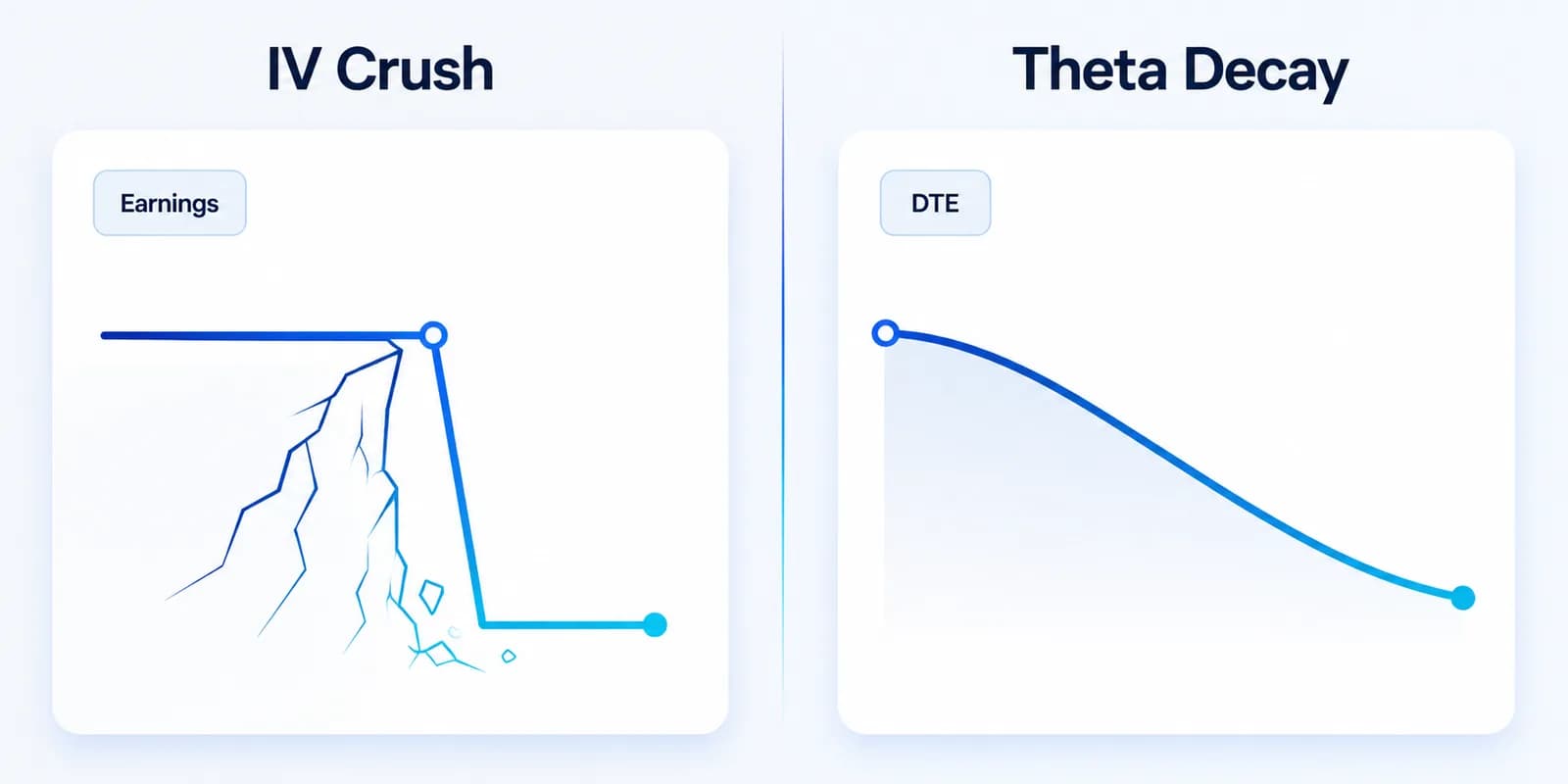
The distinction matters in practice because the two effects have different consequences. Theta decay can be planned: a seller deliberately factors in daily time decay. The IV crush, by contrast, is an event risk with a known date but unknown size that can flip the whole calculation through a single price gap.
How can you avoid an IV crush?
As an option buyer you cannot switch off an IV crush, but you can sidestep it. Four approaches are commonly used in practice to cut Vega exposure across an event. None of them is a recommendation; which one fits your account depends on risk profile, experience and goals, and must be decided individually.
- No long premium buy over earnings: closing a plain long option before the date, or not holding it over the event at all, avoids the crush entirely.
- Check IV rank before entry: a high IV rank signals a likely expensive premium. For a buyer that is a sign the uncertainty premium is being paid for dearly.
- Smaller position sizing: reducing position size before an event caps the absolute Vega loss if the crush works against the direction.
- Structure with lower Vega exposure: debit spreads or calendar constructions have a smaller net Vega than a plain long option and therefore react more weakly to the crush.
Anyone wanting to keep many underlyings in view across earnings windows quickly hits consistency limits under manual control. In OptionsApp the expected move can be set as a condition via Entry Conditions, for example through Expected Move or a VIX threshold, so a trade is not triggered at all when the expected move is too high. The earnings check itself remains a deliberate, manual decision.
Profiting from an IV crush: strategies for sellers
For premium sellers, those who write options and collect the premium, the IV crush flips the calculation. Selling before the event with negative Vega profits when the inflated premium collapses afterward. The written option can often be bought back much more cheaply after the crush.
The premium is typically highest just before the announcement. After the event the position can often be closed for a fraction of the original price. That is precisely the structural advantage of the seller in an IV crush: selling uncertainty when it is expensive and buying it back once it has become cheap.
That edge is not free. It is paid for with gap risk: if price moves overnight further than the premium edge covers, the loss from the price gap exceeds the gain from the Vega drop. A risk-defined setup like an iron condor caps that case at a known maximum loss. A short strangle without protection, by contrast, has theoretically unlimited risk and is therefore not an equivalent alternative but a fundamentally different risk class.
Is the IV crush therefore always bad? No. For the buyer it is a risk, for the seller a source of income. Both sides trade the same event from opposite positions. Anyone who has understood the IV crush picks their market side deliberately instead of buying it unintentionally as a buyer.
Set volatility as an entry condition
If you do not want to check expected moves for every underlying by hand, store the expected move as an Entry Condition like Expected Move or a VIX threshold in the Trade Template. A trade is then not triggered at all when the expected move is too high. Whether a position is held over an event stays your own decision.
Frequently asked questions about IV crush
What is an IV crush?▾
An IV crush is the abrupt drop in implied volatility after a scheduled event like an earnings release. Before the event an uncertainty premium builds up in option prices, and after the announcement that premium disappears at once. Only the extrinsic value of the option is affected, not the intrinsic value.
When does an IV crush happen and how long does it last?▾
Implied volatility peaks on the trading day before the announcement. The crush itself happens overnight and shows up in the first session afterward. Most of the drop is therefore done within a few hours, while the subsequent drift back to a normal level takes a few days.
Why does a call option lose value from an IV crush even though the stock rises?▾
A long call has positive Vega. When implied volatility falls, the extrinsic value of the option drops. For a merely moderate price move the delta gain is not enough to offset the Vega loss. The position can end up losing even though the direction was right.
How much does implied volatility fall after a quarterly report?▾
For liquid large caps front-month IV typically falls by 30 to 60 percent after earnings. Overnight drops of 30 to 70 percent are possible. For example, an ATM IV of 55 percent before the report can fall to 25 to 30 percent the next morning, even after a price move of 5 to 10 percent.
What is the difference between IV crush and volatility crush?▾
Both terms mean the same phenomenon: the rapid drop in implied volatility after an event. Volatility crush is the longer form, IV crush the more common short form, and implied volatility crush is used too. There is no substantive distinction between them.
How can you avoid an IV crush?▾
As an option buyer you cannot switch off an IV crush, but you can sidestep it. Common approaches are avoiding long premium buys across earnings, checking the IV rank before entry, using smaller position sizing and moving to structures with lower Vega exposure. Entering after the event means buying after the crush.
How do you profit from an IV crush?▾
Premium sellers with positive Theta and negative Vega profit when the inflated premium collapses after the event. Sold options can then be bought back more cheaply. That edge is paid for with gap risk: a large price gap can exceed the Vega gain. A risk-defined setup caps that case.
Does IV crush only happen around earnings?▾
No. An IV crush occurs at any scheduled binary event that the market prices an uncertainty premium into. That includes US central bank meetings, FDA drug decisions and inflation data like the CPI. For broad index options the effect is weaker because a single event rarely moves the whole basket.