
Option Greeks · Glossary
Rho in Options Trading: Rate Sensitivity, LEAPS and Sign
Founder of OptionsApp, active in the markets for 20+ years.
Rho is the option metric that states by how much money the theoretical price of an option changes when the risk-free interest rate (the model rate without default risk, roughly the policy or money-market level) rises or falls by one percentage point, all else equal. Rho belongs to the option Greeks and is a first-order Greek, the first derivative of the option price with respect to rate. Calls carry positive, puts negative rho. The value grows with time to expiration and is therefore mainly noticeable for long-dated options such as LEAPS, while it stays near zero for short maturities.
What this article means by rho
This article covers rho as an option Greek, i.e. the sensitivity of an option price to the risk-free interest rate. It is not about the Greek letter ρ as such, density ρ in physics, Spearman's rho in statistics or ρ as a radius or variable in mathematics.
Rho at a glance
- Quoted per 1 percentage point of rate. Rho 0.90 (one-year ATM call on an underlying around 180 USD) means 0.90 · 100 ≈ 90 USD price change per contract (factor 100).
- Call rho positive, put rho negative (cost-of-carry logic). Selling flips the signs.
- Grows with time to expiration: largest for LEAPS, near 0 for short-dated options (order of magnitude 0.05 to 0.10).
- Acts only on time value, not on intrinsic value.
- First-order Greek (price versus rate). It sits next to delta, theta and vega, not next to gamma, the only second-order Greek of the five.
- The least watched of the five standard Greeks. In the 2024 to 2026 rate environment (ECB deposit rate 2.25 %) again more noticeable than during the zero-rate era.
Symbol
ρ
Greek lowercase letter rho
Call / put
+ / -
call positive, put negative
Relevant for
LEAPS / long dated
near 0 for short maturities
What is rho in options?
Rho is the sensitivity metric from the family of option Greeks that states by how much money the theoretical option price shifts per one percentage point of rate change. A percentage point is the move from 2.00 % to 3.00 %, not a change of one percent of the rate. Mathematically rho is the first partial derivative of the option price with respect to the risk-free rate and therefore a first-order Greek, just like delta, theta and vega.
Rho acts only on time value (extrinsic value, the part of the option price above intrinsic value), not on intrinsic value itself. Like all Greeks, rho is a model output from a pricing model such as Black-Scholes-Merton (BSM). In practice the broker streams the value from the option chain; computing it manually is an edge case for sanity checks only. Of the five standard Greeks rho is the least watched and is often called the forgotten Greek.
What matters for classification is the order of the derivative. Delta, vega, theta and rho are first-order Greeks, first derivatives of the option price with respect to one input each. Gamma is the only second-order Greek of the five, because it measures the second derivative with respect to the underlying price (the change in delta). The table below places all five.
| Greek | Sensitivity to | Order |
|---|---|---|
| Delta | Underlying price | First order (1st) |
| Vega | implied volatility | First order (1st) |
| Theta | time to expiration | First order (1st) |
| Rho | risk-free rate | First order (1st) |
| Gamma | price (derivative of delta) | Second order (2nd) |
Gamma is the only second-order Greek of the five. Rho sits as a first-order metric next to delta, vega and theta.
Is rho positive or negative for calls?
A long call has positive rho, a long put negative. Rising rates therefore lift the theoretical value of a call and depress that of a put, all else equal. Selling flips the signs: a short call carries negative rho, a short put positive rho.
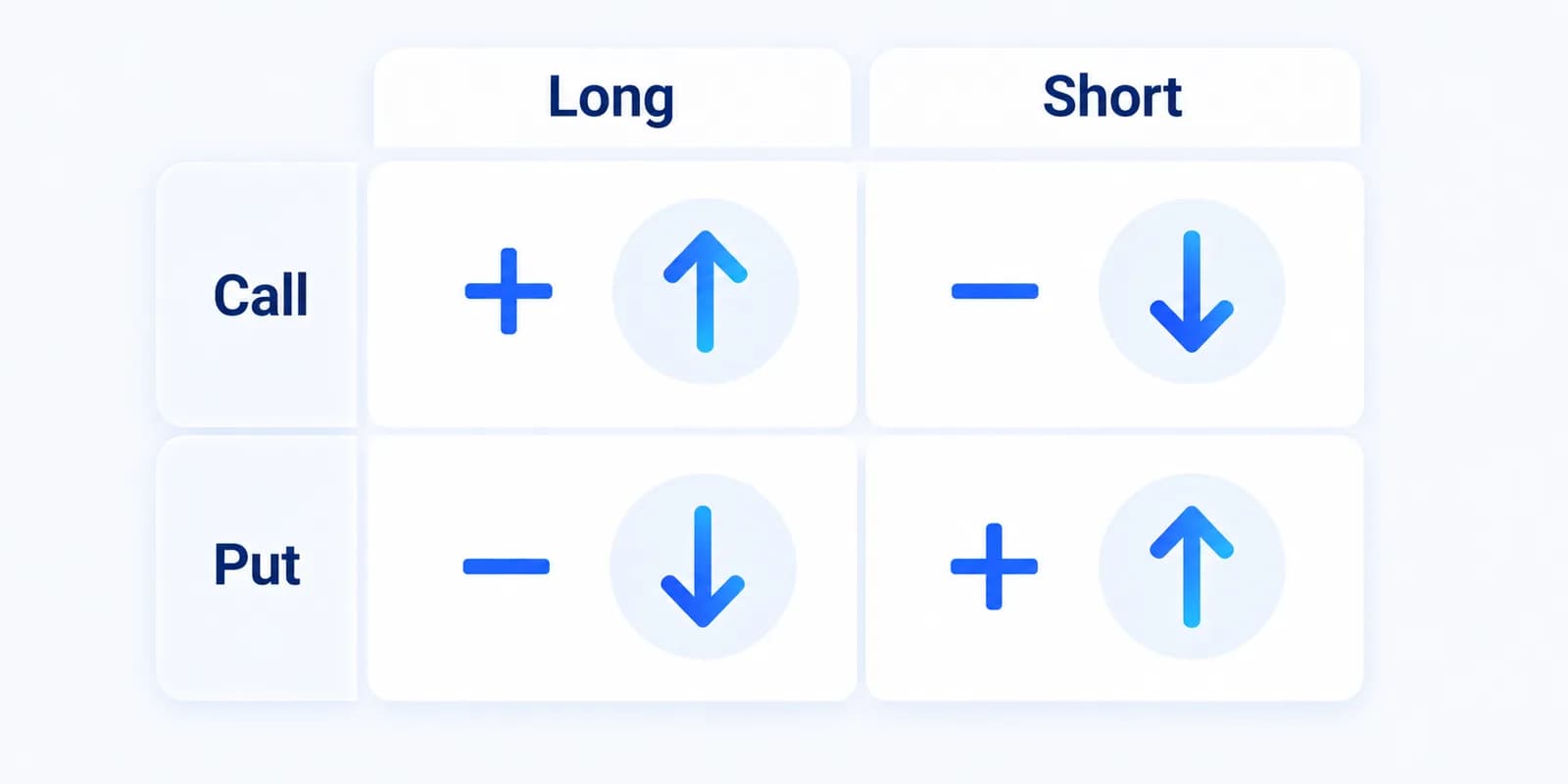
The reason is financing cost (cost of carry, the funding cost of the cash position through which the rate enters the option price). A call is economically a deferred purchase of the underlying: instead of paying the underlying in full today, the buyer ties up only the premium and can invest the rest at interest. When the rate rises, this deferral becomes more valuable, the forward price (the model-implied future price of the underlying) rises, and the call gains. The put is the mirror image. Whoever sells the option, the premium seller, carries the opposite sign.
| Position | Rho | Effect on a rate rise |
|---|---|---|
| Long call | positive (+) | gains |
| Short call | negative (-) | loses |
| Long put | negative (-) | loses |
| Short put | positive (+) | gains |
Effect assumes all else equal. Source: Investopedia (rho), Fidelity Learning Center (options and interest rates).
Why rho matters for LEAPS and long maturities
Rho grows with time to expiration. The longer an option runs, the more a rate change affects its price. For short-dated options rho is near zero, for LEAPS (long-dated options, Long-term Equity AnticiPation Securities, often one year and more) it reaches its largest values.
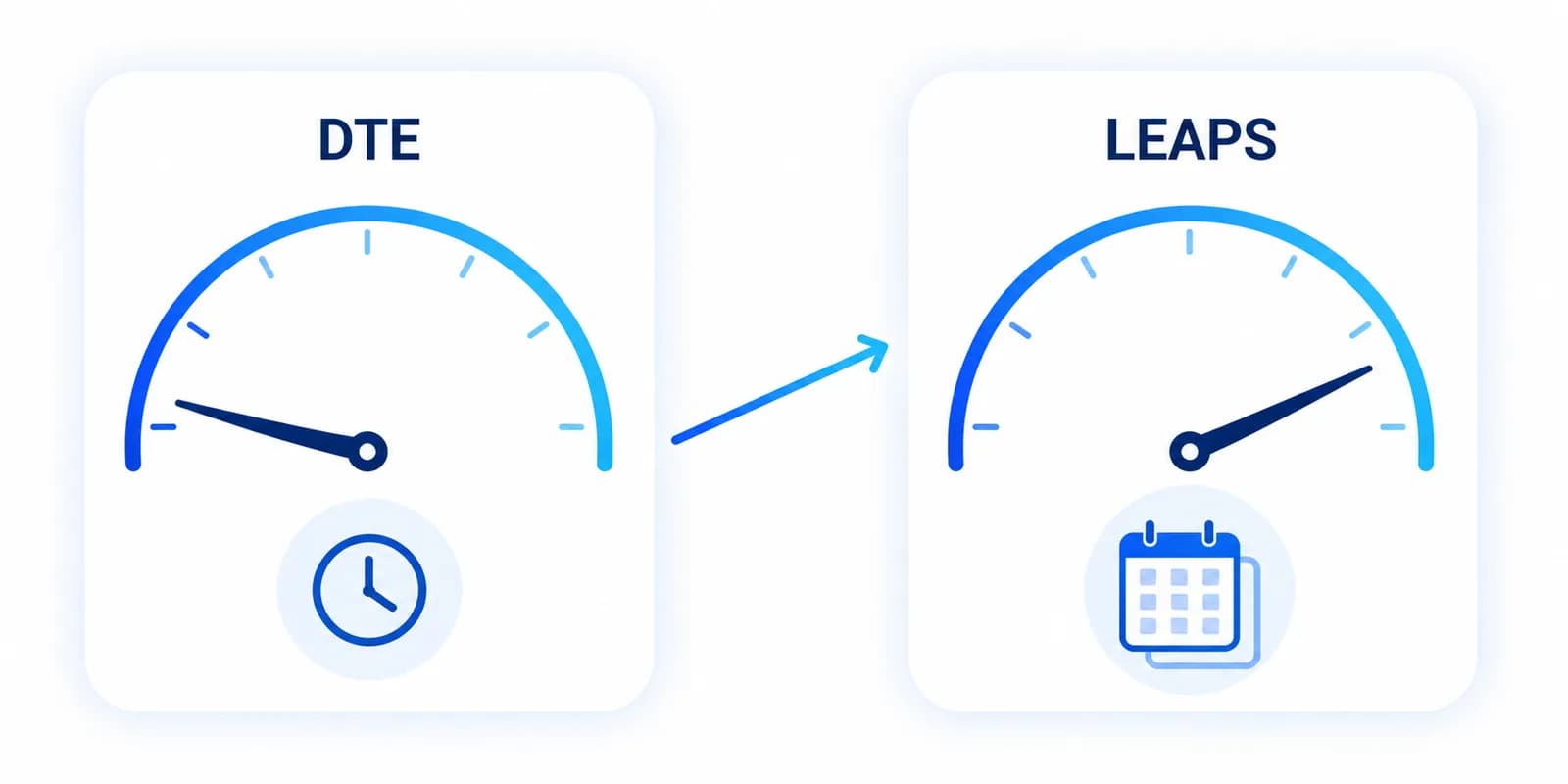
The link follows from valuation: the rate effect works through discounted future cash flows and through the forward price, and both channels grow with a longer maturity. A short-dated call (about 30 DTE, days to expiration) has rho on the order of 0.05 to 0.10, a one-year at-the-money call illustratively around 0.90. At two years the value is higher still. The chart below shows the path of call and put rho against time to expiration.
| Time to expiration | Rho (ATM call, illustrative) | Effect per contract (1 pp) |
|---|---|---|
| ~30 DTE | 0,05 to 0,10 | 5 to 10 USD |
| ~90 DTE | about 0.20 | about 20 USD |
| ~365 DTE (LEAPS threshold) | about 0.90 | about 90 USD |
| ~730 DTE (LEAPS) | about 1.70 | about 170 USD |
Illustrative magnitudes from an options calculator for an ATM call on an underlying around 180 USD. Rho scales with the strike level: on an underlying around 100 USD the figures would be roughly half. The concrete values depend on strike level, volatility and rate level and are not a fixed constant.
Example: same rate move, two maturities
A one-year at-the-money call on an underlying around 180 USD illustratively carries rho 0.90. If the risk-free rate rises by one percentage point, say after a central bank step, the theoretical price changes by about 0.90 USD per share, so 90 USD per contract. A short-dated call on the same underlying (30 DTE, rho about 0.05) gains only about 5 USD per contract on exactly the same rate move. The everyday analogy: the longer a loan runs, the more a rate change feeds through to total cost.
Why is rho often neglected?
Rho is considered the forgotten Greek because its influence in typical short-term options trading is small. Three reasons explain this.
- The rate moves rarely and on schedule. The underlying price and implied volatility change continuously, while the risk-free rate changes in steps around central bank meetings. Between those dates it is largely stable.
- For short maturities the value is small. Much of the exchange-traded volume sits in maturities of a few days to a few months. There rho often stays around 0.05 to 0.10 and barely registers against the other effects.
- Other Greeks dominate. Delta, gamma, theta and vega drive the daily value change of a typical position. Next to those forces rho reads like a footnote in daily practice and is therefore often overlooked.
When is rho relevant for options trading?
As small as rho is in short-term trading, it never vanishes entirely. In three constellations the rate effect can become noticeable and then belongs in the assessment of the position.
- Long maturities and LEAPS. From roughly six months to expiration, and all the more for LEAPS of one year and beyond, the rate contributes noticeably to the price. Holding long-dated calls means carrying positive rate sensitivity.
- Large or rate-sensitive positions. On large accounts even a small rho per contract adds up to a relevant total. Structures with many long-dated legs also concentrate rate sensitivity.
- Phases of shifting central bank policy. During rate turns, when central banks raise or cut policy rates, exactly the input rho reacts to is on the move. The effect stays smaller than that of price or volatility moves but is no longer zero.
Rho in the 2024 to 2026 rate environment
During the zero-rate era of the 2010s rho was a pure footnote for many traders: with a risk-free rate near zero the option price barely shifted when the rate moved a little. With the rate rise since 2022 and the elevated level since then, the rate effect matters again for long maturities.
The overview below shows the current rate level as context, purely descriptively and with a date stamp. It is not a rate forecast. Rates change, and the concrete effect on a position depends on its maturity and size.
| Central bank | Rate | Value | As of |
|---|---|---|---|
| EZB | Deposit rate | 2,25 % | 07/2026 (hike 11 Jun 2026) |
| EZB | Main refinancing rate | 2,40 % | 07/2026 |
| EZB | Marginal lending rate | 2,65 % | 07/2026 |
| Fed | Federal Funds Rate (target) | 3,50 to 3,75 % | 07/2026 |
Descriptive context with a date stamp, not a rate forecast. The ECB deposit rate is the rate at which banks park money at the ECB. Source: ECB (ecb.europa.eu), Federal Reserve (federalreserve.gov).
Rho compared with delta, theta and vega
Rho is the weakest of the first-order Greeks in short-term trading, because its input, the rate, moves less often and less strongly than price, time or volatility. Within the Greek stack rho therefore sits as an additional, often secondary dimension.
The division of labour is clear: delta stands for direction, gamma for the curvature of that direction, theta for time decay and vega for volatility. Rho adds rate sensitivity, which in short-term trading usually stays in the background and moves to the front for long maturities.
As a side note, alongside the rate effect there is also a dividend sensitivity, sometimes called phi or epsilon. It is the counterpart to the rate effect and acts on call and put in opposite directions, but it is not counted among the five standard Greeks.
Calculating rho: a worked example
In practice rho is read directly from the option chain, like the other Greeks. For application, the useful step is converting the rho value into a money amount via the contract multiplier (standard 100). The calculation below shows this for a long and a short maturity.
- Rho (one-year ATM call)
- 0,90illustrative, from a calculator
- Rate change
- +1 pp
- Contract multiplier
- 100
- Effect per share
- 0,90 · 1 = 0,90 USD
- Effect per contract
- 0,90 · 100 = 90 USD1 contract, 100 shares
- Rho (30-DTE call)
- ≈ 0,05
- Effect per contract
- 0,05 · 100 = 5 USDsame rate move
The sign follows from the position: for a long call the rate rise reads as a gain, for a long put as a loss, and for a sale the other way round. More important than the exact number is understanding that rho is a model-dependent magnitude that depends on strike level, volatility and rate level and is not a fixed constant.
Common misconceptions about rho
- Rho is always negligible. Too sweeping. For LEAPS and in the shifted rate environment rho is quite noticeable. Only for short maturities is the value small.
- Rho measures the rate itself. Wrong. Rho measures the price sensitivity of the option to a rate change, not the rate level.
- Rising rates are bad for all options. Wrong. Calls gain (positive rho), puts lose (negative rho).
- Rho is second-order like gamma. Wrong. Rho is a first-order Greek (price versus rate). Of the five, only gamma is second-order.
- Rho does not matter in the euro area. Too short-sighted. ECB steps (last on 11 June 2026) and long maturities make rho relevant too. The risk-free rate enters the valuation of every option.
Rho in trading practice
In practice many options traders treat rho as a control metric, not an active steering tool. How much rho weighs in a given book depends on the maturity mix and the account size and does not replace an individual investment decision.
Three observations from practice:
- For purely short-dated premium-selling positions the rate effect barely shows in daily practice and is overshadowed by theta and vega.
- As soon as long-dated calls or LEAPS enter the book, a look at aggregated rho pays off, because a directional rate sensitivity builds up there.
- In phases of expected central bank steps it can help to place the rho of long-dated positions deliberately, rather than ignoring it wholesale.
Rho FAQ
What does the rho of an option tell you?
Rho states by how much money the theoretical price of an option changes when the risk-free rate rises or falls by one percentage point. A one-year at-the-money call on an underlying around 180 USD, for example, has a rho of about 0.90 and gains roughly 0.90 USD per share on a one percentage point rate rise, about 90 USD per contract (factor 100). Lower-priced underlyings carry proportionally smaller rho. Rho only acts on time value and is usually small for short maturities.
Is rho positive or negative for calls?
A long call has positive rho, a long put negative. Rising rates therefore lift the theoretical value of a call and depress that of a put, all else equal. Selling flips the signs: a short call carries negative rho, a short put positive rho.
Why is rho often neglected?
The risk-free rate moves less often and more on schedule (around central bank meetings) than price or volatility, which move continuously. On top of that rho is small for the usual short maturities, often around 0.05 to 0.10. Delta, gamma, theta and vega therefore dominate daily risk, which is why rho is called the forgotten Greek.
When is rho relevant for options trading?
Rho matters for long-dated options such as LEAPS with six months to several years to expiration, for large or rate-sensitive positions and in phases where central bank policy shifts noticeably. In the 2024 to 2026 rate environment, with policy rates markedly higher at both the Fed and the ECB, rho is again more noticeable for long maturities than during the preceding zero-rate era. For US underlyings, which most LEAPS reference, the Fed funds rate is the relevant risk-free rate.
How do rising rates affect call and put prices?
A higher risk-free rate lifts the theoretical price of calls and lowers that of puts. The reason is financing cost: a call is economically a deferred purchase of the underlying that becomes more valuable at higher rates, because the capital not tied up can be invested at interest. The effect is small for short maturities and grows with time to expiration.
What is the practical use of rho in options trading?
Rho helps place the rate sensitivity of a position, mainly for long-dated options and large accounts. For short-dated standard positions the influence is usually minor and overshadowed by the other Greeks. Rho is therefore less an active steering tool than a control metric that should not be overlooked in the right context (LEAPS, a rate turn).
Sources
- Fidelity Learning Center, Options and interest rates (rho). fidelity.com
- Options Industry Council, Understanding Options Greeks. optionseducation.org
- Europäische Zentralbank, Key ECB interest rates. ecb.europa.eu
- Federal Reserve, Open Market Operations (Federal Funds Rate). federalreserve.gov
- Wikipedia, Greeks (finance) #Rho. en.wikipedia.org/wiki/Greeks_(finance)#Rho
- Investopedia, Rho. investopedia.com
Risk disclaimer
Options are leveraged derivatives. Trading options can lead to total loss and, on short positions, to losses exceeding the capital invested. Greeks like rho are model outputs and describe reality only approximately. Rate figures are descriptive context with a date stamp, not a forecast. Worked examples are hypothetical and no promise of future gains. This content is not individual investment advice.
Manage long-dated positions by rule
Managing LEAPS and long-dated options by hand over months costs time and invites inconsistent execution. With OptionsApp, options strategies open automatically by fixed rules and close or adjust by your stored logic. A new expiration is opened via re-entry on the same trade template. Profit target, stop loss and delta-based exits run mechanically by your defined values. Strategy choice, sizing and market view remain the trader's call.
More in the automated premium-selling guide.