
This website already describes OptionsApp 2.0, release on 08.10.2026. Until then, the download offers version 1.10. Stocks, ETFs and some new features are only available from the release onwards.
OptionsApp

Automated trading with OptionsApp: multi-asset, IBKR-native

Sebastian Legrand·Updated 11 July 2026·13 min read

Automated trading in 30 seconds

Automated tradingmeans software executes a rulebook without manual order entry: monitor market data, check conditions, route orders to the broker. OptionsApp implements this layer for options, stocks and ETFs via Interactive Brokers, without code, with multi-currency support for USD, CHF and EUR as well as a dynamic underlying search. The instruments are real exchange-traded products in the user's own IBKR account, not an over-the-counter substitute and not a bot account run by a third party.

The benefit of automation lies in discipline, reproducibility and reaction time: the engine applies every rule identically, even on the twentieth trading day in a row, and reacts without the delay of a manual entry. The quality of the results, however, is still determined by the rulebook, not by the automation. A weak rulebook does not become profitable through software, it just loses faster and more consistently. Automated trading is therefore not passive income: losses remain possible, and strategy development, monitoring and adapting to market regimes remain the trader's job, not the software's.

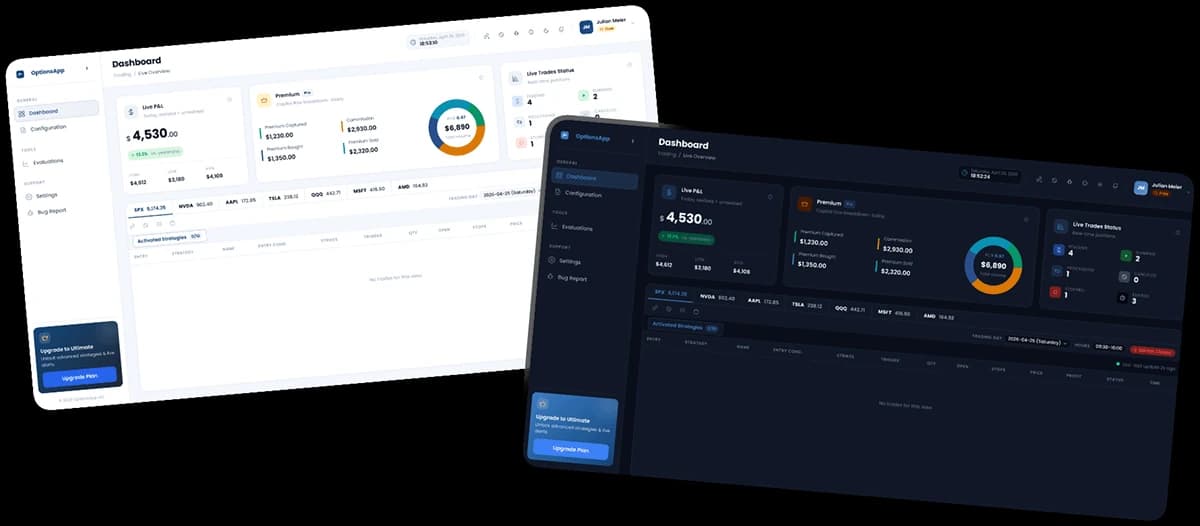
Automated trading with OptionsApp: dashboard with running strategies on desktop, laptop and tablet

In short

  • 3 asset classes: options, stocks, ETFs
  • IBKR-native via the TWS API, no CFD wrapper
  • No-code rule builder, no coding skills required
  • Multi-currency: USD, CHF and EUR with ECB exchange rates
  • Paper trading and live operation in the same tool
  • 14-day free trial

Basics

What does automated trading mean?

Automated trading means software executes trading strategies by fixed rules without manual order entry. An algorithm watches prices, checks entry and exit conditions and places orders directly at the broker. OptionsApp connects this process with options, stock and ETF strategies and handles position sizing automatically.

At its core sits a simple if-then logic. If an underlying meets specific price, volatility or time conditions, the software builds the position. Once an exit condition triggers, the trade is closed. Between those points the app manages the trade and checks that profit target, stop loss and the other exit rules are executed as configured. This does not replace thinking or strategy work. It replaces repetitive manual clicking.

The term is often confused with algo trading or AI trading. Algo trading describes any rule-based system, including institutional high-frequency setups. AI trading refers to models that adjust their behaviour from training data, often as a black box. Automated trading in this sense is rule-based, transparent and stays fully in the trader's hands.

A further three terms circulate in the retail space. Trading bot is the fuzzy umbrella term for software that places orders on its own, often found right next to return promises in the marketing of dubious providers. An expert advisor (an automated trading script in the MetaTrader ecosystem, mostly for FX) and a robo-advisor (a regulated digital asset manager, not an active trading system) are separate categories again. Algorithmic trading for retail investors in the sense described here means: own account, own rulebook, execution via a regulated broker.

Three automation levels can be distinguished. Fully manual: every order is placed by hand. Semi-automated: the software produces signals, the trader clicks to execute. Fully automated: signal and execution run without a stop in between. OptionsApp is deliberately built for the third variant; individual trades can also be opened manually via Direct Trade and then managed automatically.

The scale is not small. The share of automated trading in exchange turnover reaches up to 50 percent according to exchange figures[1]. Grand View Research puts the global algo trading market at 21.06 billion USD for 2024, with values differing noticeably by study and scope[2]. Retail traders drive a growing share, recent estimates put the retail portion between 38.5 and 43 percent[3]. Anyone engaging with the topic today is not early, but firmly in the mainstream.

One widespread myth deserves a sober look here: automated trading is not passive income. The software takes over execution, not the strategy work. The work does not disappear either, it shifts away from order entry towards developing, supervising and continuously adjusting the rulebook. A rulebook with a negative expected value simply applies its weaknesses more often and more consistently when automated, much like cruise control holds the speed but does not pick the route. Promises of predictable bot returns without any effort, by contrast, are the recurring pattern of the platforms BaFin regularly warns about.

Multi-asset

Asset classes that can be automated (multi-asset)

Practically every liquid asset class can be automated today: stocks, ETFs, options as single- and multi-leg constructs, futures, FX pairs and crypto CFDs. What matters is that the broker connects the market and the software handles the required order logic. OptionsApp builds on Interactive Brokers with access to around 150 exchanges; automation covers documented US underlyings from indices to ETFs and single stocks.

Asset classes in automated trading and their support in OptionsApp, with typical strategy and example underlying.
Asset classTypical strategyOptionsApp supportExample underlying
StocksTrend-following, mean reversionFullAAPL, NVDA, TSLA
ETFsSeasonal rotation, breakoutFullSPY, QQQ, IWM
Options (single leg)Cash-secured put, covered callFullSPY, IWM, AAPL
Options (multi-leg)Iron Condor, credit spread, wheelFullSPX, XSP, RUT
FXCarry, range tradingNot supportedEUR/USD, GBP/USD

The table is for orientation only. Which asset class fits an individual account depends on risk profile, experience and goals and has to be decided individually.

Dedicated subpages provide the depth per asset class: one on automating options strategies with a multi-leg focus, one on automated stock trading with trend-following and rotation rules, and one on options expiring the same trading day, which come with their own execution and risk demands.

Context: exchange instead of CFD

A large share of automated-trading guides ultimately leads to CFD and forex brokers from the MetaTrader ecosystem. CFDs (contracts for difference) are over-the-counter derivative contracts in which the provider itself is the counterparty. Exchange-traded options, stocks and ETFs, by contrast, run through regulated exchanges and central clearing houses, with transparent on-exchange price formation. According to the providers' legally required risk disclosures under the ESMA product intervention regime, 74 percent (IG) and 82 percent (Plus500) of retail accounts lose money trading CFDs[8]. These loss rates prove no superiority of options and no higher probability of profit; exchange-traded derivatives also carry substantial risk up to total loss (see the risk notice at the end of this page). The difference is structural: trading venue, clearing, price formation and regulatory regime.

The options row is particularly relevant for retail traders, because structural edge candidates such as theta decay can be harvested systematically. Premium-selling strategies like cash-secured puts or an automated wheel are the bread and butter for many active traders working rule-based. An iron condor has 4 legs, a credit spread 2, a wheel strategy 1 leg per selling phase, and in an automated setup all legs are routed as a combined spread order to the smart router rather than being filled sequentially.

Multi-leg spreads show the real benefit of automation. Opening a four-leg construct manually at the right moment, with the desired net credit and cleanly placed strikes, is tedious and error-prone. An engine checks market data continuously and routes all legs together as a combined spread order through the IBKR smart router.

Example payoff SPY credit put spreadTwo-leg strategy with long put 470 and short put 480, net credit of 1.40 USD per share. Max gain 140 USD, max loss 860 USD, break-even at 478.60.+140 $0−400 $−860 $470Long put480Short putMax profit: +$140Max lossBE 478.60
Example credit put spread on SPY with strikes 470 and 480 and a 1.40 USD net credit per share. Illustrative numbers, not a setup recommendation.

The example above shows a defensive credit put spread (bull put spread) that fits premium-selling setups. The concrete values serve as illustration only, not as a setup recommendation.

Platform

How OptionsApp approaches automated trading differently

OptionsApp approaches automated trading differently from classic platforms: a no-code rule builder instead of MQL5 scripting, native IBKR connection instead of CFD brokers, multi-leg options instead of an FX focus. Paper and live operation run in the same tool, multi-currency with USD, CHF and EUR is built in and the rulebook stays fully in the user's own account.

Platform comparison for automated trading: OptionsApp, MetaTrader 4, ProRealTime and DupliTrade across seven functional areas.
FeatureOptionsAppMetaTrader 4ProRealTimeDupliTrade
Options multi-legYesNoNoNo
Stocks and ETFsYesLimitedYesLimited
IBKR connectionYesNoLimitedNo
Multi-currencyYesLimitedNoNo
No-code builderYesNoLimitedYes
Paper tradingYesYesYesNo
Platform comparison for automated trading: OptionsApp, MetaTrader 4, ProRealTime and DupliTrade across seven functional areas. Own research, as of April 2026.

The table is for orientation only. Which platform fits an individual setup depends on strategy, asset class, account and experience and must be decided individually.

From practice

Classic auto-trading tools often rely on MQL-like scripting. In practice many traders prefer thinking through strategies in a table rather than in code. That is exactly what the OptionsApp rule builder targets: conditions are clicked together row by row, contract count is set via the trade template parameters, exit logic is defined in modules. The difference shows most where several premium-selling setups run at once: active retail investors typically run three to seven strategies in parallel, which is hard to execute with discipline by hand.

No-code rule builder

The visual editor enables the middle path between black-box bot and custom coding. Python skills bring no advantage, lack of scripting brings no disadvantage.

Paper and live in one tool

A rulebook is defined once and runs unchanged on the IBKR paper account or live, the same engine executes entry, exit and sizing in both modes.

IBKR-native

Connection runs directly via the TWS API, not through a CFD wrapper. Stock and options orders go to the real exchange.

Multi-currency account

USD, CHF and EUR run in parallel as account currency on the same IBKR account. The app converts via ECB reference rates, no external tools required.

A complete feature overview shows every building block in detail. The pricing is kept lean, the trial lasts 14 days.

Getting started

How to start with automated trading

Anyone who wants to automate their own trading starts in four steps: define the strategy, validate on a paper account, connect the broker, go live with reduced size. Paper operation under real market data reveals the actual execution behaviour. Once the broker onboarding is complete, nothing stands in the way of starting on the paper account.

  1. 1

    Define the strategy

    In the no-code builder the underlying, conditions, sizing rule and profit/loss triggers are configured. The logic stays in the trader's own account, no third-party algorithm takes over.

  2. 2

    Validate on a paper account

    On the IBKR paper account the rulebook runs under real market data without capital at risk. This shows whether entries, exits and sizing trigger as intended before real money is involved.

  3. 3

    Connect the broker

    Via the TWS API the OptionsApp connects to the Interactive Brokers account. TWS connection handling, reconnect logic and order construction are handled by the software; the TWS login itself stays with the user, custom API code is not needed.

  4. 4

    Go live with small size

    A forward test with reduced position size reveals how execution behaves under live conditions. Only when paper operation and forward test paint a consistent picture is the strategy scaled up.

A gap often underestimated in practice: backtests systematically overstate live results. Slippage, spreads, data frequency and above all overfitting (a rulebook tuned to historical data until it explains the past perfectly and fails on the future) are the typical causes. How easily seemingly profitable strategies emerge from enough tested variants has been shown formally by Bailey, Borwein, López de Prado and Zhu[4]. The forward test in step four addresses exactly this gap. Without it the strategy lacks a real-world check under live conditions.

For starting capital the community discusses 2,000 to 5,000 EUR as a rough range. It is not carved in stone. What matters is the relation between margin, commissions, slippage and position size. For smaller accounts XSP options are often considered, since contract size is much lower than SPX.

Broker

Automated trading with Interactive Brokers

Interactive Brokers delivers the asset universe for automated trading: stocks, options, futures and FX across roughly 150 exchanges, plus a free, documented API. OptionsApp adds the no-code strategy layer on top of the TWS API, so no custom API code is needed. Order construction, connection handling and reconnect are handled by the software.

Architecture OptionsApp and Interactive Brokers: from rulebook to exchange execution.Architecture diagram OptionsApp and Interactive Brokers: the strategy is configured in the no-code builder, the rule engine triggers via the TWS API, IBKR's smart router routes orders to the target exchange.From rulebook to executionData flowStrategy definition
No-code builder, conditions, sizing
Rule engine
Market data check, triggers, risk filters
TWS API
Connection, order construction, reconnect
IBKR Smart Router
Order routing, multi-leg logic
Exchange
CBOE, CME, NASDAQ, NYSE and more
Order status, fills, positions backFrom trigger to IBKR receipt typically within seconds (setup-dependent)
Automated trading via IBKR: the rule engine triggers through the TWS API, the smart router routes the order to the exchange.

Latency is underestimated in retail setups. A manual order entry runs through perception, decision and typing, while an automated pipeline of trigger, order construction and TWS routing skips that delay. How large the edge is depends on hardware, location and market-data connection. Sounds like a detail, but for short-dated strategies like 0DTE options (zero days to expiration, options expiring on the same trading day) it is the difference between a clean fill and chasing the position. OptionsApp also opens 0DTE trades automatically: at set times, via an entry condition, via webhook or as a re-entry, several times a day if needed, always within regular US trading hours (RTH). It then executes stop loss, profit target and exits according to the stored rules. The space is no longer a niche: 0DTE contracts reached a record 62 percent share of SPX options volume in August 2025, with CBOE most recently putting the retail share at 53 percent[9].

OptionsApp connects to the trader's own IBKR account exclusively through the Trader Workstation (TWS), and the TWS login stays under the user's control. Margin requirements, commissions and live market data mirror the IBKR account directly. Multi-leg options especially benefit, because the app sends the spread order as a combination to the smart router rather than splitting it into single orders.

For retail investors in Germany one classification matters: section 80 (2) of the German Securities Trading Act (WpHG) defines algorithmic trading (a computer algorithm automatically determines order parameters) and attaches organisational, risk-control and labelling duties to it, aimed at investment firms[5]. Private individuals trading their own account via a regulated broker are not covered. According to BaFin, licensing requirements only arise when services are provided to third parties, for example signal following (automatically replicating third-party trade signals), social trading offerings or asset management[6]. This is general context, not legal advice.

Seriousness has become its own screening criterion in automated trading. Since late 2024 BaFin has warned in a series of consumer alerts about platforms advertising alleged AI trading bots and predictable returns; a single alert covered more than 700 near-identical websites without a legal notice[7]. The sequence repeats: money is supposed to be deposited into an account held by the platform, a bot promises profits, the withdrawal fails. Four traits separate serious automation from that pattern:

  1. Account separation:the money stays in the trader's own account at a regulated broker, the software gets no access to deposits or withdrawals.
  2. Tangible provider: a full legal notice, a registered office and named contacts instead of an anonymous website.
  3. No promises: serious providers describe mechanics and risks, no return or profit guarantees.
  4. Transparent rulebook: the logic is visible and can be verified by the user, no black box.

For OptionsApp this means concretely: it controls the user's own Interactive Brokers account via the TWS API and holds no client money.

From practice: IBKR connection

Permanently running strategies often use a Windows server with a dedicated TWS instance for this single task. A recurring topic is the nightly TWS restart: the OptionsApp reconnect logic mostly handles these transparently for running strategies. The biggest practical difference is order construction for multi-leg spreads. An iron condor is four legs plus a net credit constraint that manually is error-prone when handled manually. The engine assembles the combo, the trader only formulates the conditions.

Features

Dynamic underlying search and multi-currency

The dynamic underlying search binds stocks, ETFs and indices with configurable trading classes instead of restricting them to a fixed list. Multi-currency allows USD, CHF and EUR strategies in parallel on a single IBKR account, with ECB exchange rates. Together they make automated trading more broadly usable, without external tools for FX conversion or symbol upkeep.

Many auto-trading platforms force users into a hard-coded symbol list. Convenient, but costly: a good setup candidate outside that list cannot be traded. OptionsApp reverses the logic since version 1.9.18. Stocks, ETFs and indices can be bound dynamically with configurable trading classes instead of a rigid list. In addition, wide bid/ask spread protection checks right before entry whether the bid-ask spread (difference between bid and ask price) exceeds a set threshold and cancels the order if it does.

Entry itself is controlled via entry conditions. Rule-based filters such as a VIX threshold, the expected move (the daily move implied by the options market) or indicators like EMA, RSI and MACD decide whether and when a trade is placed on the target DTE (days to expiration, the option's remaining lifetime). The concrete threshold values belong in the trader's own rulebook and should not be copied from a tutorial.

Multi-currency in OptionsApp: USD, CHF and EUR as account currency with ECB exchange rates. The documented underlyings are US-based.
Account currencyExample underlyingExchange rate basis
USDSPX, SPY, QQQ, AAPLnative trading currency
CHFSPX, QQQ, IWM, NVDAECB reference rate
EURSPX, SPY, NVDA, TSLAECB reference rate

Account value and evaluations can be shown in the chosen account currency (for example EUR), while positions are held in their native US trading currency. Conversion runs on ECB reference rates, without an external tool. More on this topic area is covered under automated options trading.

FAQ

Frequently asked questions on automated trading

Common questions on automated trading bundle what comes up regularly in support requests, forums and community discussions. Answers are kept deliberately compact so they work as short definitions but still leave depth for follow-ups.

Note on tax questions

Tax matters are always individual and depend on the taxpayer's personal situation. The tax answers below are general context, not tax advice. Before relevant trading decisions, an individual review with a qualified tax advisor is strongly recommended. As of 2026, subject to change.

Automated trading means software executes a predefined rulebook: market data is monitored, entry and exit conditions are checked, orders are routed to the broker. The trader defines the logic once, execution then runs without manual order entry; monitoring the positions remains the trader's job. The result is a reproducible process, fewer emotional mistakes and consistent strategy execution.

Yes, automated trading is permitted for retail investors in Germany and most of Europe. The duties under section 80 (2) of the German Securities Trading Act (WpHG), including organisational, risk-control and labelling requirements for algorithmic trading, target investment firms. Private individuals trading their own account via a regulated broker are not covered. Licensing only becomes an issue when services are provided to third parties, such as offering trade signals, social trading or asset management. This is general context, not legal advice.

No. Classic solutions like MQL5 or Python require code, newer no-code platforms do not. In OptionsApp rules are configured via forms and condition blocks, without writing a single line of code. Even complex logic such as combined conditions, delta filters or time windows can be expressed visually.

Yes, and that is the biggest gap in classic auto-trading platforms. MetaTrader and similar systems are FX- and CFD-oriented. For multi-leg options strategies like Iron Condor, Credit Spreads or Wheel a broker with options market access and a software that routes multiple legs as a combined order are required. OptionsApp covers that together with Interactive Brokers.

For automated trading with global asset coverage Interactive Brokers is the established standard for retail investors. IBKR offers access to around 150 exchanges, a free API and competitive commissions. Alternatives like CapTrader or LYNX broker IBKR accounts with local service. For pure stock algorithms without options some direct banks also offer API access.

It depends on strategy and asset. As a rough discussion value, 2,000 to 5,000 EUR is mentioned in the community as a lower bound, so that margin requirements, commissions and slippage stay in a sensible ratio to position size. For multi-leg options on indices a higher entry is more practical, for stock strategies with small positions a lower one is fine. Concrete numbers follow from the personal rulebook.

Tax matters are individual. Under German tax law, gains from automated trading in private accounts are generally subject to the flat 25 percent capital gains tax plus solidarity surcharge and possibly church tax, above the saver's allowance of 1,000 EUR (2,000 EUR for joint filers). Premium income from short options counts as capital income. The former cap on offsetting losses from forward transactions (20,000 euros) was repealed retroactively (back to 2020) by the Annual Tax Act 2024; such losses can again be offset against gains from forward transactions without that cap. Individual treatment should be clarified with a qualified tax advisor.

If execution runs locally, the software loses its broker connection, but open orders remain active in the broker system and are processed according to their conditions. Stop-loss orders sitting at the broker remain valid. App-side rules such as stop adjustments, profit targets or time-based exits are not executed during an outage; only orders already resting at the broker remain active. For permanently running strategies a Windows server in a data center with redundant power is therefore common, so that endpoint failures do not stop the strategy.

Three loss drivers dominate in practice: a rulebook fitted too tightly to historical data that fails live (overfitting), technical failures such as broker disconnects, and unexpected market events outside the rulebook. Add the backtest-live gap: under real conditions results are often worse than the historical simulation suggests, driven by slippage, spreads and execution delays. Forward testing and conservative sizing reduce the risk but do not eliminate it.

In practice active retail investors run three to seven independent strategies in parallel, for example a premium-selling strategy on indices, a trend-follower on ETFs and a wheel strategy on single stocks. More than ten parallel strategies quickly becomes hard to oversee. More important than the count is correlation: strategies that behave identically in crisis phases offer little diversification.

No, automated trading is not passive income. The software relieves the trader of execution only, not of the strategy work: the rulebook still needs to be developed, supervised and adjusted to changing market regimes. Software does not turn a weak rulebook into a profitable one, it only executes it more consistently. Providers holding out fixed bot returns with zero effort show up regularly in BaFin's consumer alerts on dubious platforms.

Trading bot is the umbrella term for software that places orders automatically; in the retail space it is often tied to crypto offerings and dubious return promises. An expert advisor is a trading script in the MetaTrader ecosystem, mostly for forex and CFDs. A robo-advisor, by contrast, is a regulated digital asset manager running ETF portfolios, not an active trading system. Rule-based automation on one's own brokerage account is a fourth, separate category.

The tax-related answer describes general conditions as of 2026. It is neither tax advice nor a recommendation for a specific structure. Individual treatment may differ and should be clarified with a qualified tax advisor.

Sources

Sources

  1. Wikipedia, Automatisierter Handel: Anteil automatisierter Systeme am Börsenhandel. Abruf 2026. de.wikipedia.org
  2. Grand View Research, Algorithmic Trading Market Size Report, 2024-2031. grandviewresearch.com
  3. Mordor Intelligence, Algorithmic Trading Market, Retail Segment. mordorintelligence.com
  4. Bailey, Borwein, López de Prado, Zhu: The Probability of Backtest Overfitting. Journal of Computational Finance, 2017. papers.ssrn.com
  5. § 80 Abs. 2 WpHG, Organisationspflichten von Wertpapierdienstleistungsunternehmen beim algorithmischen Handel. gesetze-im-internet.de
  6. BaFin, Automatisierte Handelssysteme: Erlaubnispflicht bei Dienstleistungen für Dritte. bafin.de
  7. BaFin, Verbrauchermitteilung zu Plattformen mit angeblichen KI-Trading-Bots, Juni 2025. bafin.de
  8. CFD-Verlustquoten laut Pflicht-Risikohinweisen der Anbieter (IG, Plus500), Abruf 2026; Rahmen: ESMA-Produktintervention, Beschluss (EU) 2018/796. eur-lex.europa.eu
  9. CBOE Insights, SPX 0DTE Options Volume Share, 2025. cboe.com

Ready to automate your trading?

Get started with OptionsApp. 14 days free, no credit card required. Automate options, equities and ETFs on one platform.