
Option Greeks · Glossary
Delta in Options Trading: Calculation, Hedging and Meaning
Founder of OptionsApp, active in the markets for 20+ years.
Delta is the sensitivity measure capturing how the theoretical price of an option changes when the underlying moves by one unit. For calls delta runs between 0 and +1, for puts between -1 and 0. In practice delta serves as a directional indicator, as a building block for multi-leg structures and as a rough heuristic for the probability that an option finishes in the money.
What this article means by delta
This article covers delta as an option Greek, i.e. a sensitivity in derivatives pricing under Black-Scholes. It is not about the Greek letter Δ as such, mathematical or physical delta functions, the term "delta" between two business metrics or brands carrying "delta" in their name.
Delta at a glance
- Delta range: calls 0 to +1, puts -1 to 0. ATM options typically sit near ±0.5.
- Standard equity options cover 100 shares. Dollar delta = delta x multiplier (100) x spot.
- In multi-leg structures all leg deltas are aggregated with the correct sign into a net delta.
- Delta is an approximation of ITM probability, not the exact value.
- Delta is not the leverage of an option. Leverage corresponds to omega or lambda.
Symbol
Δ
Greek capital letter delta
Range call
0 ... +1
ATM ≈ 0.50
Range put
-1 ... 0
ATM ≈ -0.50
What is delta in options?
Delta is the sensitivity measure from the family of option Greeks that captures how much the theoretical option price changes when the underlying moves by one unit. Mathematically delta is the first partial derivative of the option price with respect to spot. In the Black-Scholes model, published in 1973 by Black, Scholes and Merton (Nobel prize 1997 to Merton and Scholes), the European call carries delta = N(d1) and the put delta = N(d1) − 1. N denotes the cumulative standard normal distribution.
In practice the broker reports delta directly from the option chain. Calculating it manually is an edge case relevant only for model sanity checks or proprietary pricing tools. What matters is the interpretation: delta shows the immediate directional dependence of the option on the underlying.
A key bridge to dollar terms: standard US equity options cover 100 shares (multiplier 100). An option with delta 0.40 changes per contract by 40 USD when the underlying moves 1 USD (0.40 x 100). This factor-100 logic applies to options on equities, ETFs and most index products. Mini and nano options use different multipliers; the broker contract spec is the source of truth.
Delta also serves as a rough probability gauge: according to the Options Industry Council, an option's delta approximates the probability that it finishes in the money. A short put with delta 16 is therefore often credited with an 84 percent chance of expiring worthless (1 minus 0.16). This equivalence is only an approximation and diverges meaningfully from the true probability under skew and smile.
How does delta change with the spot price?
The further an option runs into the money, the larger its delta becomes, and the more sensitive it gets to moves of the underlying price. A deep in-the-money call has a delta close to +1 and reacts almost 1:1 to underlying moves. At the money (ATM, At the Money), the delta of a call sits around +0.5. A deep out-of-the-money call has a delta close to 0 and barely reacts to spot moves. For puts, signs are mirrored: deep ITM gives a delta near -1, ATM around -0.5, deep OTM near 0. Delta changes most steeply around the strike (exercise price), that is exactly where gamma operates strongest.
In practice an option close to the money reacts to spot moves at roughly half the speed of the underlying. A deep ITM option moves almost one-for-one with spot. A far OTM option barely reacts to small wiggles but, via gamma, overreacts to larger jumps.
How does delta change with time to expiration?
Delta is not only a function of spot but also of time. As remaining duration shrinks, the moneyness effect amplifies: ITM options see delta walk toward ±1, OTM options see it decay toward 0. ATM options stay near ±0.5 but become increasingly gamma-sensitive. This drift is called charm.
For premium sellers charm matters because the delta of a sold OTM option drifts toward zero on every quiet day. If the market walks toward the short strike instead, delta accelerates sharply in the final stretch as gamma spikes.
Delta sign across option strategies
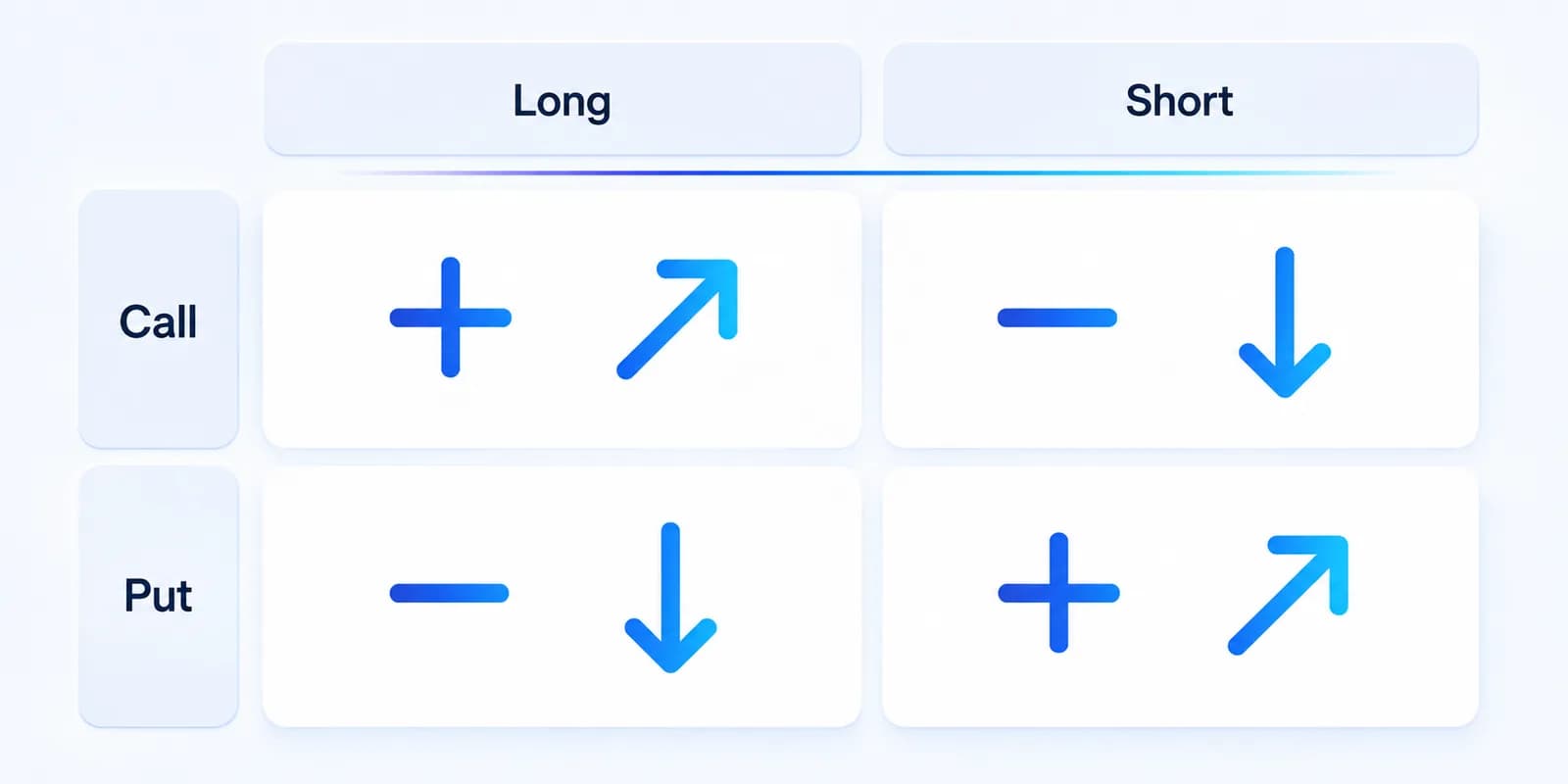
Selling an option flips the sign of delta. Selling a call with delta +0.30 leaves a position with delta -0.30 in the account. This inversion is the single most frequent rookie pitfall. The table below summarises typical signs per position.
| Position | Delta | Directional bias |
|---|---|---|
| Long call | 0 ... +1 | bullish |
| Short call | -1 ... 0 | bearish/neutral |
| Long put | -1 ... 0 | bearish |
| Short put | 0 ... +1 | bullish/neutral |
| Bull put spread | slightly positive | bullish/neutral |
| Bear call spread | slightly negative | bearish/neutral |
| Iron Condor | near 0 (symmetric) | neutral |
The sign logic holds across underlyings. The same applies to pure credit spreads: a credit spread on the put side carries slightly positive net delta, one on the call side slightly negative. The net value reflects the bias but is small by construction because long and short legs partially offset.
Delta as a heuristic for ITM probability
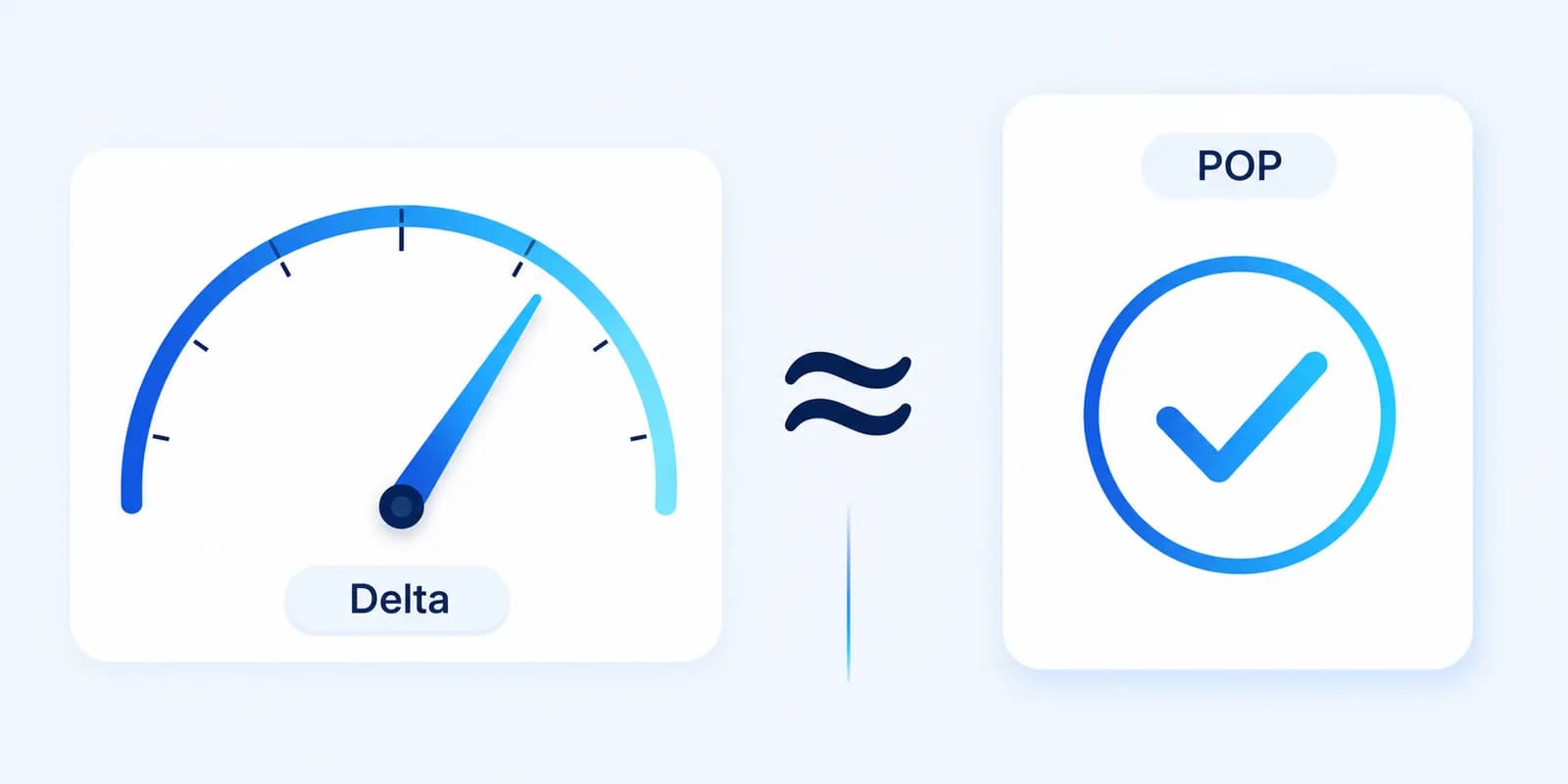
A widely cited rule of thumb says option delta roughly equals the probability of finishing in the money. A short put with delta -0.16 is often described as having about 84 percent OTM probability (1 - 0.16). The heuristic is handy but not exact. It is an approximation and should be labelled as such.
Accuracy caveat
Delta is not identical to ITM probability. Delta lives under the risk-neutral measure of the Black-Scholes model; the true ITM probability lives under the physical measure and depends additionally on drift, skew and smile. Under symmetric assumptions both values are close, around equity skew or index puts they diverge meaningfully. Broker platforms like tastytrade and Interactive Brokers therefore typically expose a separate POP (probability of profit) or ITM-probability metric that should not be conflated with delta.
Practical consequence: delta is fine for sorting option chains quickly (e.g. picking delta-16 shorts for spread strategies), but unfit as a yield promise or basis for expected win rates. Anyone using delta-as-POP automated premium selling as a filter should document the caveat in the personal rulebook.
Aggregating delta across multi-leg structures
In multi-leg structures net delta is the sign-correct sum of all leg deltas. Long legs keep the delta sign from the chain, short legs flip it. The table below illustrates this for a bull put spread and a symmetric Iron Condor.
| Strategy | Leg | Chain delta | Position delta |
|---|---|---|---|
| Bull put spread | Short put 95 | -0,30 | +0,30 |
| Long put 90 | -0,15 | -0,15 | |
| Net delta | +0,15 | ||
| Iron Condor (symmetric, delta-16 shorts) | Short put | -0,16 | +0,16 |
| Long put | -0,08 | -0,08 | |
| Short call | +0,16 | -0,16 | |
| Long call | +0,08 | +0,08 | |
| Net delta | 0,00 | ||
The bull put spread net delta of +0.15 shows a clear bullish bias, smaller than a single-leg short put because the long put absorbs part of the directional risk. In a symmetric Iron Condor both spread halves cancel and net delta starts near zero. At account or portfolio level the aggregated net delta is monitored as a core risk metric. The delta-exit rules in OptionsApp apply such thresholds per position automatically.
What does delta mean in trading practice?
Three practical uses recur in daily trading. How to apply each depends on the personal setup:
- Strike selector. Delta serves as a rough indicator of moneyness. Delta-16 shorts or delta-30 longs are frequently discussed values in practice.
- Dollar delta as risk metric. Multiplied by multiplier and spot price, delta gives the dollar-value market-move sensitivity per position or portfolio.
- Steering quantity for delta hedging. Net delta of a position or portfolio is neutralised through offsetting trades. The full hedging mechanic is its own discipline and does not belong in a delta glossary.
Strike selector: many premium-selling rulebooks define short strikes by delta rather than by distance or percent. A delta-16 short is a frequently discussed value for spread strategies; delta-30 shorts are considered more aggressive. The advantage of delta notation: it scales with implied volatility (IV) automatically; under high IV the delta-16 strike sits further OTM than under low IV.
Dollar delta: factor 100
Dollar delta = delta x multiplier x spot.
Example: a stock trades at 100 USD, an ATM 30-DTE (days to expiration) call carries delta 0.52. Standard equity option, multiplier 100. Dollar delta = 0.52 x 100 x 100 = 5,200 USD per contract. A 1-USD move in spot adds 52 USD per contract, 1 percent of the underlying 5,200 USD.
Delta hedging as a concept: holders of options can neutralise directional risk via an offsetting position in the underlying. A bought call with delta +0.40 corresponds to selling 40 shares per contract. Because delta changes constantly with spot, time and volatility, real-world hedging is dynamic: the hedge ratio is rebalanced continuously. Market makers and volatility traders run this re-hedging as a core process.
A position or portfolio with net delta near zero is called delta-neutral. Such setups are largely immune to small directional moves but still react to volatility (vega) and time decay (theta). A full treatment of hedging mechanics belongs in a dedicated strategy page, not a delta glossary. The concept is enough here.
Interaction of delta with gamma and theta
Delta does not live alone. It is the first derivative of the option price, and the second derivative, gamma, captures how fast delta itself moves under spot changes. ATM options carry the highest gamma; every 1-USD move shifts delta most. Deep ITM or deep OTM gamma is flat.
On the time axis theta drives the picture: every day an option loses time value. Charm captures the interaction of delta and time (delta drift) and rounds out the view. Premium sellers typically run negative gamma and positive theta: while the market stays calm theta accrues; on large moves negative gamma bites disproportionately.
Looking at delta in isolation is rarely enough. Practitioners read the Greek stack together: delta for direction, gamma for convexity, theta for time, vega for volatility. The combination is the picture.
Calculating delta: a worked example
Assumption: a stock trades at 100 USD, ATM call with 30 days to expiration, implied volatility 25 percent, risk-free rate 4 percent, no dividend. The option chain reports delta directly, in this example 0.53. Under Black-Scholes the value comes from the cumulative standard normal of d1, where d1 is built from spot, strike, time, rate and implied volatility.
- Spot S
- 100 USD
- Strike K
- 100 USD
- Time to expiry T
- 30 / 365 = 0,0822
- implied vol σ
- 0,25
- rate r
- 0,04
- d1
- (ln(S/K) + (r + σ²/2) · T) / (σ · √T) ≈ 0,082
- Call delta
- N(d1) ≈ 0,533
- Dollar delta
- 0,533 · 100 · 100 = 5.330 USD1 contract, 100 shares
Computing Black-Scholes manually is an edge case in practice. The broker streams delta from its pricing engine, which incorporates skew, smile and live market data. Understanding that all Greeks are model outputs (approximations of reality that diverge under volatility smile, jump risk or thin liquidity) matters more than the formula itself.
Dollar delta calculator
Share equivalent
53.3 shares
P&L per 1 USD move
+53.3 USD
Dollar delta (notional)
5,330 USD
Snapshot: delta constantly changes with spot, time to expiration and volatility (gamma). A negative delta means a short bias. The calculator does not replace position monitoring and is not investment advice.
Common misconceptions about delta
- Delta is not the option's leverage. Leverage in the classical sense captures how the percentage change of the option exceeds the percentage change of the underlying and is captured by omega or lambda. Delta measures only absolute price sensitivity per unit move.
- Delta is not the ITM probability. It is a quick approximation, no more. Broker platforms expose a separate metric for the actual probability.
- Sign confusion on short positions. Selling an option flips the sign. A sold call carries position delta between -1 and 0, not positive delta as the long call does.
- Delta is a snapshot. It only applies in the immediate neighbourhood of current spot. For larger jumps gamma must be included; otherwise the delta estimate underestimates the actual price move.
- Model output, not market reality. Delta is a model output. Under stress with vol smile, jump risk or thin liquidity actual behaviour diverges from model expectations.
Delta in trading practice
In practice delta serves many options traders primarily as a fast strike selector and as a portfolio-level risk sensor, less as a POP substitute. How to apply delta concretely depends on the individual rulebook and does not replace an individual investment decision.
Three observations from practice:
- Delta as a heuristic is genuinely useful for sorting the chain because it scales with implied volatility automatically. A short put with delta 16 sits further out of the money under high IV than under low.
- At portfolio level the aggregated net delta tends to act more as an early-warning signal than single-position delta, because opposing positions only reveal themselves in the sum.
- A useful habit is to check for every new position whether the delta carries the intended direction or is only a by-product of strike selection.
Delta FAQ
How do you calculate the delta of an option?
Under Black-Scholes, delta is derived from the standard normal distribution of the modified distance between spot and strike. For a European call delta equals N(d1), for the put delta equals N(d1) − 1; with a continuous dividend yield q the factor e^(−qT) is added (call delta = e^(−qT)·N(d1)), and the short form holds for q = 0. In practice the broker reports delta directly from the option chain; computing it manually is only useful for model sanity checks.
What does delta 0.5 mean?
A delta of 0.5 means the option price moves about 0.50 USD when the underlying moves 1 USD. For a standard equity option covering 100 shares this implies roughly 50 USD of value change per 1-USD step in the underlying. Options near 0.5 delta typically sit near the money.
Is delta the probability that an option expires in the money?
Not exactly. Delta is an approximation of the ITM probability, not the precise value. Delta lives under the risk-neutral measure of the pricing model; the true probability lives under the physical measure. For symmetric assumptions the two are close, under skew and smile they diverge. Delta is a quick heuristic, not an exact figure.
What is delta hedging?
Delta hedging means neutralising the directional risk of an options position by an offsetting position in the underlying. A trader holding a call with delta +0.40 can offset the directional risk by selling 40 shares per contract (40 = 0.40 × 100). Since delta changes with spot, time and volatility, hedging is dynamic: market makers continuously rebalance.
What does delta-neutral mean?
Delta-neutral means the sum of all position deltas is close to zero. A delta-neutral setup is largely immune to small directional moves but still reacts to volatility (vega) and time decay (theta). Pure premium-selling structures such as a symmetric Iron Condor often start delta-near-zero and drift as the market moves.
Why is put delta negative?
A put gains value when the underlying falls, so the slope of the put price function with respect to spot is negative. Long puts carry delta between -1 and 0, short puts between 0 and +1. The negative sign is not a judgement but only describes the inverse directional relationship to the underlying.
What delta do deep ITM options carry?
Deep ITM calls carry delta near +1, deep ITM puts near -1. The option then behaves close to 100 shares of the underlying (long or short respectively) because nearly every dollar of spot movement translates into the option price. Time value is small, intrinsic value dominates.
How does delta change as expiration approaches?
As remaining duration shrinks, the effect amplifies: ITM options see delta walk toward ±1, OTM options see it decay toward 0. ATM options stay near 0.5 or -0.5 but become increasingly sensitive to small moves because gamma spikes in the final days. This delta drift is called charm.
Sources
- Options Industry Council, Understanding Options Greeks. optionseducation.org
- Wikipedia, Greeks (finance) #Delta. en.wikipedia.org/wiki/Greeks_(finance)#Delta
- Wikipedia, Delta neutral. en.wikipedia.org/wiki/Delta_neutral
- Hull, J. C., Optimal Delta Hedging for Options. Rotman School of Management, University of Toronto.
- Macroption, Delta vs. Probability of Expiring ITM. macroption.com
- tastylive Market Measures, Delta and Probability (2017). tastylive.com
- Project Finance, What is Delta Hedging. projectfinance.com
Risk disclaimer
Options are leveraged derivatives. Trading options can lead to total loss and, on short positions, to losses exceeding the capital invested. Greeks like delta are model outputs and describe reality only approximately. Worked examples in this article are hypothetical and no promise of future gains. This content is not individual investment advice.
Greeks aggregation in OptionsApp
OptionsApp opens options strategies automatically based on a delta target and closes or adjusts them by your stored rules. A new expiration is opened via re-entry on the same trade template. Profit target, stop loss and delta exit run mechanically by your defined values. Strategy choice, sizing and market view remain the trader's call.
More in the automated premium-selling guide.