
Option Greeks · Glossary
Theta: The Time Decay of an Option
Founder of OptionsApp, active in the markets for 20+ years.
Theta is the option sensitivity that measures the time decay of an option per calendar day in monetary units. Long options usually have negative theta and lose value every day; short options have positive theta. Time decay accelerates mainly for at-the-money options toward expiration, while it tends toward zero deep in or out of the money.
This page covers theta in options trading as the time-decay sensitivity. Other uses of the Greek letter theta (statistics, neuroscience, mathematics) are not in scope.
Theta at a glance
- Theta measures an option's time decay per calendar day, expressed as the change in option price under otherwise constant market conditions.
- Long options: theta negative. Short options: theta positive. Multi-leg strategies sum signed thetas into a net theta.
- Multiplier 100: on a standard equity option, a theta of -0.05 equals roughly $5 loss per calendar day per contract.
- Non-linear behavior: |theta| grows toward expiration, peaks at-the-money. Deep ITM and deep OTM theta approaches zero.
- Theta income in premium-seller setups (Iron Condor, credit spread) is paid for with gamma risk, not a free lunch.
- Theta is a Black-Scholes model output, not a directly observable market quantity. Real-world prices can differ.
Unit
Currency/day
per share, in option's quote currency
Profile
Non-linear
Accelerates near expiry
Peak
ATM
Spot ≈ strike
What is theta?
Theta is the option's sensitivity to the passage of time. It captures the model-implied change in the option price when one calendar day elapses while all other inputs (spot, implied volatility, rates) stay constant. In the Black-Scholes framework theta is the partial derivative of the option price with respect to time, formally theta = ∂C/∂t.
An important reading note: theta is a model output, not a directly observable market quantity. Brokers and option chains typically quote theta per share and per calendar day. On a standard equity option with multiplier 100, the displayed theta is multiplied by 100 to get the dollar impact per contract. A theta of -0.05 therefore corresponds to a $5 model-implied loss per calendar day per contract.
Theta is one of the classical option greeks alongside delta, gamma, vega and rho. It is the only sensitivity that is not tied to a market or environment variable but purely to the clock. As long as an option carries any remaining time value, theta is non-zero; at expiration the time value is definitionally exhausted and theta is no longer meaningfully defined. The Chicago Board Options Exchange (CBOE) and the Options Industry Council (OIC) list theta alongside delta, gamma, vega and rho as one of the five standard sensitivities every common option model reports.
How does theta change with time to expiration?
Theta grows non-linearly as time to expiration shrinks. With a long expiration the daily decay is small because the remaining time value is spread over many days. As expiration approaches, the remaining time value melts faster each day. Mathematically this acceleration follows from the square-root-of-time scaling in Black-Scholes: option price ≈ volatility contribution × √time.
In practice that means: between 90 and 30 DTE |theta| moves in a moderate band, from roughly 30 DTE onward daily decay rises noticeably, in the final one to two weeks markedly. There is no hard threshold, but the acceleration mechanism is general and is one of the central arguments for or against short expirations in a setup.
Theta decay calculator
Theta today (per day)
−0.03
Time value at 21 DTE
2.05
Decay first 7 days
0.24
Decay final 7 days
1.18
Square-root-of-time approximation for an at-the-money option (time value proportional to the square root of remaining life). The final days shed far more time value than the first, hence the 21-DTE debate. ITM/OTM options and volatility shifts move the curve. Not investment advice.
How does theta change with the spot price?
Theta depends not only on time but also on spot distance to the strike. For a single option |theta| peaks where time value peaks, which is at-the-money. Deep in-the-money the option price is mostly intrinsic value, which does not decay; time value and therefore theta are small. Deep out-of-the-money the absolute option price is small to begin with, so the daily decay is mathematically tiny.
Hence the typical bell shape of theta over spot. It narrows and steepens as expiration approaches because the ATM effect amplifies. For multi-leg strategies the individual thetas add up with the correct sign; a centered Iron Condor therefore shows its peak net theta midway between the two short strikes.
Theta sign across option strategies
The sign of theta depends on whether the position is long or short. Long options lose value over time, their theta is negative. Short options benefit from decay, their theta is positive. Multi-leg strategies sum the individual signed thetas into a net theta.

| Strategy | Net theta | Note |
|---|---|---|
| Long Call / Long Put | − | Buyer pays time value |
| Short Call / Short Put | + | Premium seller collects decay |
| Bull Put Spread | + | Credit strategy |
| Bear Call Spread | + | Credit strategy |
| Iron Condor | + | Both-side credit |
| Long Strangle / Long Straddle | − − | Both legs long, heavy decay |
| Calendar Spread | + / ? | Front-month short decays faster than back-month long |
The table is a reference. Which strategy fits a personal account depends on risk profile, experience and goals and must be decided individually.
Theta day pattern: what happens over the weekend?
Theta is defined on a calendar-day basis, so time value decays mathematically over Saturday and Sunday just like on weekdays. Comparing an option price at Friday close with the price at Monday open, one might naively expect three calendar days worth of time value to be gone. In practice the market looks different.
Market participants know the weekend effect and tend to price it into the Friday close. Implied volatilities often nudge up over the weekend, partially offsetting the decay. Numerically an option with theta of -0.08 per share would lose $0.16 of time value over Saturday and Sunday, or $16 per contract across two calendar days; the observable Friday-to-Monday move is usually a markedly smaller amount. Weekend theta is not a free lunch.
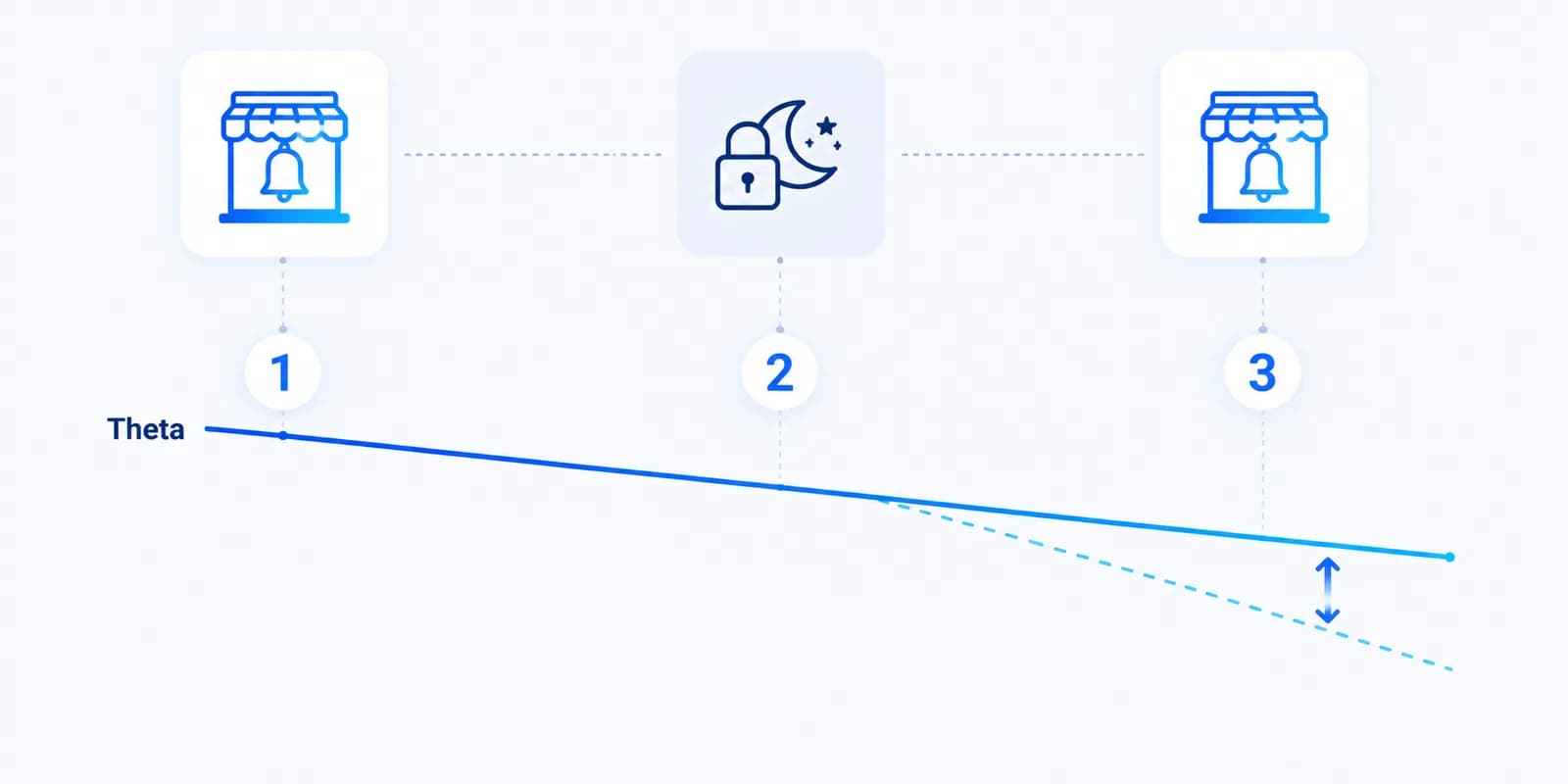
For traders of 0DTE options and other short-duration positions the day pattern is more relevant than for 45-DTE premium sellers. Holding an option over weeks averages out the weekend effect; holding hours or days exposes the pricing behavior directly in the account statement.
Theta in premium-seller setups: do sellers really profit from theta?
Premium-seller strategies such as the cash-secured put, the covered call, the bull put spread, the bear call spread or the Iron Condor structurally carry positive net theta. Every quiet day the sold option loses time value, and that loss is the short side's gain. This is the source of the common picture of the seller who 'collects theta'.
This view is not wrong but incomplete. Theta income is paid for with gamma risk. The same options that throw off rich theta react sharply to spot moves because their delta shifts quickly per unit of spot change. A calm week delivers the planned theta; a gap up or down can wipe out weeks of decay in one session. Premium sellers do not earn theta 'risk-free', they are compensated for movement risk taken on.
Concretely this shows up in the choice of expiration, delta and wing width. More theta means tighter strikes and higher gamma. Lower gamma means further OTM and longer expirations, with smaller theta in return. Where the personal sweet spot sits depends on the rulebook and risk profile and must be set individually.
More on the classical credit strategies in the glossary entries on Iron Condor, credit spread, bull put spread and bear call spread.
Theta acceleration and the 21-DTE heuristic
The 21-DTE threshold is a heuristic often cited in the tastytrade backtest community, not a mathematical theorem and not a rule. The idea: beyond this threshold gamma rises disproportionately, the expected value of many premium-seller setups deteriorates, and a position review or an early exit can improve expected value. Empirical discussion ranges roughly between 14 and 28 DTE depending on underlying, setup and data window.
The generic reading matters: the point is an early position review before expiration, not the specific number '21'. Concrete thresholds like 21 DTE or a 50 percent profit target are widely discussed values, not natural laws. Which trigger fits a personal setup depends on underlying, strategy, risk profile and experience and belongs in the individual rulebook.
Theta acceleration is the mechanism behind this discussion. Whoever understands the mechanism can justify their own trigger empirically and does not need to follow a blanket '21 is the right number' claim.
Theta-gamma interaction: why theta income is gamma risk
The most important Greek relationship for premium sellers is the one between theta and Gamma. Gamma measures the change of delta per unit of spot move. Setups with high positive theta structurally also carry high negative gamma, because theta and gamma are coupled through the second derivative of the option price in the classical models. A seller who collects daily theta in return bears the risk that a bigger spot move drifts delta uncontrollably.
| DTE | |Theta| | |Gamma| | Implication for sellers |
|---|---|---|---|
| 60 | low | low | Little theta, calm position |
| 30 | moderate | moderate | Balanced zone, often used |
| 7 | high | very high | Peak theta, gamma risk explosive |
This coupling yields a simple observation: there is no risk-free theta zone. More theta means more gamma. Less gamma means less theta. This trade-off is the core of every premium-seller rulebook.
Worked example: time value vs. intrinsic value
A concrete example makes the relationship between intrinsic value, time value and theta tangible. Assume SPY trades at $505 and a trader looks at a call with strike 500 and 30 DTE.
| Quantity | Value | Note |
|---|---|---|
| SPY Spot | 505,00 USD | current price |
| Strike Call | 500 | slightly ITM |
| Option price | 8,20 USD | per share |
| Intrinsic value | 5,00 USD | 505 − 500 |
| Time value | 3,20 USD | Option price − intrinsic |
| Theta | -0,08 USD/Tag | per share |
| Dollar impact per contract | -8,00 USD/Tag | Theta x 100 |
The option price of $8.20 breaks down into $5.00 intrinsic value and $3.20 time value. Theta only applies to the time value: each calendar day the time value erodes by $0.08 per share in the model. Multiplied by the standard equity-option multiplier of 100 that is a $8.00 model-implied loss per contract per day, all else equal. This is a snapshot; as time passes |theta| grows non-linearly (see theta-vs-DTE diagram above).
Experience shows that theta only gives a reliable picture when it is read alongside the position's gamma rather than in isolation. How that trade-off is struck in each case depends on the individual rulebook and must be decided by each trader.
Common misconceptions about theta
- 'Theta decays linearly' : wrong. Time decay is non-linear, |theta| grows toward expiration and accelerates in the final weeks.
- '21 DTE is a rule' : no. 21 DTE is a commonly discussed heuristic from tastytrade backtests, not a mathematical theorem or a natural law.
- 'Premium sellers earn theta risk-free' : no. Theta income is paid for with gamma risk; more theta means more movement risk.
- 'Weekend theta is a free lunch' : no. Market participants tend to price weekend decay into the Friday close.
- 'Theta is constant' : no. Theta changes continuously with spot, implied volatility and time to expiration.
Theta management (profit target, pre-expiration review, sizing) is a classical rulebook that can be automated. Executing the rulebook consistently rules out many typical theta mistakes systematically. More in the pillar run rule sets automatically.
Theta FAQ
How is time decay calculated?
Time decay follows from the partial derivative of the option price with respect to time, in the Black-Scholes model written as theta = ∂C/∂t. In practice brokers and option chains display theta directly as a model output per option, typically per calendar day and per share. For a standard equity option with a multiplier of 100, a theta of -0.05 corresponds to roughly $5 loss per day per contract.
When does theta accelerate?
Theta grows non-linearly. In the first weeks after entry the daily decay is moderate, from roughly 30 to 45 days to expiration the absolute value rises noticeably, and in the final two weeks it accelerates strongly. The exact shape depends on volatility, spot distance to strike and option type. There is no universal threshold, but the acceleration mechanism is general.
Do premium sellers really profit from theta?
Premium sellers run positive theta on short options and collect the daily time decay paid by the counterparty. That theta income is paid for with gamma risk: the same options that throw off rich theta react strongly to spot moves. Without risk management and sizing, theta income is not a free lunch, it is compensation for movement risk.
What does 21 DTE mean at tastytrade?
21 DTE refers to a days-to-expiration threshold that the tastytrade backtest community often cites as a trigger for position review or an early exit. The idea: beyond this threshold gamma rises disproportionately, expected value deteriorates. 21 DTE is a heuristic discussion value from specific backtests, not a mathematical theorem or a rule. Which trigger fits a personal setup is part of the individual rulebook.
How high is the theta of an ATM option?
For a single option theta peaks at-the-money, when spot is close to the strike. The concrete value depends on remaining time, implied volatility and underlying. Deep ITM and deep OTM theta approaches zero because there is little time value left to decay.
What happens to theta over the weekend?
Theta is defined on a calendar-day basis, so weekends decay just like weekdays mathematically. In practice market participants tend to price weekend decay into the Friday close, so the gap on Monday open is rarely visible. Weekend theta is therefore not a free lunch.
Is theta different for long and short options?
Long options carry negative theta because time value shrinks each day and the position loses value. Short options carry positive theta: the counterparty's time decay works in favor of the premium seller. Multi-leg strategies sum the individual thetas with the correct sign into a net theta.
What does a theta of -0.05 mean?
On a standard equity option with multiplier 100, a theta of -0.05 means the option price per share is expected to fall by $0.05 per calendar day, holding everything else constant. Per contract that is a $5 loss per day. The negative sign marks the long perspective; from the short side it would read +0.05.
Sources
- OIC, Understanding Options Greeks. optionseducation.org
- Gabler Banklexikon, Theta. gabler-banklexikon.de
- Schwab, Get to Know Option Greeks. schwab.com
- Wikipedia, Greeks (finance) #Theta. en.wikipedia.org
- Black, F. and Scholes, M. (1973). The Pricing of Options and Corporate Liabilities. Journal of Political Economy, 81(3), 637-654.
- tastylive, public discussion of 21-DTE management heuristics for premium-seller setups. tastylive.com
Risk disclaimer
Theta is a model output (Black-Scholes), not a directly observable market quantity. Real option prices can deviate from the model-implied decay. Theta income in premium-seller setups is paid for with gamma risk; calm periods deliver the planned income, larger spot moves can wipe out weeks of income in one session. Example values and heuristics in this article are no promise of future gains and do not replace individual investment advice.
Automate theta setups with OptionsApp
Define rule set, connect broker, your theta rulebook executes automatically: profit target, pre-expiration review and sizing follow your own settings. Strategy choice and monitoring remain yours. Free 14-day trial, no payment details; the trial ends automatically.
More in the pillar Automated trading.