
Automated Stock Trading
Automated stock trading is the rule-based buying and selling of stocks. Instead of placing every order by hand, you let software execute your rulebook consistently. OptionsApp automates your stock trading via Interactive Brokers, including dynamic underlying search, multi-currency and flexible strategy configuration.
Automated stock trading in brief
- Definition: software buys and sells stocks by a predefined rulebook, from order entry to a rule-based exit.
- 5 levels of automation: from a stop-loss order at the broker via recurring investing and robo-advisors to a rule-based system and a custom API build.
- A substantial share of exchange turnover at major venues comes from automated systems; ESMA put the European high-frequency share at 43 percent of traded value in 2014.
- Legal for private investors on their own account; a licence is only required for services offered to third parties.
- OptionsApp automates trading via the official Interactive Brokers TWS API (the Trader Workstation programming interface); entries are automated during US regular trading hours (RTH, 9:30 am to 4:00 pm ET).
Basics
What is automated stock trading?
Automated stock trading means the rule-based buying and selling of stocks by software. The software checks market data against your stored rulebook, routes the orders and applies your rules to open positions. Stock trading becomes reproducible and decoupled from manual order entry.
In automated stock trading you define once the conditions under which a stock is bought or sold. Technical indicators, price logic, time filters or risk parameters: every rule is applied consistently. Emotional mistakes, overtrading or inconsistent stops during execution fall away; discipline shifts into preparing the rulebook.
The scale is well documented: automated systems account for up to 50 percent of exchange turnover at major venues, and for European equity trading ESMA (the EU securities regulator) counted 76 percent of all orders as high-frequency trading (automated trading at very high order speed) back in 2014. Mordor Intelligence sizes the algorithmic-trading market, depending on the study, at 20.23 billion USD in 2026 with a projection of 29.54 billion USD by 2031. Automation is not a niche at the exchange, it has been standard infrastructure for years.
Overview
Can stocks be bought and sold automatically?
Yes. Stocks can be traded automatically on 5 levels: order types at the broker, recurring investing, robo-advisors, a rule-based trading system and a custom build on a broker API. The levels differ in effort, cost and control. The higher the level, the more of your own rules drive entries and exits.
Level 1 of 5
Order types at the broker
A stop-loss order (sell order triggered when the price falls below a set level), a trailing stop (stop that follows the price at a fixed distance) and an OCO order (one cancels other: filling one order cancels the other) automate the exit of single positions. Available at Interactive Brokers at no extra cost.
Level 2 of 5
Recurring investing
Buys a fixed amount at fixed intervals, usually ETFs or single stocks. Only the buying rhythm is automated, there is no market logic: purchases happen regardless of price. Suited to long-term investing without active trading decisions.
Level 3 of 5
Robo-advisor
Digital wealth management that runs ETF portfolios automatically, including allocation and rebalancing. Fees often sit around 1 percent per year. No trading: control over individual buys and sells is deliberately handed over.
Level 4 of 5
Rule-based trading system
Software executes self-defined if-then rules on your own broker account: entries, exits, stops, logging. In the MetaTrader world these systems are called expert advisors (EAs, trading robots common in CFD and forex); for real US stocks and ETFs, OptionsApp works on this level.
Level 5 of 5
Custom build on a broker API
Developers code automation directly against an interface such as the Interactive Brokers TWS API. Maximum freedom, but development, operations and error handling are entirely in your own hands. More below in the software vs. in-house comparison.
Robo-advisor, trading bot or rule-based trading system?
| Criterion | Robo-Advisor | Trading-Bot | Rule-based trading system |
|---|---|---|---|
| Goal | Long-term ETF wealth management | Short-term trades, often third-party logic | Executing your own rulebook mechanically |
| Horizon | Years to decades | Minutes to days | Intraday to weeks, depending on the rulebook |
| Cost | Around 1 percent per year (Finanztip) | Varies widely, often opaque | Software subscription plus broker fees |
| Control | Fully delegated | Low, logic often not visible | Full, every rule self-defined |
Robo-advisor cost figure: Finanztip (as of 2026). The table is for orientation; which level fits an account depends on goals, experience and risk profile and remains an individual decision.
OptionsApp is a level-4 rule-based trading system: it executes a self-defined rulebook on your own Interactive Brokers account. How to set up such rulebooks across options, stocks and ETFs is covered in the guide to automated trading.
How it works
Automate stock trading in three steps
How your stock strategy becomes an automated system.
Define rules
Define entry and exit conditions for your stocks: technical indicators, time filters and fixed trading days. Add position size, stop-loss and profit target. This creates the rulebook for your automated stock trading.
Connect broker
OptionsApp connects via TWS API to your Interactive Brokers account. Communication runs over the broker's official interface. From now on the app executes your rulebook.
Let it trade automatically
Activate the strategy and the software trades stocks automatically by your rules. Entry, exit, stop management, reporting: all without manual order entry. You see the status of your automated stock trading continuously updated in the app.
Execution
Buy and sell stocks automatically: rules in OptionsApp
Which rules are possible in automated stock trading.
OptionsApp's automated stock trading lets you buy and sell stocks automatically by clearly defined criteria. Combine technical indicators and time logic into one strategy; a VIX threshold (the CBOE volatility index) can act as an extra filter.
Buy stocks automatically
- Buy at the scheduled time when EMA 20 sits above EMA 50
- Buy on fixed weekdays when the RSI is below 30
- Buy on a fixed date, for example for seasonal setups
- Entry via time window plus Movement Since Opening
Sell stocks automatically
- Automatic stop-loss on drawdown
- Exit on a fixed date, for example for seasonal setups
- Profit target at a defined price
- Time-based exit (e.g. end-of-day)
Buying and selling stocks with options: the premium-selling bridge
There is a second, often overlooked way to automate stock purchases and sales: options. A cash secured put (selling a put option with cash set aside; if assigned, the shares are bought at the strike) works like a limit order that collects a premium. A covered call (selling a call option on shares already held) mirrors this on the sell side above a target price and earns an extra premium.
Example numbers: a stock trades at 105 USD, the target buy price is 100 USD. Selling a put with strike 100 (exercise price) earns a 2 USD premium per share, 200 USD per contract at the standard multiplier of 100 (exceptions exist, for example for futures options). If the stock closes above 100 USD at expiration, the premium is kept and no shares are bought. If it closes below, the shares are typically assigned at expiration at the strike, an effective entry of 98 USD (strike 100 minus the 2 USD premium). The risk: assignment also happens when the price sits far lower; from the strike down, the option seller carries the full price risk.
Both strategies can run rule-based in OptionsApp: see how to automate cash secured puts and covered calls. Terms like strike, premium and assignment are covered in the options and trading glossary.
Benefits
Advantages of automated stock trading
Why more retail investors automate their stock trading.
Save time on stock trading
Automated stock trading runs continuously throughout US trading hours, without every order being entered by hand. Stocks are bought and sold by your rulebook, even across multiple parallel strategies. Monitoring your positions remains your job.
Rule-based discipline
Rules you define once are executed consistently. No spontaneous deviations from the rulebook, no forgotten stop orders. The software does not deviate from your rulebook on its own; technical disruptions can still affect execution.
Fewer emotional execution errors
Greed, fear and overtrading no longer influence execution. The system acts strictly on your predefined conditions: stocks are bought or sold when criteria are met, reproducibly, day after day. Emotions do not disappear; they shift into how the rulebook is designed.
One interface, dynamic selection
Dynamic underlying search instead of a fixed list: stocks, ETFs and indices can be added via configurable trading classes. Multi-currency with USD, CHF and EUR: positions are held in their native currency, your overall portfolio is shown in your account currency (e.g. EUR or USD).
Where the limits of automation are
An honest assessment includes the limits: automation does not improve a weak rulebook, it only executes it more consistently. Rules fitted too tightly to the past risk overfitting (over-optimizing a rulebook on historical data) that disappoints in live trading. Add operational risks such as dropped connections between software, TWS and broker, which need monitoring. Discipline shifts rather than disappears: away from daily execution, towards designing and maintaining the rulebook.
Automate your stock trading
Try all features free for 14 days
Platform
OptionsApp: The platform for automated stock trading
What sets OptionsApp apart for automated stock trading.
Direct order routing
As soon as the scheduled time is reached and the stored condition holds, OptionsApp routes the order to Interactive Brokers via the TWS API. The entry fills at market; stop loss and profit target sit at the broker right after.
Dynamic underlying search
Not bound to a fixed list. You dynamically pick which stock, ETF or index you want to trade automatically. Trading-class selection included. Instrument selection stays genuinely open.
Multi-currency with auto-conversion
Hold positions in USD, CHF and EUR in parallel. Single positions are shown in native currency, total P&L is converted automatically into your account currency using ECB exchange rates. Set up once, adjustable whenever needed.
Entry and exit conditions for stocks
Technical indicators (EMA, SMA, RSI, MACD), movement filters such as Movement Since Opening or a time window decide at the scheduled time whether to buy. Sells happen when a stop or profit target is hit or the planned exit is reached.
Automatic risk management
Stop-loss and profit target run in the background on every automated stock trade. Exits trigger mechanically by your rules, not by the mood of the day.
Reporting and analysis
Every automatically executed stock trade is logged and analyzed: live P&L per position, daily P&L, side-by-side comparison of up to 3 strategies and filters by closing reason. Your rule-based trading becomes measurable.
Interactive Brokers integration
The Interactive Brokers connection runs through the TWS API: a direct connection, real-time market data and order execution over an established interface.
Clean dashboard
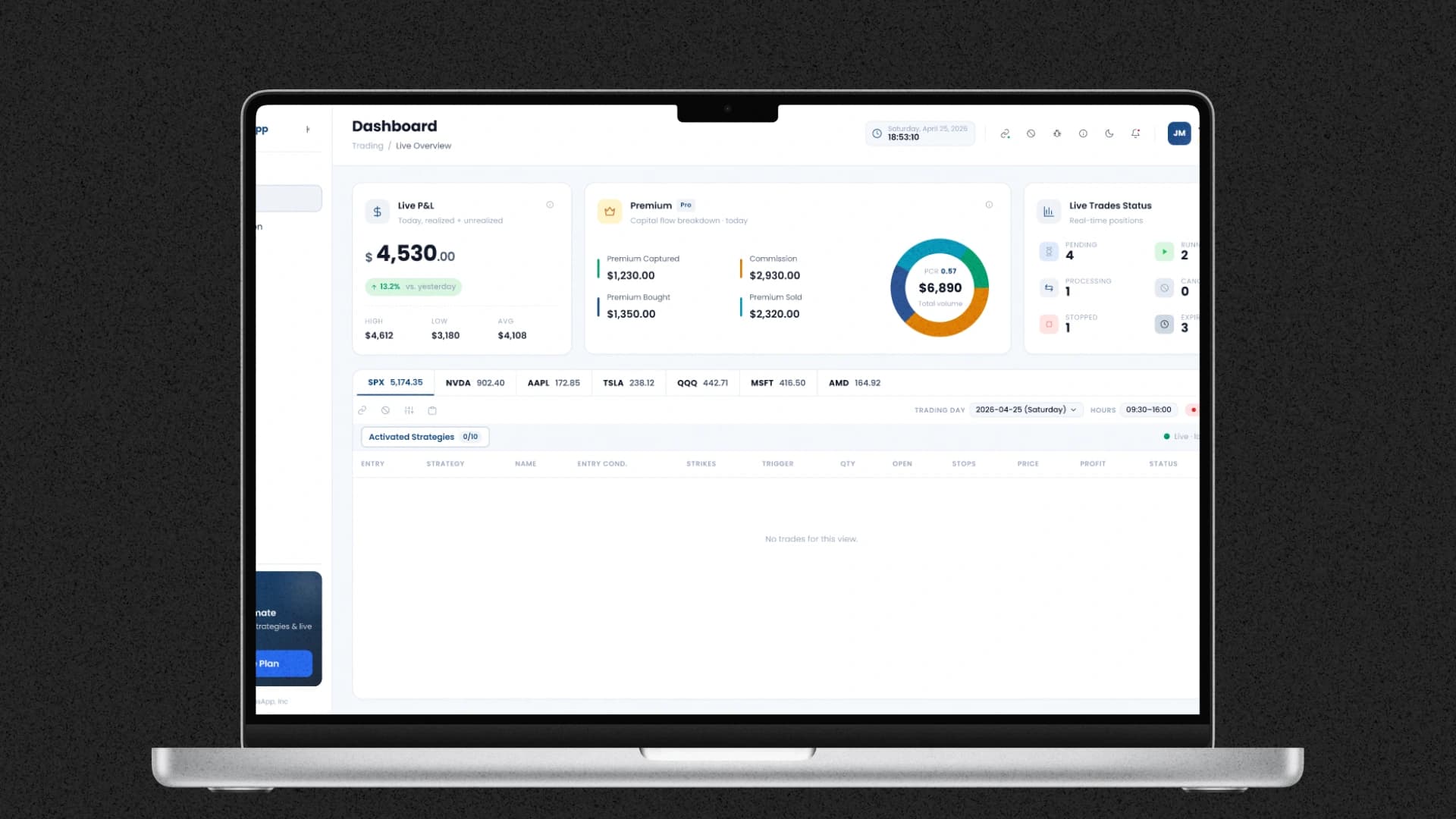
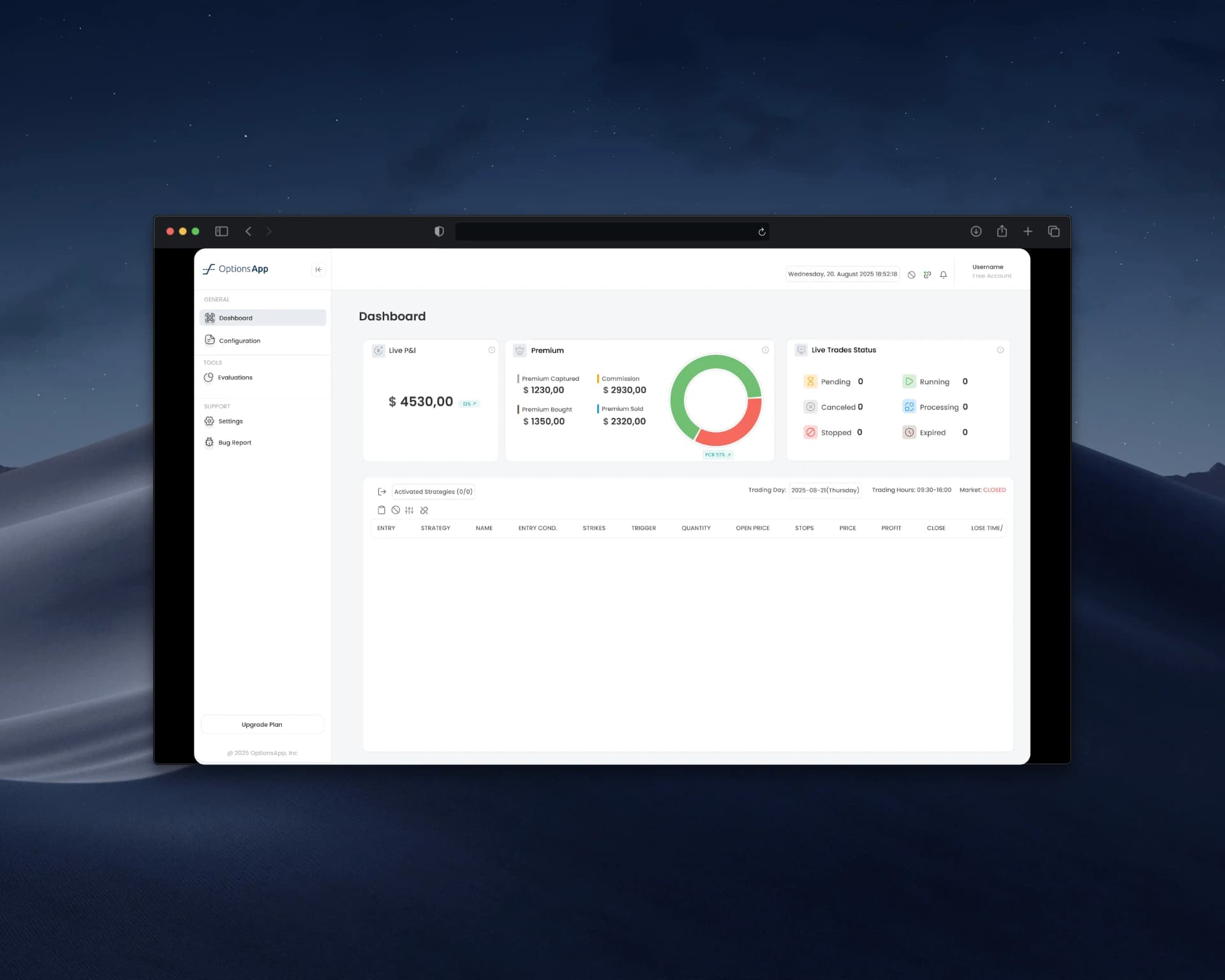
All running stock strategies in one dashboard. Live status per stock, current orders, open positions, daily P&L. Automatic trading stays transparent, even with many parallel systems.
Broker
Automated stock trading with Interactive Brokers
OptionsApp's automated stock trading runs directly over the Interactive Brokers TWS API. As an official Interactive Brokers partner, OptionsApp uses an established interface that is stable and permanently supported. Your automatically executed stock trade is routed to the broker without detours.
Interactive Brokers provides a solid broker backbone: low stock commissions, access to US and European markets, real-time market data and an extensive API. Combined with OptionsApp this becomes a full-fledged system for automated stock trading.
Traders who also want to automate options find everything in the same product: automated options trading and automated stock trading on one platform.
Features
Dynamic underlying search and multi-currency
Free instrument selection and account handling in USD, CHF and EUR.
Many automated trading platforms limit you to a fixed list. OptionsApp is different: a dynamic underlying search lets you add stocks, ETFs and indices via configurable trading classes instead of being tied to a rigid selection. Documented underlyings currently include US values such as SPX, NDX, SPY, QQQ, AAPL, NVDA and TSLA. Which instruments are tradable depends on your market-data permissions at Interactive Brokers.
To make account handling work across currencies, OptionsApp supports multi-currency: positions run in USD, CHF and EUR with ECB exchange rates. Single positions are displayed in their native currency. Your overall P&L is automatically converted into your chosen account currency (e.g. EUR), so you can assess the portfolio clearly even when positions in different currencies run in parallel.
Dynamic
Free search across stocks, ETFs and indices. No fixed list.
Extensible
Stocks, ETFs and indices addable via trading classes.
Multi-currency
USD, CHF and EUR with ECB rates, auto-conversion into your account currency.
Context
Algorithmic vs. rule-based stock trading
Terms like algorithmic stock trading, automated stock trading and rule-based stock trading are often used synonymously. They are not quite the same.
Rule-based stock trading follows clearly defined if-then rules you have written. Every decision is traceable. That's what OptionsApp does: it executes a rulebook you understand, consistently.
Algorithmic stock trading can go further: complex mathematical models, statistical arbitrage or machine learning where decision logic is not always transparent to the user. Standard for institutions, often too opaque for retail traders.
German law even has its own definition: under section 80 (2) of the Securities Trading Act (WpHG), algorithmic trading exists when a computer algorithm automatically determines order parameters such as timing, price or quantity. The organisational and labelling duties in that provision apply to investment firms, not to private investors trading their own account.
Automated stock trading is the umbrella term: both rule-based and algorithmic fall under it. OptionsApp deliberately focuses on rule-based stock trading because transparency and control matter most for private traders.
Legal
Is automated stock trading legal in Europe?
Short answer: yes. Automated stock trading on your own account is legal for private investors and requires no licence. Licensing duties only arise when someone offers such systems as a service to third parties, for example as a signal service or asset management. You trade via a regulated broker (Interactive Brokers), and OptionsApp forwards your own rulebook to the broker.
For taxation, the normal capital-gains regime of your country applies to automated stock trading. Trade positions and profits are treated like any other stock portfolio. As a private trader you remain responsible for your strategy and risk decisions.
The OptionsApp software is signed with a Sectigo certificate, confirming the installer is unaltered and comes from the vendor. The connection to the broker runs over its official interface and personal data is processed in line with the GDPR. Your credentials and trading decisions stay under your control. For software questions see the documentation or contact our support directly.
Safety
How to spot serious providers for automated stock trading
Serious providers can be identified by four traits: the money stays in your own account at a regulated broker, a full legal notice names the company and the people behind it, there are no profit promises, and the rulebook is traceable. If one of these is missing, caution is warranted.
The background is concrete: in a single consumer notice dated 3 June 2025, BaFin, Germany's financial regulator, warned about more than 700 near-identical trading websites promising high profits through supposed artificial intelligence. Since late 2024 the regulator has published at least 12 such notices on entire platform series, including one on 4 February 2025 about trading bots for crypto assets. The pattern is similar: deposits go straight to the provider instead of into your own broker account, paired with unrealistic profit promises.
- Regulated broker account. Capital stays in your own account at a supervised broker; the software only gets a trading connection. Providers that take deposits directly are a warning sign.
- Full legal notice. Company name, address and responsible people are stated and verifiable. BaFin's company database shows whether a provider is known to the regulator.
- No profit promises. Serious software sells features, not profits. Fixed percentages per month are not a realistic promise in the stock market.
- Traceable rulebook. You can see which rules are traded and verify every order at the broker. A system that only claims results cannot be verified.
OptionsApp is built along these lines: it holds no client money and instead controls your own Interactive Brokers account via the TWS API. Every order remains visible in the broker account.
Make or buy
Stock trading software instead of in-house development
Many solutions for automated stock trading require Python skills, a custom API bridge or even cloud infrastructure. Expert advisors from the MetaTrader world, in turn, live in the CFD and forex ecosystem and usually do not cover real US stock trading on a broker account. OptionsApp is deliberately a ready-to-use stock trading software for retail investors: you assemble rules in a graphical editor via dropdowns and forms. A real stock trading platform you don't have to build yourself.
With this stock trading software you can build more complex strategies by naming and combining multiple conditions, without a single line of code. That makes automated stock trading accessible to traders with experience but no software background. Compared to in-house development you save months of engineering, maintenance and debugging.
If you already have a stock strategy, you can translate it into OptionsApp step by step. Our support and community help with the setup. The documentation covers everything from the TWS connection and trade templates to entry and exit conditions.
From hands-on practice
Before a rulebook runs automatically, it is almost always executed by hand for a while. Three operational weak spots keep showing up in practice, regardless of how good the strategy is. How to handle them depends on the personal rulebook:
- Forgotten stop orders. The entry gets filled, the protective order is supposed to follow right away, then something gets in the way. Such gaps rarely show on day one; they show once routine fades.
- Inconsistency after losing days. After several red days in a row the next signal tends to get skipped, even though nothing in the rulebook changed. Exactly those skipped trades are missing from the evaluation later.
- Missing logs. Without complete records it is hard to reconstruct whether a rule was weak or just executed inconsistently.
In an automated setup these points disappear structurally: stop-loss and profit target are attached at entry, entry conditions check soberly rather than by mood, and every trade lands in the evaluation automatically. Which thresholds belong in a rulebook remains a personal decision.
FAQ
FAQ about automated stock trading
Compact answers on legal basics, costs and setup. The current OptionsApp plans and pricing complement the cost overview.
Automated stock trading means the rule-based buying and selling of stocks by software. It monitors the market, triggers orders, manages stops and closes positions following a predefined rulebook, without manual order entry. Emotional ad-hoc interventions during execution are removed and execution becomes reproducible.
Yes. On your own account, automated stock trading is legal for private investors and requires no licence. You trade via a regulated broker (such as Interactive Brokers); the software only executes your own trading decisions. Licensing is only required when such systems are offered as a service to third parties, for example signal services or asset management. Strategy and risk remain your own responsibility.
A robo-advisor is digital wealth management: it invests long-term in ETF portfolios for an annual fee in the range of 1 percent. A trading bot or rule-based trading system trades short-term if-then rules with a much higher order frequency and full control over every rule. One is investing, the other is active trading.
Comprehensive, current figures are rare and depend heavily on the measurement method. For Europe, ESMA's Economic Report 1/2014 put high-frequency trading at 43 percent of traded value, 49 percent of trades and 76 percent of all orders; no newer comprehensive surveys exist. Most of it comes from institutional players such as market makers and funds.
No. OptionsApp is a visual stock trading platform. You configure rules through forms and dropdowns, no code. Automated stock trading is accessible for traders without a programming background. Those who want more complex logic can name and combine multiple conditions freely.
Thanks to the dynamic underlying search, you pick the instrument freely instead of being tied to a fixed list. Documented underlyings currently include large US stocks (AAPL, NVDA, TSLA) and US ETFs (SPY, QQQ, IWM, GLD). Configurable trading classes let you add further instruments. Which values are available for your Interactive Brokers account depends on your market-data permissions.
Yes, via the multi-currency feature. It supports USD, CHF and EUR with ECB exchange rates. Total P&L is automatically converted into your chosen account currency. You stay on top of things even when positions in different currencies run in the same account.
Rule-based stock trading follows clearly defined if-then rules: simple, transparent, traceable. Algorithmic stock trading can additionally use complex mathematical models, statistical optimization or machine learning. OptionsApp focuses on rule-based stock trading with technical indicators: strong enough for most strategies, without black-box risk.
Software executes rules; artificial intelligence does not make a weak strategy profitable. BaFin, Germany's financial regulator, has published at least 12 consumer warnings since late 2024 about platforms promising fixed profits through supposed AI. OptionsApp deliberately works rule-based: every entry and exit condition is self-defined and traceable, no artificial intelligence makes the trading decisions.
The range is wide: robo-advisors charge a management fee around 1 percent per year, marketplace trading robots (such as expert advisors for MetaTrader) go from free to several hundred euros, and rule-based software like OptionsApp runs on a subscription. For stock trading, the OptionsApp plans differ in the number of openings per month: 10 on Basic, 40 on Pro, 80 on Pro+ and unlimited on Ultimate; positions already running do not count. Current plans are listed on the pricing page, and everything can be tested free for 14 days.
OptionsApp is not a black box. Many stock trading bots take trading decisions away from you and operate on opaque algorithms. OptionsApp is the opposite: you define your own rulebook, the software executes it consistently. Automated stock trading based on your strategy, not someone else's. If you want a classic trading bot that buys and sells stocks automatically without your input, this is not for you. If you want to automate your own stock strategy, it is the right tool.
Read more
Read more
Automated trading
The central guide across all asset classes: options, stocks, ETFs.
ViewAutomated options trading
How automated options trading works and how it differs from stock trading.
View0DTE options
Automate short-expiry options. Strategies, risk management, real examples.
ViewTAT vs. OptionsApp
Trade Automation Toolbox and OptionsApp compared: features, assets, support.
ViewAll features
The complete feature set of OptionsApp for options, equities and ETFs.
ViewReady to automate your trading?
Get started with OptionsApp. 14 days free, no credit card required. Automate options, equities and ETFs on one platform.