
Options Greeks · Glossary
Options Greeks: What Delta, Gamma, Theta, Vega and Rho Mean
Founder of OptionsApp, active in the markets for 20+ years.
Options greeks are sensitivity measures that quantify how the price of an option changes when one input parameter moves. They come from the Black-Scholes model and are named with greek letters. The five primary greeks are delta, gamma, theta, vega and rho.
Options greeks at a glance
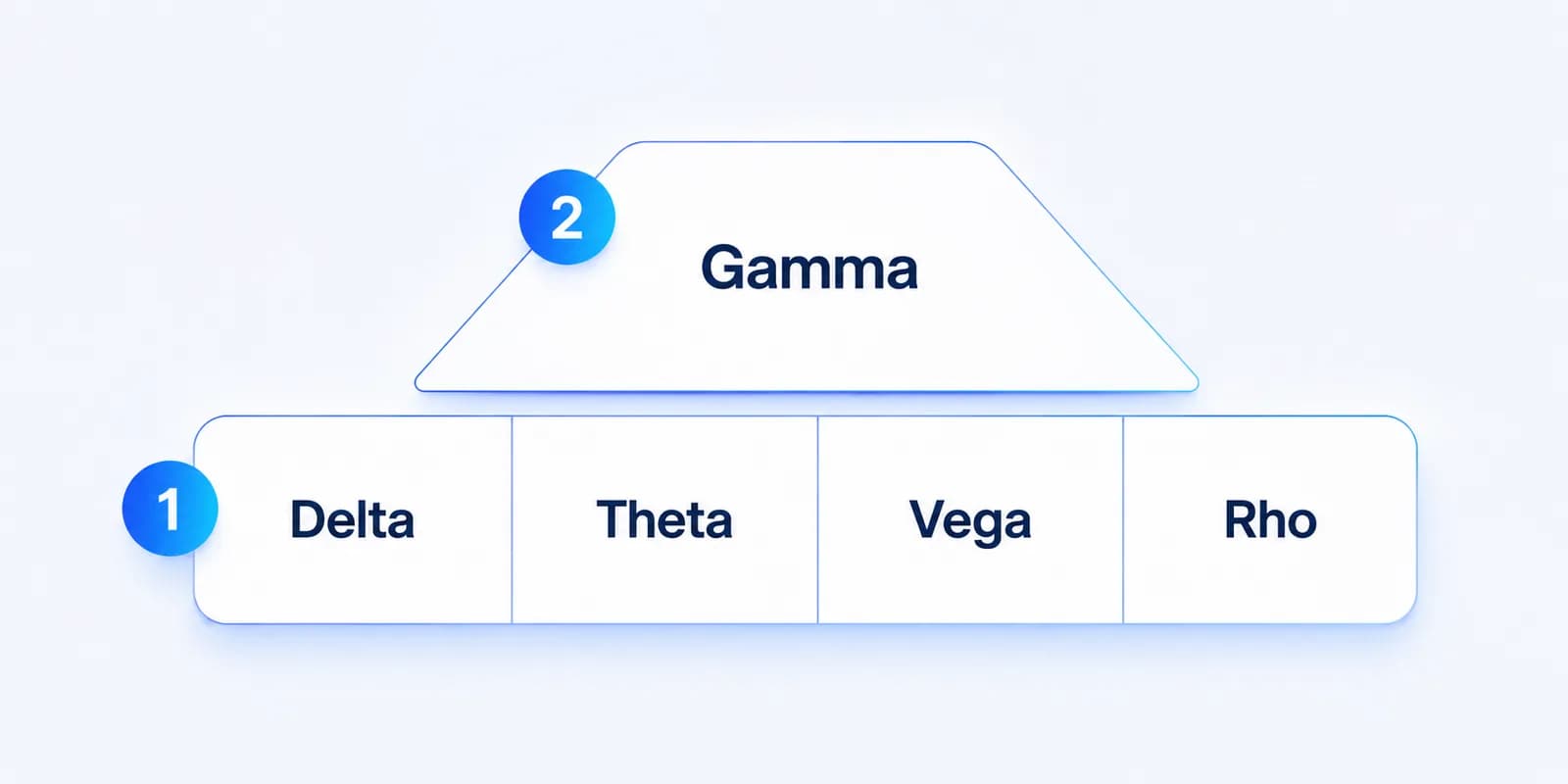
- 5 standard greeks: delta, theta, vega, rho (first-order) and gamma (second-order).
- Each greek = partial derivative of the option price with respect to one parameter (spot, time, volatility, interest).
- Origin: Black-Scholes model, 1973; Nobel Prize for Merton and Scholes in 1997.
- When options are sold the signs flip relative to long positions.
- Greeks are model outputs, not market observations. They hold approximately under normal conditions.
Disambiguation: two worlds
Greeks in options trading (this page)
Sensitivity measures like delta, gamma, theta, vega and rho from the Black-Scholes model.
Greek letters in general (not here)
Mathematical, physical or statistical symbols such as sigma for standard deviation, not covered here.
First-Order
5
Delta, gamma, theta, vega, rho
Model
1973
Black-Scholes paper
Multiplier
100
Shares per US equity option
What are options greeks?
Options greeks are sensitivity measures that describe how much an option's price reacts to a change in a single input parameter. When the underlying moves, time passes, implied volatility (IV) jumps or the risk-free rate shifts, the greeks estimate the direction and magnitude of the resulting option-price move. They are derived from the Black-Scholes model rather than observed in the market.
In options trading delta, gamma, theta, vega and rho form the standard set. Delta, theta, vega and rho are first partial derivatives of the option price with respect to spot (S), time (T), volatility (σ) and interest (r), the first-order greeks. Gamma is the second derivative with respect to spot and therefore formally a second-order greek, but so important in practice that every standard table lists it alongside the others.
Related glossary entries: the options-strategy glossary as overview and the detail pages on delta, gamma and theta.
The five primary options greeks at a glance
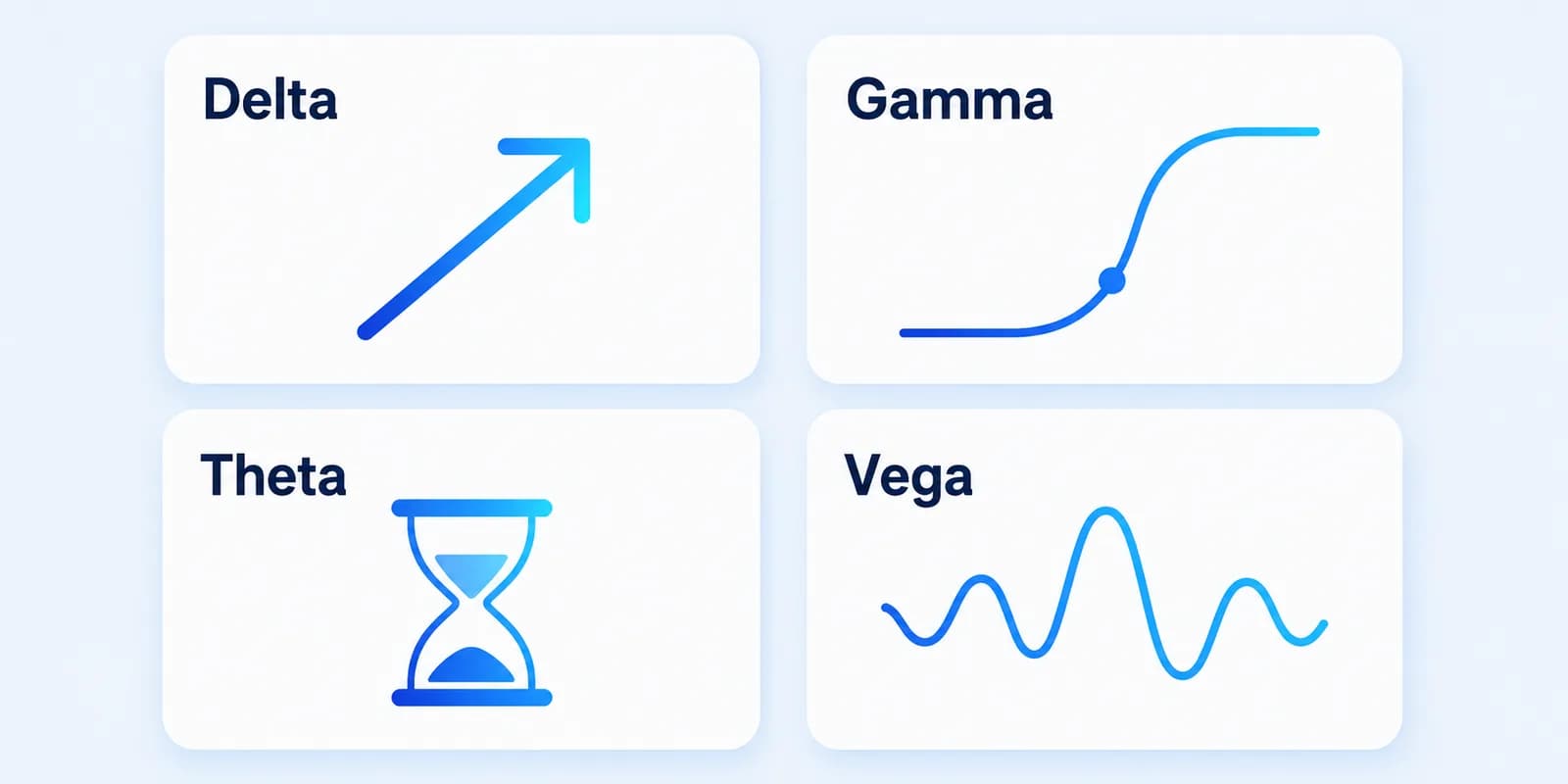
The five primary options greeks are delta, gamma, theta, vega and rho. Each captures a different sensitivity: delta the reaction to spot moves, gamma the change in delta, theta pure time passing, vega the reaction to implied volatility, rho the reaction to interest rates. Together they form a compact risk profile of any options position.
The greeks explorer computes all five greeks and the theoretical option price live from the Black-Scholes model. Change underlying price, strike, implied volatility, days to expiration and rate, switch between call and put: the values react instantly and make the sensitivities tangible.
Greeks explorer
Option price
3.04 USD
Delta
0.535
Gamma
0.0554
Theta (per day)
-0.054
Vega (per 1%)
0.114
Rho (per 1%)
0.041
Black-Scholes model without dividends, most accurate near the money. Theta per calendar day, vega and rho per 1 point, all values per share (contract = ×100). Model illustration, not a live quote and not investment advice.
| Greek | Symbol | Measures | Order |
|---|---|---|---|
| Delta | Δ | Change in underlying spot | First-Order |
| Gamma | Γ | Change in delta as spot moves | Second-Order |
| Theta | Θ | Time passing, time to expiry | First-Order |
| Vega | ν | Implied volatility (IV) | First-Order |
| Rho | ρ | Risk-free interest rate | First-Order |
The sign matrix below shows the typical greek signs for long and short positions and for common spread constellations. It is conceptual orientation, not a setup recommendation.
Note on the 100 multiplier: a US standard equity option covers 100 shares of the underlying. Greeks in the option chain are usually quoted per share. For position effect: greek value times contract count times 100. A delta of 0.30 on one contract equals a position sensitivity of 30 share-equivalents.
Black-Scholes 1973: where the greeks come from
Options greeks are a by-product of the Black-Scholes model, published in 1973 by Fischer Black and Myron Scholes in the Journal of Political Economy. Robert Merton developed key extensions in parallel. In 1997 Merton and Scholes received the Nobel Prize in Economics for the work; Fischer Black had passed away in 1995 and could not receive the prize.
The model provides a closed-form formula for the fair price of European options. Taking partial derivatives with respect to each input yields the greeks. That is why the term the greeks options is so common in English literature. The greeks hold exactly only under the model's assumptions (lognormal returns, constant volatility, continuous trading). In the real world they are a useful approximation, not a law.
Delta: spot sensitivity of an option
Delta measures how much the option price changes when the underlying moves by one unit. For calls delta sits between 0 and +1, for puts between 0 and −1. At the money (ATM) delta is near 0.50 for calls and near −0.50 for puts. Delta is often read as the rough probability that the option expires in the money, but that is a heuristic, not a precise number.
Delta on long positions: long call positive, long put negative. On short options the signs flip. At portfolio level net delta matters because it quantifies the overall directional bet.
Read more: delta glossaryGamma: the change in delta
Gamma measures how much delta changes when the underlying moves by one unit. Formally gamma is the second derivative of the option price with respect to spot. Long options (long call and long put) are gamma-positive; short options are gamma-negative. Gamma peaks near the money and tapers off the further the strike sits from spot.
Close to expiration gamma rises sharply near the strikes. That is where the well-known gamma risk for premium sellers comes from, because delta can jump on small spot moves. The detail page covers the mechanics.
Read more: gamma glossaryTheta: time decay
Theta measures how much option value is lost per day when all other parameters stay constant. Long options are theta-negative because their time value erodes each day. Short options are theta-positive and inch toward maximum gain over time. This is the economic foundation of every premium-selling strategy.
Time decay is not linear. It accelerates close to expiration, especially for at-the-money options. Practical implications, the interplay with gamma and concrete profit-target discussions live on the theta detail page.
Read more: theta glossaryVega: volatility sensitivity
Vega measures how much the option price changes when implied volatility (IV) rises by one volatility point. Long options are vega-positive, short options vega-negative. Vega is largest at the money and rises with time to expiration; close to expiry it falls toward zero. For premium-sellers vega matters twice over: an IV spike causes mark-to-market losses, an IV crush helps. Vega is not strictly a greek letter, the name became convention.
The vega detail page covers the ATM maximum, the profile across time to expiration, IV crush around earnings and the net vega of multi-leg structures with dedicated diagrams.
Read more: vega glossaryRho: interest-rate sensitivity
Rho measures how much the option price changes when the risk-free rate rises by one percentage point. Calls are rho-positive, puts rho-negative. For retail traders with mostly short-dated options (DTE, days to expiration, below 90) the effect is small and usually ignored in practice. On long-dated LEAPS spanning multiple years rho can become noticeable. During fast rate-cycle phases like 2022 to 2024, rho gets situational attention.
The rho detail page places rho across time to expiration, shows the LEAPS relevance in the 2024 to 2026 rate environment and works through a call and put rho example.
Read more: rho glossaryHigher-order greeks: vanna, volga, charm and speed
Beyond the standard set of five greeks (delta, theta, vega and rho as first-order, gamma as second-order) sit further second- and third-order greeks. They measure how the first-order greeks themselves change as conditions move. For retail traders they are usually secondary; for market makers and exotic books they matter more. The main names:
| Name | Measures | Order |
|---|---|---|
| Vanna | Change in delta when IV moves | Second-Order |
| Volga | Change in vega when IV moves | Second-Order |
| Charm | Change in delta as time passes | Second-Order |
| Speed | Change in gamma when spot moves | Third-Order |
Conceptual orientation. These higher-order greeks appear in English-language literature regularly under the umbrella third order greeks, even though strictly only speed is third-order in this list.
Which options greeks matter for premium sellers and buyers?
Which options greeks matter depends on whether options are sold or bought. Premium sellers focus on theta, vega and gamma. Option buyers look first at delta and vega. In both cases the portfolio-level net theta is worth tracking because it encodes the daily expected value compactly.
| Role | Greeks in focus | Typical setups |
|---|---|---|
| Premium seller | Theta (+), Vega (−), Gamma (−) | Iron Condor, Credit Spread, Bull Put, Bear Call |
| Buyer (long) | Delta (±), Vega (+), Theta (−) | Long call, long put, long straddle |
The table provides orientation. Which greek thresholds suit a given account depends on risk profile, experience and setup and must be decided individually.
Continuously tracking net greeks across a portfolio is manually heavy. A consistently automated rule set can wire greek thresholds straight into entry and exit filters. More in the automated trading pillar and on the OptionsApp features page.
Greeks inside the rule set: what works in practice
With premium-selling strategies on indices and liquid large caps, practice shows that single greek metrics only become meaningful at portfolio level. How greeks are used individually depends on the personal rulebook. Three observations tend to recur:
- Net theta as daily pulse. Portfolio net theta tends to be a more robust daily metric than any single trade outcome because it aggregates expected value compactly.
- Vega limit at account level. A vega cap per $1,000 net liquidation value (NLV) can help contain the effect of IV spikes.
- Gamma threshold near expiration. A rough gamma threshold close to expiry can trigger position reviews before risk builds up structurally.
These are general observations, not a rulebook proposal. Concrete thresholds belong in personal configuration as part of the setup process, not in glossary content.
Options greeks FAQ
What are the main options greeks?
The main options greeks are delta, gamma, theta, vega and rho. Delta, theta, vega and rho are first-order greeks (first derivatives of the option price); gamma is a second-order greek (second derivative with respect to spot) and counts as part of the standard set for its practical relevance. Delta represents spot sensitivity, gamma the change in delta, theta time decay, vega volatility sensitivity and rho interest-rate sensitivity.
How many options greeks are there?
The first-order greeks are delta, theta, vega and rho; gamma is added as a second-order greek. These five form the standard set for retail traders. Beyond them are higher-order greeks like vanna, volga, charm and speed, which mainly matter for market makers and in advanced models.
Which options greek is the most important?
Which greek matters most depends on the setup. For directional traders delta is central because it captures spot sensitivity. Premium sellers usually look at theta and vega first, since time decay and volatility drive expected value. Gamma becomes important close to expiration, rho is typically negligible for retail accounts.
Who invented the options greeks?
The options greeks come from the Black-Scholes model, published in 1973 by Fischer Black and Myron Scholes with contributions from Robert Merton. Merton and Scholes received the 1997 Nobel Prize in Economics for the work; Black had already passed away. The greeks themselves are partial derivatives of this model with respect to its input parameters.
What does theta-positive mean?
Theta-positive means a position benefits from pure time passing. Holding everything else equal it gains a small amount each day. Short options are theta-positive, long options theta-negative. Premium-selling strategies like iron condor, bull put spread and bear call spread are typically structured to be net theta-positive.
What is the difference between first-order and higher-order greeks?
First-order greeks (delta, theta, vega, rho) are first partial derivatives of the option price with respect to one input. Gamma is the second derivative with respect to spot and therefore a second-order greek. Higher-order greeks like vanna, volga and charm describe how first-order greeks themselves change and are mostly tools for market makers.
Are options greeks the same as greek letters in mathematics?
No. Options greeks use greek letters as symbols but are defined sensitivity measures from the Black-Scholes model used in options trading. Greek letters in mathematics, physics or statistics carry their own meaning there, such as sigma for standard deviation. The two worlds share the alphabet, not the definition.
How are options greeks used in practice?
Options greeks are mainly used for risk assessment and setup planning. Traders check before entry whether the greek signs match the market view, monitor net portfolio delta over the trade's lifetime and use theta and gamma profiles for decisions on early exit or position review. Specific threshold values belong in the personal rulebook.
Sources and further reading
- Black, F. and Scholes, M. (1973). The Pricing of Options and Corporate Liabilities. Journal of Political Economy, 81(3), 637-654.
- Nobel Prize 1997 Press Release. nobelprize.org
- OIC, Understanding Options Greeks. optionseducation.org
- Wikipedia, Greeks (finance). en.wikipedia.org
- Britannica Money, Option Greeks. britannica.com
- Hull, J. C. Options, Futures, and Other Derivatives. Pearson.
Risk disclaimer
Options are leveraged derivatives. Options greeks are Black-Scholes model outputs and hold approximately under normal market conditions. Examples and sign tables in this article are no investment advice and no promise of future gains. Capital, margin and tax situation should be checked individually before any trade.
Trade greek-based rules with OptionsApp
Define rule set, connect broker, execution runs. OptionsApp executes entry filters, profit target and position review based on configured values, including greek thresholds such as a net-delta limit. What gets triggered stays your call; so does monitoring your positions. Free 14-day trial, no payment details; the trial ends automatically.
More in the automated trading.