
Options strategies · Glossary
Credit Spread: Definition, Structure and Variants in Options Trading
Founder of OptionsApp, active in the markets for 20+ years.
A credit spread in options is a vertical two-leg strategy with the same expiration that collects net premium. In fixed income the same term means a yield premium measured in basis points. This page covers the options strategy and delineates the bond meaning at the end.
Credit spread at a glance
- Credit spread = vertical two-leg spread on the same expiration that collects net credit at entry.
- Two variants: bull put spread (bullish/neutral) and bear call spread (bearish/neutral).
- Max profit = net credit x 100. Max loss = (strike width − net credit) x 100.
- Theta-positive, vega-negative. Delta direction depends on variant.
- Two simultaneous credit spreads (bull put + bear call) form an Iron Condor.
- Not to be confused with the bond credit spread (yield premium in basis points).
Disambiguation: two meanings
Options strategy (this page)
Vertical two-leg spread, net credit at entry, defined risk.
Bond spread (covered briefly below)
Yield premium of a corporate bond over a government bond of same maturity, measured in basis points.
Legs
2
Short leg + long leg
Cash flow
Credit
Net premium to account
Risk
Defined
Loss capped
What is a credit spread?
A credit spread is an options strategy built from exactly two options on the same underlying with the same expiration. One option, the short leg, is sold. The second, the long leg, is bought in the same option type (put or call) further out of the money. The premium difference flows in as a net credit at entry. Both max profit and max loss are fixed and calculable at entry.
The probability of profit can be approximated from the short leg delta: delta is the model's rough ITM probability, so a short option at delta 16 expires worthless in roughly 84 percent of cases, a delta 30 short in about 70 percent. This is a model approximation, not a guaranteed hit rate (source: Investopedia). That is why many credit spread setups aim for a high hit rate with a small win per trade.
The credit spread sits inside the vertical-spread family. Vertical means: same option type, same underlying, same expiration, different strike. Common synonyms are vertical credit spread, put credit spread (the bullish-neutral variant) and call credit spread (the bearish-neutral variant). In German-speaking trading communities the term is often equated with premium-selling, because the short leg dominates.
Related glossary entries for context: the options-strategy glossary as overview, the Iron Condor as a combination of two credit spreads, and the theta entry on time decay.
Credit spread structure: short leg, long leg, net credit
A credit spread is built from three pieces: the short leg closer to spot, the long leg further out of the money (OTM), and the resulting net credit. Both legs share underlying, expiration (DTE, days to expiration) and option type. The distance between short and long strike is called wing width or strike width and defines the position's maximum risk.
The short leg carries most of the collected premium. It sits closer to spot and therefore commands a higher option price. The long leg works as insurance against extreme moves. It is cheaper, reduces the net credit and in return caps the potential loss. Without the long leg the trade would be a naked short: on the short call with theoretically unlimited risk, on the short put with a high but capped loss of strike times multiplier minus premium.
Contract multiplier on US equity options is 100. A premium quoted at $1.20 per share equals $120 per contract. SPX index options also use a 100 USD per index point multiplier. This convention underlies all formulas in the next section.
The two variants: bull put spread and bear call spread
A credit spread comes in exactly two variants: the bull put spread and the bear call spread. Choice depends on directional view. Bullish-neutral leads to a bull put spread with puts below spot, bearish-neutral to a bear call spread with calls above spot. Both collect net credit, both have defined risk.
Variant 1
Bull Put Spread
Sell a put closer to spot, buy a put further below, both below spot. Outlook: bullish or sideways. Profit if the underlying ends above the short put strike. Also called put credit spread.
Read more: Bull put spreadVariant 2
Bear Call Spread
Sell a call closer to spot, buy a call further above, both above spot. Outlook: bearish or sideways. Profit if the underlying ends below the short call strike. Also called call credit spread.
Read more: Bear call spread| Attribute | Bull Put Spread | Bear Call Spread |
|---|---|---|
| Outlook | Bullish or neutral | Bearish or neutral |
| Position | Short put + long put (lower strike) | Short call + long call (higher strike) |
| Strikes vs. spot | Both below spot | Both above spot |
| Break-even formula | Short put − net credit | Short call + net credit |
| Delta | + | − |
The table provides conceptual orientation. Concrete strike examples, capital calculations and adjustment playbooks live in the detail glossary of each variant.
When a bull put spread and a bear call spread are opened simultaneously on the same underlying and expiration, the result is an Iron Condor. Formally the Iron Condor is the sum of two credit spreads, a key building block for understanding many premium-selling strategies.
Calculating max profit, max loss and break-even
Max profit, max loss and break-even of a credit spread are derived directly from net credit and strike width. All three are fixed at entry. This pre-trade calculability is the key advantage over unlimited premium-selling strategies and makes the credit spread a defined-risk position.
Max profit
Netto-Credit x 100
Both options expire worthless.
Max loss
(Strike-Diff. − Credit) x 100
Spot fully past both strikes.
Break-Even
Short strike ± credit
− for bull put, + for bear call.
Conceptual mini-example without a concrete ticker: a bull put spread with a 5-point strike width and a $1.20 net credit per share yields a max profit of $120 per contract. Max loss equals (5 − 1.20) x 100 = $380 per contract. Break-even sits $1.20 below the short put strike. Concrete strike choices for real underlyings live in the detail glossary of each variant.
Reg-T margin equals max loss: strike width minus net credit, times 100. A common rule of thumb in practice is the credit-to-width ratio: if credit is less than one-third of the strike width, the risk-reward looks unattractive to many experienced traders. On a 5-point strike width that means a credit below $1.67 per share counts as borderline. Which threshold suits a personal rulebook remains an individual trader decision.
The calculator below turns both formulas into a live tool. Pick a variant (bull put or bear call), enter the strikes and net credit: max profit, max loss, break-even and risk/reward update instantly, along with the payoff diagram at expiration.
Credit spread calculator
Max profit
+120 USD
Max loss
−380 USD
Break-even
98.80
Risk/reward
1 : 3.17
P&L at expiration, excluding fees and the path during the trade. A pure illustration of the defined structure, not a signal and not investment advice.
Credit spread Greeks: theta, vega, delta
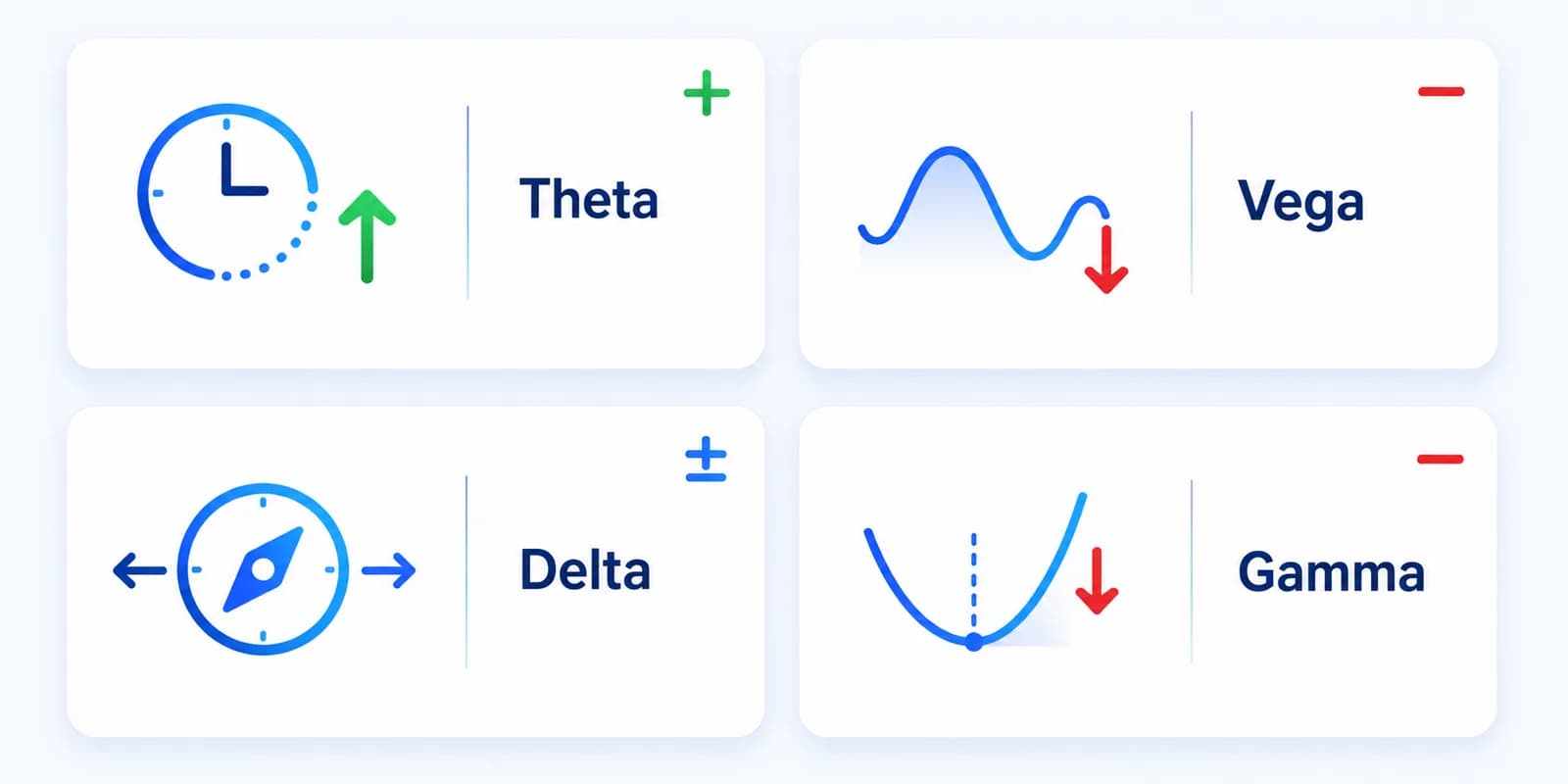
Credit spread Greeks follow clear signs: theta-positive, vega-negative, gamma-negative. Delta depends on the variant. These signs result from the short leg dominating the long leg and hold approximately under normal conditions. Near expiry or in extreme moves effects can amplify or flip.
| Greek | Sign | Meaning |
|---|---|---|
| Theta | + | Time decay works in favor of the position. |
| Vega | − | Falling implied volatility (IV) helps, rising hurts. |
| Delta | ± | Bull put spread: positive. Bear call spread: negative. |
| Gamma | − | Delta sensitivity near short strike rises as DTE shrinks. |
Theta-positive means: holding everything else equal, the position gains a small amount each day, ultimately realizing the full net credit at expiry. Vega-negative means an IV crush after earnings or fading market stress helps, while an IV spike causes mark-to-market losses even on a flat underlying. More context in the theta glossary entry.
When does a credit spread make sense?
A credit spread fits whenever a directional or range-bound view meets a need for defined risk. The trader expects the underlying to end on a specific side of the short strike. The combination of premium-selling logic, capped loss and manageable margin explains the strategy's popularity.

Three market conditions favor credit spreads in practice:
- Elevated implied volatility. Higher IV means richer premium; the net credit grows without risk necessarily rising in lockstep.
- Liquid underlyings. Tight option-chain spreads matter, otherwise slippage erodes the credit.
- Clear directional or range expectation. A bullish, bearish or well-grounded sideways view, ideally anchored by technical or fundamental cues.
Concrete thresholds like an IV rank above 30 or short options at delta 16 and 45 DTE are popular discussion values, not natural laws. They originate from tastylive backtests and community practice and belong in the personal rulebook, not in the general strategy definition. Anyone opening a credit spread should plan profit target, position review and rolls before entry.
And for whom NOT: A pronounced trend trader betting on large directional moves fits poorly with the capped profit of a credit spread; a debit spread or long option is usually more suitable here. Anyone who cannot monitor the option chain daily carries elevated slippage risk on illiquid underlyings. And in a low-IV environment with IV rank below 20 the net credit is often so small that risk-reward no longer justifies the defined max loss.
Credit spread pros and cons at a glance
Like every options strategy, the credit spread has clear strengths and weaknesses. Strengths sit in defined risk and premium-selling logic. Weaknesses sit in capped profit per trade and the short strike's proximity to spot.
Pros
- Defined risk: max loss known at entry.
- Theta-positive, benefits from time decay.
- Lower capital requirement than naked premium-selling.
- High statistical hit rate possible on OTM setups.
- Compatible with Reg-T accounts, no portfolio margin needed.
Cons
- Capped profit, unfavorable risk-reward on a single trade.
- Vega-negative: an IV spike causes mark-to-market losses.
- Gamma risk near the short strike close to expiry.
- Slippage and fees disproportionately erode the credit.
- Manual execution tends to produce errors and breaks rule-set consistency.
Several of these weaknesses are not strategy problems but consequences of manual execution. A consistently automated rule set can rule out these errors systematically. More in the automated trading pillar and on the OptionsApp features page.
Credit spread vs. debit spread: the direct comparison
Credit spread and debit spread are the two vertical-spread families. The credit spread collects net premium, the debit spread pays it. Greeks signs mirror each other. Both have defined risk, the difference is the cash flow at entry and the directional view behind the trade.
| Attribute | Credit Spread | Debit Spread |
|---|---|---|
| Cash flow at entry | Cash in | Cash out |
| Outlook | Sideways or away from short | Directional move toward long |
| IV tendency | Benefits from high or falling IV | Benefits from low or rising IV |
| Theta | + | − |
| Vega | − | + |
| Risk-reward | Higher hit rate, smaller win | Lower hit rate, larger win |
The table is for orientation. Which variant fits a given account depends on individual risk profile, experience and goals and must be decided individually.
Tax treatment of credit spreads in Germany
Important note: Tax matters are always individual and depend on the personal situation of the taxpayer. The following is not tax advice. Before any relevant trading decision, individual clarification with a qualified tax advisor is strongly recommended.
In Germany credit spread gains are typically treated as derivative income under § 20 Abs. 2 Nr. 3 EStG and taxed at 25 percent Abgeltungsteuer plus solidarity surcharge (5.5 percent of the tax) and church tax if applicable. Income flows in the year of close or expiration.
Losses enter the dedicated derivatives loss bucket under § 20 Abs. 6 Satz 5 EStG. The previously discussed annual 20,000 EUR offset cap for derivatives no longer applies since the Jahressteuergesetz 2024 (retroactive to 2020); derivative losses can now be offset without limit against derivative gains. Foreign brokers do not withhold German tax, declaration runs through Anlage KAP of the income tax return.
This overview describes general conditions. It is neither tax advice nor a recommendation regarding a specific structure. Individual treatment may differ and should be discussed with a qualified tax advisor.
Delineation: credit spread on bonds
The term credit spread also exists in the bond world with a completely different meaning. There it is the yield premium of a corporate bond over a risk-free government bond of the same maturity, measured in basis points (100 bps = 1 percentage point). A widening credit spread signals rising credit-risk premiums and therefore higher perceived default risk. More detail on Wikipedia (en.wikipedia.org/wiki/Credit_spread_(bond)). This meaning is out of scope for the current page, which focuses on the options strategy.
From practice: credit spreads in an automated workflow
Many options traders use credit spreads for years on indices and liquid large caps. In practice three recurring operational error sources tend to come up, none of them strategy-related:
- Missed early exit. Holding out for the full credit often lets the spread run longer than planned, so risk can grow disproportionately.
- Inconsistent pre-expiration review. If the review near expiry is handled unevenly, gamma risk can grow quietly.
- Sizing drift. Once several spreads run in parallel, position size can slip toward higher capital tied up per trade.
An automated workflow can reduce these error sources structurally. Profit target and position review run on stored rule values without a screen-side emotional decision. That is not a return promise, it is a reduction of operational error sources. Which thresholds suit the personal rulebook is part of the configuration step, not of glossary content.
When does a credit spread fail?
Three market constellations regularly break credit spreads, regardless of bull put or bear call variant.
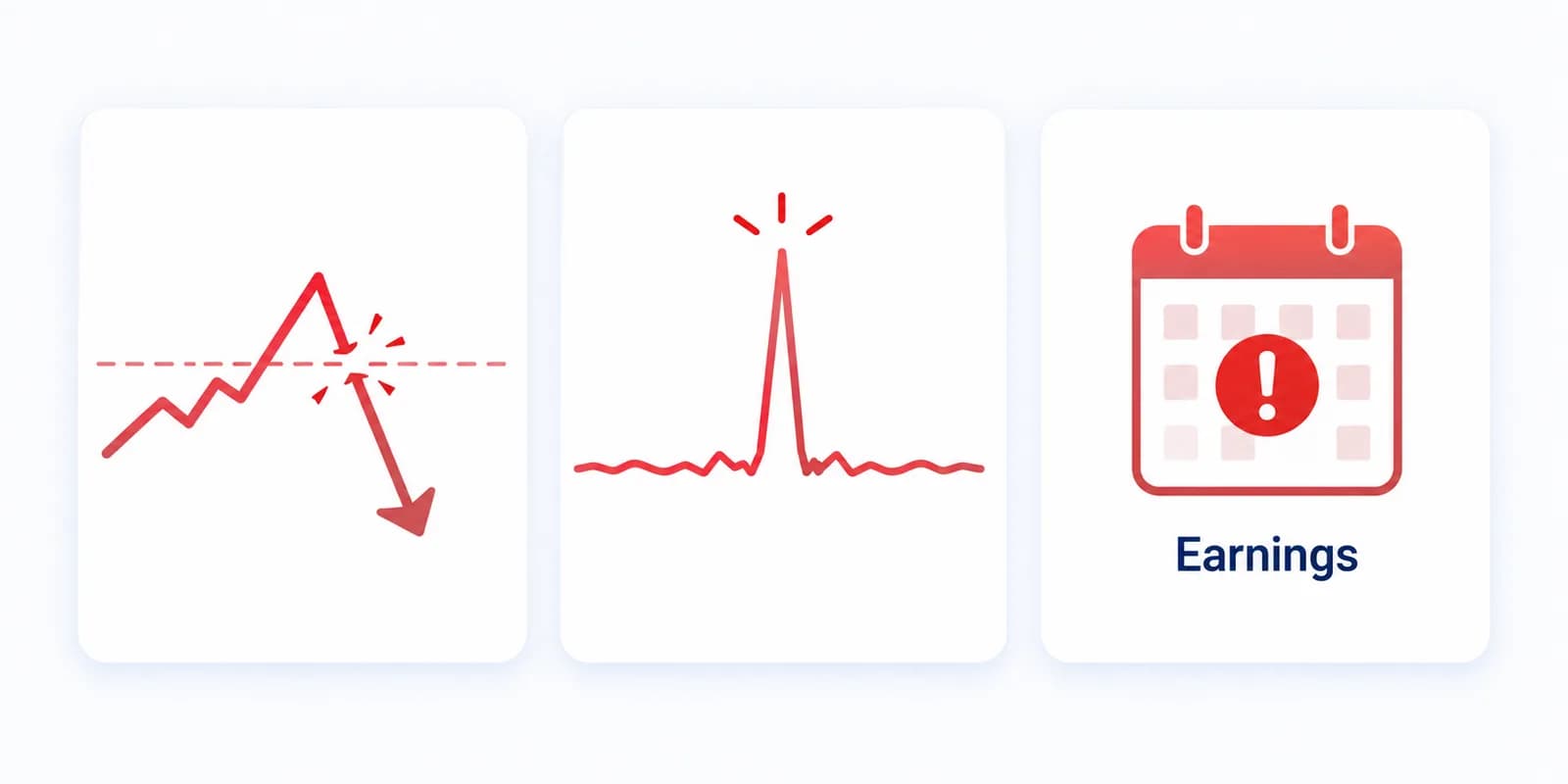
1. Trend break through the short strike
When the underlying breaks through the short strike, negative delta dominates and positive theta is neutralised. Commonly discussed reaction: roll to a new expiration only with intact trend, otherwise close. Whether that fits your rulebook is your call.
2. Volatility spike collapses risk-reward
A VIX jump from 15 to 25 or higher within days blows up vega on both short options regardless of underlying moves. Possible filter rule: with VIX jump over 5 points per day, reduce position sizing or actively close existing positions.
3. Earnings or macro surprise inside the duration
Earnings pops or macro surprises inside the duration shift the underlying distribution materially. Possible filter rule: no credit spreads on single stocks in the earnings window, index credit spreads with macro events in the next 5 days only as deliberate vega-crush play with reduced size.
Credit spread FAQ
What is a credit spread in simple terms?
A credit spread is an options strategy built from two options on the same underlying with the same expiration. One option is sold, a second further out of the money is bought. The premium difference flows to the account as a net credit at entry. Both risk and reward are fixed at entry.
What is the difference between credit spread and debit spread?
A credit spread collects net premium, a debit spread pays net premium. Credit spreads are theta-positive and vega-negative, debit spreads are the opposite. Both families are vertical spreads with defined risk.
How do you calculate the maximum profit of a credit spread?
Max profit equals net credit per share times the contract multiplier (typically 100). Formula: max profit = net credit x 100. Achieved when both options expire worthless and the underlying ends on the right side of the short strike.
When do you use a credit spread?
A credit spread fits a directional or range-bound view paired with a need for defined risk. A bullish-neutral view leads to a bull put spread, a bearish-neutral view to a bear call spread. Elevated implied volatility tends to improve premium intake.
What is the risk on a credit spread?
Max loss equals strike width minus net credit times 100. It triggers if the underlying expires fully past both strikes. The loss is always capped, unlike on naked short positions. That cap is exactly what makes the credit spread the defined-risk variant.
What are bull put spread and bear call spread?
Bull put spread and bear call spread are the two credit spread variants. The bull put spread uses two puts below spot, the bear call spread two calls above spot. Both collect net credit. Concrete strike examples live on the dedicated detail glossary entries.
What is a vertical credit spread?
Vertical credit spread is the formally precise name. Vertical means both legs share option type, underlying and expiration but differ in strike. The term distinguishes the trade from time-spread or calendar-spread families with different expirations.
Which Greeks does a credit spread have?
A credit spread is net theta-positive, vega-negative and gamma-negative. Delta is direction-dependent: positive for a bull put spread, negative for a bear call spread. These signs follow from the short leg dominating the long leg and hold under normal conditions.
How are credit spreads taxed in Germany?
Gains are typically treated as derivative income under § 20 Abs. 2 Nr. 3 EStG and taxed at 25 percent Abgeltungsteuer plus solidarity surcharge and church tax if applicable. Losses enter the dedicated derivatives loss bucket under § 20 Abs. 6 EStG. Individual situation should be checked with a qualified tax advisor.
Is an options credit spread the same as a bond credit spread?
No. In options, credit spread means a two-leg strategy with net premium. In fixed income, credit spread refers to the yield premium of a corporate bond over a government bond of the same maturity, measured in basis points. Same word, completely different meaning.
Sources
- Fidelity, Credit Spread Strategies. fidelity.com
- Investopedia, Credit Spread (Options). investopedia.com
- Wikipedia, Credit spread (options). en.wikipedia.org
- Gabler Banklexikon, Credit Spread (Anleihen-Kontext).
- Jahressteuergesetz 2024, Abschaffung der Verlustverrechnungsbeschränkung für Termingeschäfte (rückwirkend ab 2020), § 20 Abs. 6 EStG.
Risk disclaimer
Options are leveraged derivatives. A credit spread can produce a loss equal to strike width minus net credit. Examples and rules of thumb in this article are no promise of future gains and not investment advice. Capital, margin and tax situation should be checked individually before any trade.
Trade credit spreads automatically with OptionsApp
Set up a rule set, connect a broker, the workflow runs: OptionsApp opens the spread via entry conditions, closes it at the stored profit target (for example 50 percent of the credit) and acts on the configured stop loss. Which delta, DTE and profit target values go into the rule set stays your decision. Free 14-day trial.
More in the automated trading.