
Options strategies · Glossary
Bull Put Spread: Definition, Structure, Example and Strategy
Founder of OptionsApp, active in the markets for 20+ years.
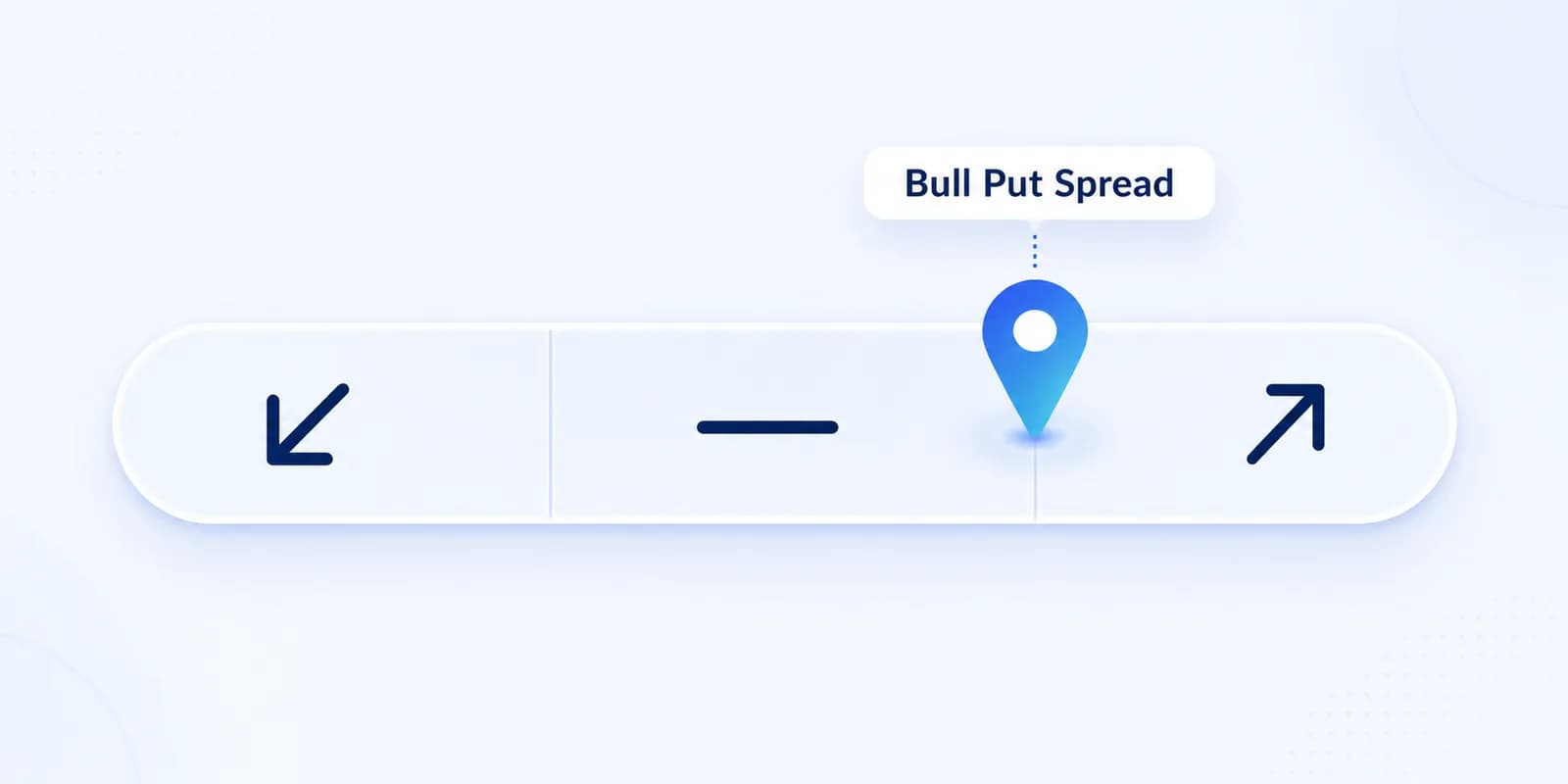
The Bull Put Spread is a bullish two-leg options strategy. You sell a put closer to spot and buy a further-out put as protection, same expiration. The trade collects a net credit. It reaches maximum profit above the short put strike and stays profitable down to the break-even (short strike minus net credit). Max profit and max loss are both fixed at entry.
Synonyms: Bull Put Spread, Bull Put Credit Spread, Put Credit Spread and Short Put Vertical refer to the same trade. The terms originate in different trader communities (Fidelity, tastytrade, OIC) but describe identical two-leg constructions. This page uses Bull Put Spread throughout.
Bull Put Spread at a glance
- Bull Put Spread = sell put at higher strike + buy put at lower strike, same expiration, net credit collected.
- Bullish-to-neutral outlook. Both puts are usually OTM (Out of the Money); ITM (In the Money) variants are a special case.
- Max profit = net credit x 100. Max loss = (wing width − credit) x 100. Risk defined at entry.
- Usually theta-positive, vega-negative and mildly delta-positive when both puts are OTM. Earns from time decay and flat-to-rising prices.
- Combined with a Bear Call Spread in the same expiration it forms an Iron Condor.
- Capital scales with wing width and underlying. See the SPY worked example below.
Legs
2
1 short put + 1 long put, usually both OTM
Outlook
Bullish
Bullish or sideways above short strike
Risk
Defined
Capped profit, capped loss
What is a Bull Put Spread?
A Bull Put Spread is a bullish two-put options strategy on the same underlying with identical expiration. The higher-strike put is sold, the lower-strike put bought. A net credit lands at entry. The trade reaches maximum profit above the short strike and stays profitable down to the break-even (short strike minus net credit). Risk caps at wing width minus credit.
It is the bullish spoke of the credit spread family (the bearish counterpart is the Bear Call Spread). A separate bullish debit-spread variant using calls is the Bull Call Spread, which does not belong to the credit-spread family. Systematic premium sellers favor the Bull Put Spread because it earns theta, keeps margin manageable, and risk is known at entry. English literature uses Bull Put Credit Spread, Put Credit Spread and Short Put Vertical interchangeably for the same construction.
The Bull Put Spread is typically traded on liquid stocks (Apple, Microsoft, Tesla), ETFs (SPY, IWM, QQQ) and indices (SPX, RUT). For European retail the stock or ETF variant is the natural starting point because the contract size is smaller; SPX shows up mainly in the pro space due to cash settlement and absence of assignment risk. Per CBOE data, US exchanges cleared roughly 1.2 billion option contracts per month in 2023, a large share of them in vertical spreads such as the Bull Put Spread (source: CBOE Options Education).
Bull Put Spread structure and legs
The Bull Put Spread has 2 legs on the same underlying with the same expiration. Both legs are puts; they differ in direction (long or short) and strike. The build is always the same: sell put at the higher strike, buy put at the lower strike.
- Short put: higher strike, closer to spot, generates the bulk of the premium.
- Long put: lower strike, further from spot, acts as insurance against a sharp drop.
- Both legs share the same expiration and underlying.
- The strike difference is the wing width. It defines max loss.
| Metric | Example value (SPY 500) |
|---|---|
| Outlook | bullish or sideways |
| Risk profile | defined risk |
| Cashflow | credit (cash inflow) |
| Max profit (formula) | Netto-Credit x 100 |
| Max loss (formula) | (Spreadweite − Credit) x 100 |
| Break-Even | short strike − credit |
| DTE range discussed (Days to Expiration) | frequently 30 to 45 days |
| Short delta range | commonly 0.16 to 0.30 |
| IV rank discussion | values above 30 are commonly discussed |
The table is for orientation. The specific DTE, delta and IV rank values that fit a personal setup depend on individual risk profile, experience and goals and belong in the personal rulebook. These are discussion values from the premium-selling community, not natural laws.
Maximum profit, maximum loss and break-even
For a Bull Put Spread, max profit, max loss and break-even are fully known at entry. That clarity is one of the main reasons the strategy is attractive from a risk-management angle. All three values derive from the net credit, wing width and short strike.
- Max profit
- Netto-Credit · 100
- Max loss
- (Spreadweite − Netto-Credit) · 100
- Break-Even
- Short-Strike − Netto-Credit
For the SPY 490/485 example with 1.50 USD credit: max profit 150 USD, max loss 350 USD, break-even 488.50. Risk/reward sits at about 1 to 2.33. The 0.16 short-put delta serves as a rough, risk-neutral POP approximation around 84 percent; whether expectancy is positive depends additionally on the actual distribution (skew, costs, slippage) and does not follow from delta alone.
Important: a 1:2.33 ratio is only the static entry math. Active management changes the picture. An early profit target or early exit reduces average loss and smooths the equity curve. Which threshold fits a personal setup belongs in the individual rulebook.
Bull put spread calculator
Max profit
+150 USD
Max loss
−350 USD
Break-even
488.50
Risk/reward
1 : 2.33
P&L at expiration, excluding fees and the path during the trade. A pure illustration of the defined structure, not a signal and not investment advice.
Bull Put Spread example with real numbers (SPY, 35 DTE)
The following example shows a typical Bull Put Spread on SPY. SPY trades at 500 USD, IV rank 38, 35 days to expiration. A 0.16-delta put at strike 490 is sold and a long put at strike 485 is bought. The multiplier for stock and ETF options is 100.
| Metric | Value |
|---|---|
| Underlying | SPY @ 500 USD |
| IV-Rank | 38 |
| DTE | 35 |
| Short Put 490 | +3,00 USD je Kontrakt |
| Long Put 485 | −1,50 USD je Kontrakt |
| Net credit | 1,50 USD x 100 = 150 USD |
| Wing width | 5 USD |
| Max profit | 150 USD |
| Max loss | 350 USD |
| Break-Even | 488,50 USD |
| Buying power Reg-T | 350 USD |
| POP (≈ 1 − Short-Delta) | ~ 84 % |
Over the next 18 trading days SPY drifts up to 504. The spread builds about 75 USD of mark-to-market profit through theta and is bought back via a GTC order. In this winning scenario, where the underlying actually stays above the short strike, that equals roughly 21 percent return on the tied-up capital. Such values are only possible in this specific positive case; they are not an expectancy statement and not a forecast for future trades.
Illustrative example derived from past trades. No guarantee of future results.
On cash-settled index options (SPX, XSP) the same setup runs at larger scale, for example 25-point wings on SPX at 5,000. Cash settlement removes the assignment risk. Which variant fits a given account is an individual question.
Bull Put Spread Greeks: delta, theta, vega, gamma
The Bull Put Spread is usually theta-positive, vega-negative, delta-positive and gamma-negative, provided both puts are OTM. This combination of option Greeks means: profit from time decay, loss on volatility expansion, mild long delta exposure to the underlying, risk from fast moves toward the short strike. The table shows per-leg contributions.
| Leg | Delta | Gamma | Theta | Vega |
|---|---|---|---|---|
| Short Put 490 | + | − | + | − |
| Long Put 485 | − | + | − | + |
| Net | + (leicht long) | − | + | − |
Net positive theta comes from the short put sitting closer to the money, losing more time value per day than the long put. Negative vega arises from the same asymmetry. Both effects accelerate near expiration: theta grows, vega magnitude flattens. This time dynamic is why systematic premium sellers like the Bull Put Spread, provided the underlying stays above the short strike.
When does a Bull Put Spread make sense?
A Bull Put Spread fits when three conditions line up: a bullish-to-neutral outlook, elevated implied volatility for attractive premium and enough time to expiration for the theta path. Discussion values from the premium-selling community sit at IV rank above 30 and DTE between 30 and 45 days; these are no natural laws.
IV rank quantifies where current IV (implied volatility) sits in the 52-week range. At IV rank 0 it is at the yearly low, at 100 at the high. Lower IV rank means thin premium, higher IV rank brings richer credits but also more volatility risk. Where the personal sweet spot sits is a rulebook question.
The strategy struggles in clearly bearish trends, immediately before earnings (unless trading a deliberate IV crush play) and around FOMC, CPI or NFP within the expiry. Important: the strategy carries a bullish bias. Anyone expecting a crash is structurally on the wrong side here.
Win rate and Probability of Profit (POP)
POP (Probability of Profit) of a Bull Put Spread follows approximately from the short put delta. In the Black-Scholes model delta is roughly the probability that the option finishes ITM (in the money). A 0.16-delta short put thus has about 16 percent ITM probability, which means the spread sits at about 84 percent POP.
| Short put delta | POP | Relative credit | Character |
|---|---|---|---|
| 0,10 Δ | ~ 90 % | low | far OTM, defensive |
| 0,16 Δ | ~ 84 % | balanced | frequently discussed range |
| 0,20 Δ | ~ 80 % | higher | closer to money, more premium |
| 0,30 Δ | ~ 70 % | high | aggressive, many tests |
The raw expectancy is: POP x max profit − (1 − POP) x max loss. At 0.16 delta and the SPY example above (150 vs 350 USD) that calculates to 0.84 x 150 − 0.16 x 350 = 126 − 56 = 70 USD positive expectancy per trade before management. Active management (early exit, profit target) can lift or lower this in backtests. Which concrete thresholds (profit target, DTE trigger, stop loss) fit a personal setup belongs in the individual rulebook and should be tested individually.¹
Pros and cons of the Bull Put Spread
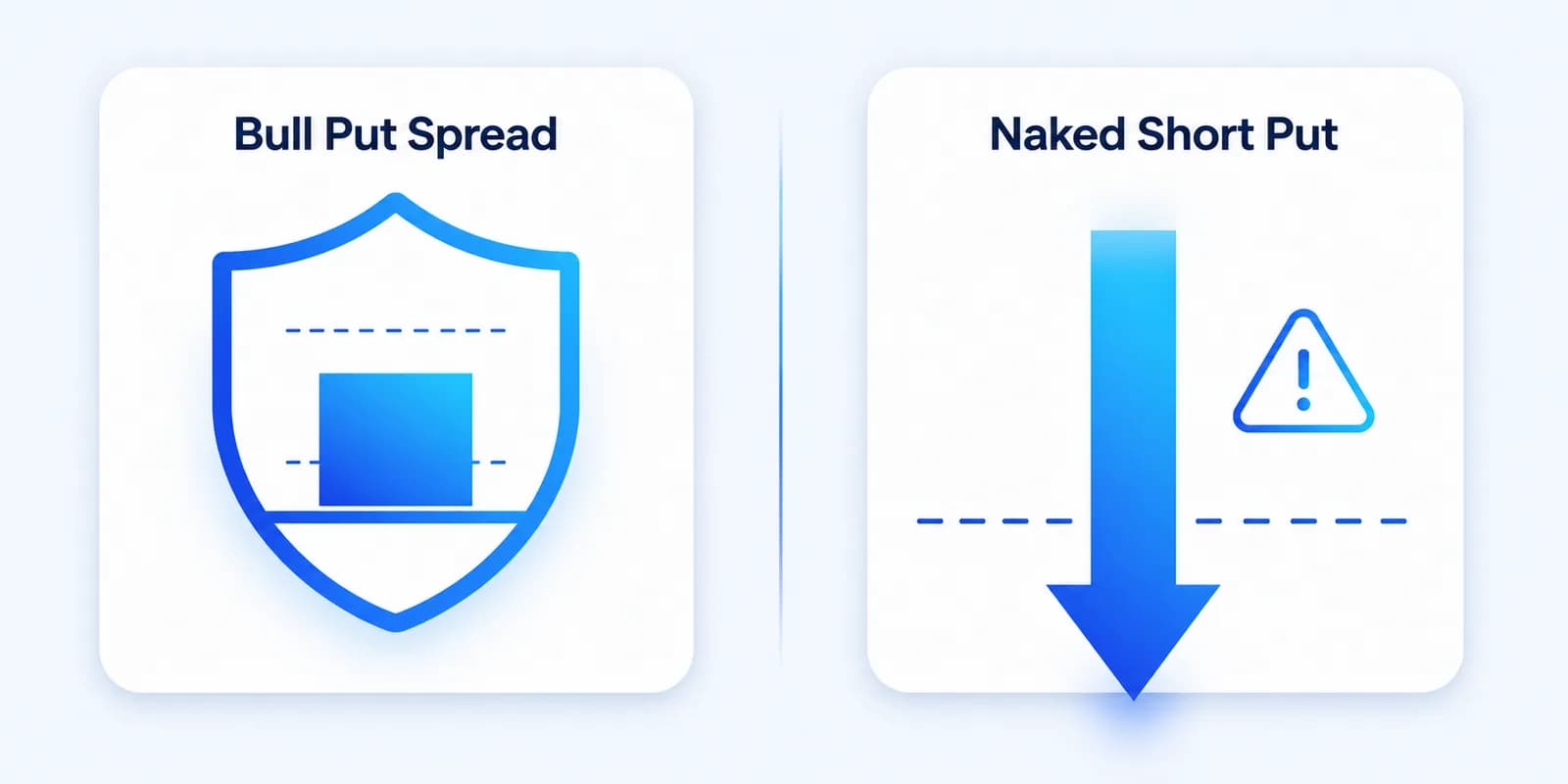
Like any options strategy the Bull Put Spread has clear strengths and clear weaknesses. The summary below states them without selling the strategy as a recommendation. Defined risk, theta income and simple execution are the main pros. Skewed risk/reward, vega drag and assignment risk are the main cons.
Pros
- Defined max loss at entry
- High POP on OTM setup (0.10 to 0.20 delta)
- Far lower margin than a cash-secured short put
- Usually theta-positive in OTM setups, earns in sideways markets
- Clear rule set, easy to automate
Cons
- Skewed single-trade RRR (often 1:2 to 1:4)
- Vega-negative: loses on vol spike
- Gamma risk near expiration when spot tests the short strike
- Assignment risk on stock options around dividends
- Manual execution typically introduces errors and breaks the rule-based consistency
Implementation note: Several of the cons above (missed profit target, forgotten position review, emotional adjustments under pressure, two-leg slippage) are not strategy weaknesses but consequences of manual execution. With a fixed rulebook the operational part can be executed via automation, restoring consistency and making typical discipline errors far less frequent; slippage and fees arise on the market side and remain. More in the feature overview.
6 common Bull Put Spread mistakes
Common mistakes on the Bull Put Spread are not strategic but operational: strikes too close, expiration too short, ignored earnings date, poor sizing, market order on two legs, blocked management. The table below lists six common ones with consequence and commonly discussed alternative. The values shown are orientation points, not a recommendation; which parameters go into your trade template is your call.
| Mistake | Consequence | Commonly discussed alternative |
|---|---|---|
| Short strike too close (above 0.30 delta) | Low POP, frequent tests | Pick a more conservative delta target |
| Bull Put Spread at low IV rank | Thin premium, weak RRR | Apply an IV rank filter |
| Earnings inside the expiry ignored | Gap risk on earnings, IV crush no help | Check earnings calendar, pick expiry before it |
| Expiry too short (0DTE without experience) | High gamma, weak adjustment options | Pick longer DTE until the rulebook is solid |
| Market order on a 2-leg trade | Slippage 0.05 to 0.20 USD | Always limit at mid |
| Sizing by gut feel | Concentration risk, drawdown spikes | Set a percentage cap of net liquidation value per trade |
Adjusting and rolling the Bull Put Spread
When a Bull Put Spread comes under pressure several maneuvers are used in practice. The list below shows four common options as orientation. Which one fits a given setup depends on the individual rulebook, risk budget and experience level. None of this is a recommendation; it describes typical patterns and how a rulebook might look.
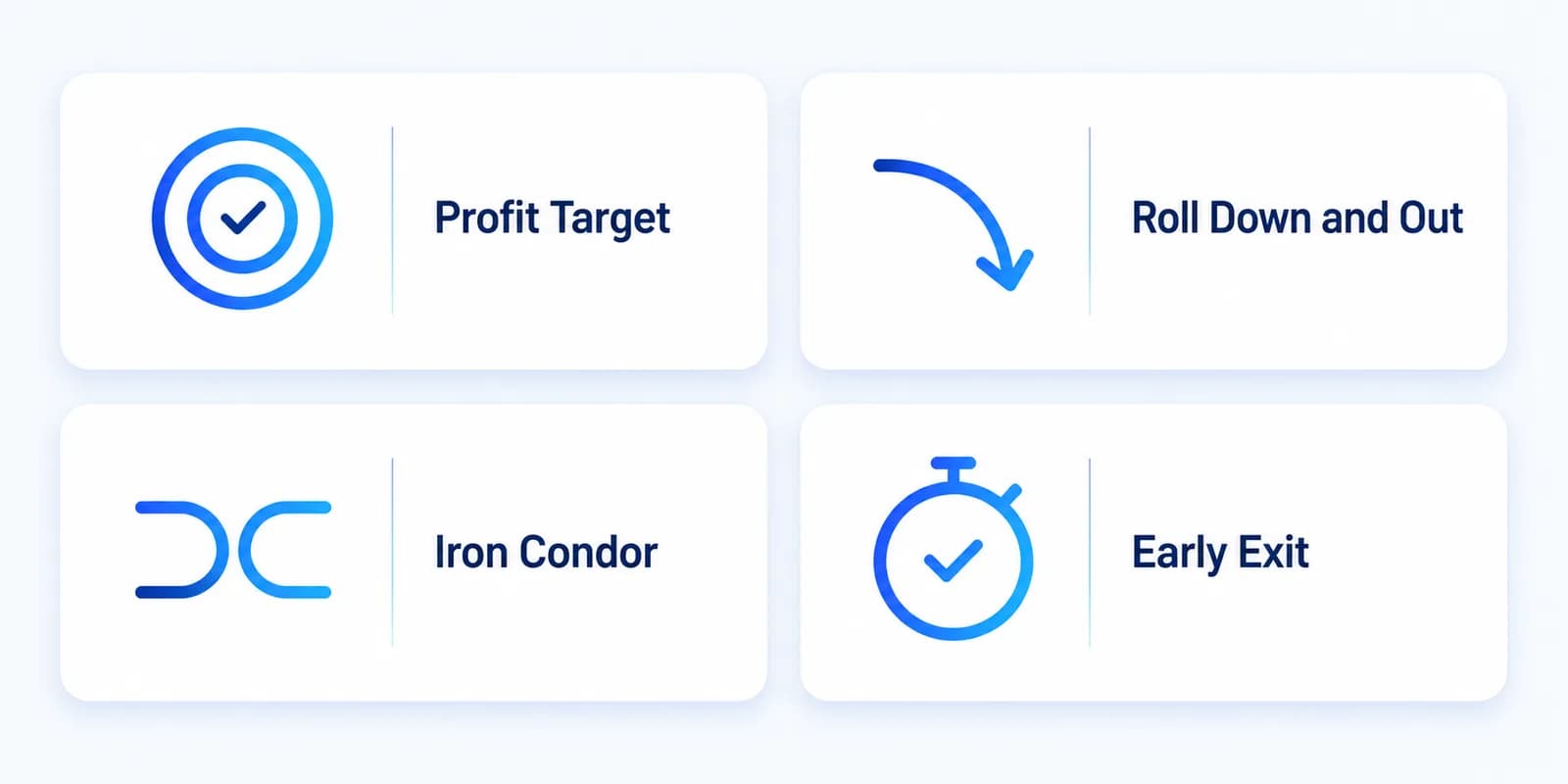
- 1Profit target exit
A common pattern: once the spread reaches an early profit target (around 50 percent of max profit is frequently discussed), it can be closed via GTC. In the SPY example above this would be at 75 USD mark-to-market profit. Publicly available tastylive backtests show this management reduces average loss.
- 2Roll down and out
If the short strike is tested, one option is to roll both puts to a later expiration and lower strikes. Frequently 30 to 45 days further out at lower strikes. The goal can be additional credit that shifts the break-even. Rolling within the same expiration rarely works because credit is lacking.
- 3Convert to an Iron Condor
After a sharp move up, one option is to add a Bear Call Spread above current spot. The trade becomes an Iron Condor. The added credit reduces net risk but introduces a second possible loss side. The thesis shifts from bullish to neutral.
- 4Early exit
As remaining duration shrinks gamma risk rises, especially when the underlying tests the short strike. At a defined trigger point the position is typically re-evaluated: close, roll or hold deliberately. In practice traders use triggers between roughly 14 and 28 DTE; 21 DTE is a frequently discussed value. Which value fits a personal setup belongs in the rulebook.
Experienced credit-spread traders consistently see that combining an early profit target with a clear pre-expiration review trigger (moves 1 and 4) produces much steadier equity curves than ad-hoc decisions. The reason is plain: a predefined rulebook removes the emotional layer.
Automate the Bull Put Spread with OptionsApp
OptionsApp encodes profit target, early-exit trigger, roll and conversion logic as an individually configurable rule set. Once configured, the workflow runs without manual order entry; monitoring and adjustment decisions remain with the trader. Bull Put Spreads become a scalable, disciplined process.
See the featuresAssignment risk and exercise
On American stock and ETF options the short put can be exercised any time before expiration. In practice this mainly happens in two cases: just before a dividend when the put is deeply ITM, and on expiration evening when spot pins close to the short strike. The long put structurally caps the assignment damage; loss stays bounded by wing width minus credit.
Operationally: if the short put is assigned, 100 shares per contract land in the account. The long put remains as insurance and can either be exercised (flattening the shares at the long strike) or sold in the market. Trading cash-settled index options (SPX, XSP) avoids the entire topic structurally: no assignment, everything settles in cash.
Pin risk at expiration is the second trap. If the underlying lands exactly between strikes it is unclear whether the short put is assigned. A common pattern is to close both legs before the last trading day rather than letting pin risk run.
Bull Put Spread vs. Bear Call Spread, Iron Condor, Cash-Secured Put and Bull Call Debit Spread
The Bull Put Spread sits in a family of related strategies. The table below stacks five common building blocks side by side, with outlook, cashflow character, risk profile, margin character and typical use. It helps reveal structural differences without painting any strategy as objectively better.
| Criterion | Bull Put Spread | Bear Call Spread | Iron Condor | Cash-Secured Put | Bull Call Debit |
|---|---|---|---|---|---|
| Outlook | bullish / sideways | bearish / sideways | neutral | bullish | strongly bullish |
| Cashflow | Credit | Credit | Credit | Credit | Debit |
| Risk | defined | defined | defined | high (strike x 100) | defined (debit) |
| Margin/capital | low | low | medium | very high | low |
| POP (16 Δ Short) | ~ 84 % | ~ 84 % | ~ 72 % | ~ 84 % | materially lower |
| Typical use | bullish premium-selling | bearish premium-selling | neutral premium-selling | wheel strategy, share entry | directional long bet |
The table serves orientation. Which variant fits a given account depends on individual risk profile, experience and goals and must be decided per trader. Important: a defined-risk strategy like the Bull Put Spread is not a direct substitution for a strategy with theoretically unlimited risk like a cash-secured short put or a naked short put. The risk profiles differ structurally.
Lessons from practice
In systematic credit-spread practice three points tend to surface again and again. How to handle them individually depends on the personal rulebook.
- Profit target defined up front. A mechanically set threshold has the advantage that the exit decision happens before stress, not under it. Waiting for the full 100 percent of max profit usually means walking through the more dangerous last third of the duration.
- Sizing as the central lever. A percentage cap of net liquidation value per trade keeps maximum drawdown in a manageable range. Which percentage fits depends on the personal risk profile.
- Operational hygiene. Limit orders at mid instead of market orders on two legs, earnings calendar checked before entry, GTC orders placed at trade start. Pure discipline.
That third, operational layer is exactly what OptionsApp rule sets can encode instead of running it manually. Strategy and market judgement stay with the trader; the mechanical layer is where errors most often appear.
Tax treatment of the Bull Put Spread in Germany 2026
Important note: Tax matters are always individual and depend on the personal situation of the taxpayer (tax class, church tax, residence, broker domicile, other income, loss carryforwards). The following overview is not tax advice. Before any relevant trading decision, individual clarification with a qualified tax advisor is strongly recommended.
In Germany Bull Put Spread gains are typically treated as capital income and taxed at 25 percent Abgeltungsteuer plus solidarity surcharge (5.5 percent of the tax) and church tax if applicable. Classification follows § 20 Abs. 2 Nr. 3 EStG (derivative transaction). Premium-selling income typically accrues in the tax year of position closure.
Losses typically flow into the special derivatives loss bucket under § 20 Abs. 6 Satz 5 EStG. Until 2023 the annual offset was capped at 20,000 euro against derivatives gains. The German Annual Tax Act 2024 abolished this cap retroactively to 2020.² Derivative losses are thus again fully offsetable against derivative gains. Practical detail can vary by individual situation.
Foreign brokers like Interactive Brokers and CapTrader typically do not withhold German Abgeltungsteuer. Income is declared via Anlage KAP. LYNX as a CapTrader white-label works identically. German brokers with withholding currently offer limited options coverage for multi-leg strategies like the Bull Put Spread.
This overview describes general tax conditions for German retail investors. It is neither tax advice nor a recommendation regarding any specific tax structure. Individual tax treatment can differ significantly depending on personal circumstances and should be discussed with a qualified tax advisor.
When does a bull put spread fail?
Three market constellations regularly break a bull put spread. Knowing them lets you filter, hedge or skip the entry.
1. Downside trend break inside the duration
If the 50-day moving average breaks and the underlying drops below the short strike, the setup flips from theta collector to delta loser. Example: SPY 490/485 with 1.50 USD credit, SPY drops 500 to 480 in ten days. Position moves to 4.50-5.00 USD loss.
2. Volatility spike without price action
If VIX jumps 8-12 points without spot moving, vega on the short put explodes. Mark-to-market can eat 60-80 percent of the entry credit even though the position would technically close profitably at expiry.
3. Earnings or macro event inside the duration
Single-stock bull put spreads with earnings inside the duration have a fundamentally different risk profile than standard math suggests. Possible filter rule: no bull put spreads on single stocks within ten trading days before earnings, no index spreads with FOMC inside the next 5 days unless as deliberate vega-crush play.
Bull Put Spread FAQ
What is a Bull Put Spread?
A Bull Put Spread is a bullish options strategy with 2 legs: sell a put at a higher strike, buy a put at a lower strike, same expiration. The trade collects a net credit. It is profitable as long as the underlying stays above the short put strike at expiration.
How does a Bull Put Spread work?
A Bull Put Spread earns through theta and probability. You sell a put closer to spot and buy a put further away as protection. The difference is the net credit. If the underlying stays above the short strike both puts expire worthless and the credit is the profit.
What is the maximum profit on a Bull Put Spread?
Max profit equals net credit x 100. At a credit of 1.50 USD per spread that is 150 USD per contract. The condition is that the underlying expires above the short put strike so both puts decay to zero.
What is the maximum loss on a Bull Put Spread?
Max loss equals wing width minus net credit, x 100. On a 5-point spread with 1.50 USD credit that is 350 USD per contract. Loss is triggered when the underlying expires below the long put strike. Risk is defined at entry.
How do you calculate the break-even of a Bull Put Spread?
Break-even on a Bull Put Spread equals short put strike minus net credit. With a short put at 490 and 1.50 USD credit, break-even is 488.50. Above that value the trade is profitable, below it the position is in the red.
What is the difference between a Bull Put Spread and a Bear Call Spread?
A Bull Put Spread is the bullish mirror of a Bear Call Spread. Both are 2-leg credit spreads with defined risk. The Bull Put profits when the underlying rises or stays flat, the Bear Call profits when it falls or stays flat. Combined in the same expiration they form an Iron Condor.
What is the difference between a Bull Put Spread and an Iron Condor?
A Bull Put Spread has 2 legs and a bullish thesis. An Iron Condor combines a Bull Put with a Bear Call in the same expiration, so 4 legs, and expresses a neutral range-bound view. The Iron Condor collects more credit but has two possible loss sides instead of one.
How much margin does a Bull Put Spread require?
Margin equals max loss: wing width x 100 minus net credit x 100. For a 5-point spread at 1.50 USD credit a Reg-T account ties up 350 USD. Compared with a cash-secured short put the capital requirement is far lower because the long put serves as the cap.
How do you roll a Bull Put Spread?
A common pattern is rolling down and out: move both puts to a later expiration and lower (further OTM). The goal can be additional credit that shifts the break-even. Rolling within the same expiration rarely works because credit is lacking. Which trigger fits a personal setup belongs in the individual rulebook.
Sources
- tastylive Learn, Short Put Vertical Spread und Credit Spread Backtests (öffentlich). tastylive.com
- Bundesministerium der Finanzen, Jahressteuergesetz 2024: Abschaffung der Verlustverrechnungsbeschränkung für Termingeschäfte rückwirkend ab 2020. Anlage zu § 20 Abs. 6 EStG. Quelle: BMF und VLH. vlh.de
- Fidelity Learning Center, Bull Put Spread Strategy Guide. fidelity.com
- The Options Industry Council (OIC), OptionsEducation: Bull Put Spread (Credit Put Spread). optionseducation.org
- Wikipedia, Vertical Spread. en.wikipedia.org/wiki/Vertical_spread
Risk disclaimer
Options are leveraged derivatives. A Bull Put Spread can lose up to wing width minus net credit. Historical backtests, win rates and example calculations are no promise of future gains. Always check capital, margin and tax situation before trading. This content is not individual investment advice.
Automate Bull Put Spreads with OptionsApp
Define rule set, connect broker, workflow runs. OptionsApp executes entry conditions, profit target, stop loss and rolls automatically based on your own configured values. Free 14-day trial.
More in automated options trading guide.