
Options strategies · Glossary
Bear Call Spread: Definition, Structure and Worked Example
Founder of OptionsApp, active in the markets for 20+ years.
A Bear Call Spread is a bearish 2-leg options strategy with one expiration. You sell a call closer to the money and buy a further OTM (out of the money) call as protection. The position opens for a net credit. Max profit, max loss and break-even are fixed at entry. It reaches maximum profit below the short strike and stays profitable up to the break-even (short strike plus net credit).
Bear Call Spread at a glance
- Bear Call Spread = short call closer to the money + long call further OTM, same expiration, net credit collected.
- Bearish to neutral. The trade wins as long as the underlying does not break above the short strike.
- Max profit = net credit x 100. Max loss = (strike width − credit) x 100. Both fixed at entry.
- Theta-positive, vega-negative, delta-negative. Benefits from time decay and from a calm or falling implied volatility.
- Combined with a Bull Put Spread below it forms an Iron Condor.
Legs
2
1 short call + 1 long call
Outlook
Bearish
neutral to falling
Risk
Defined
Capped profit, capped loss
What is a Bear Call Spread?
A Bear Call Spread is a vertical credit spread with a bearish bias. Common synonyms are call credit spread, short call vertical and vertical call spread. The position consists of two legs on the same underlying: a short call closer to the money and a long call at a higher strike, both with identical expiration.
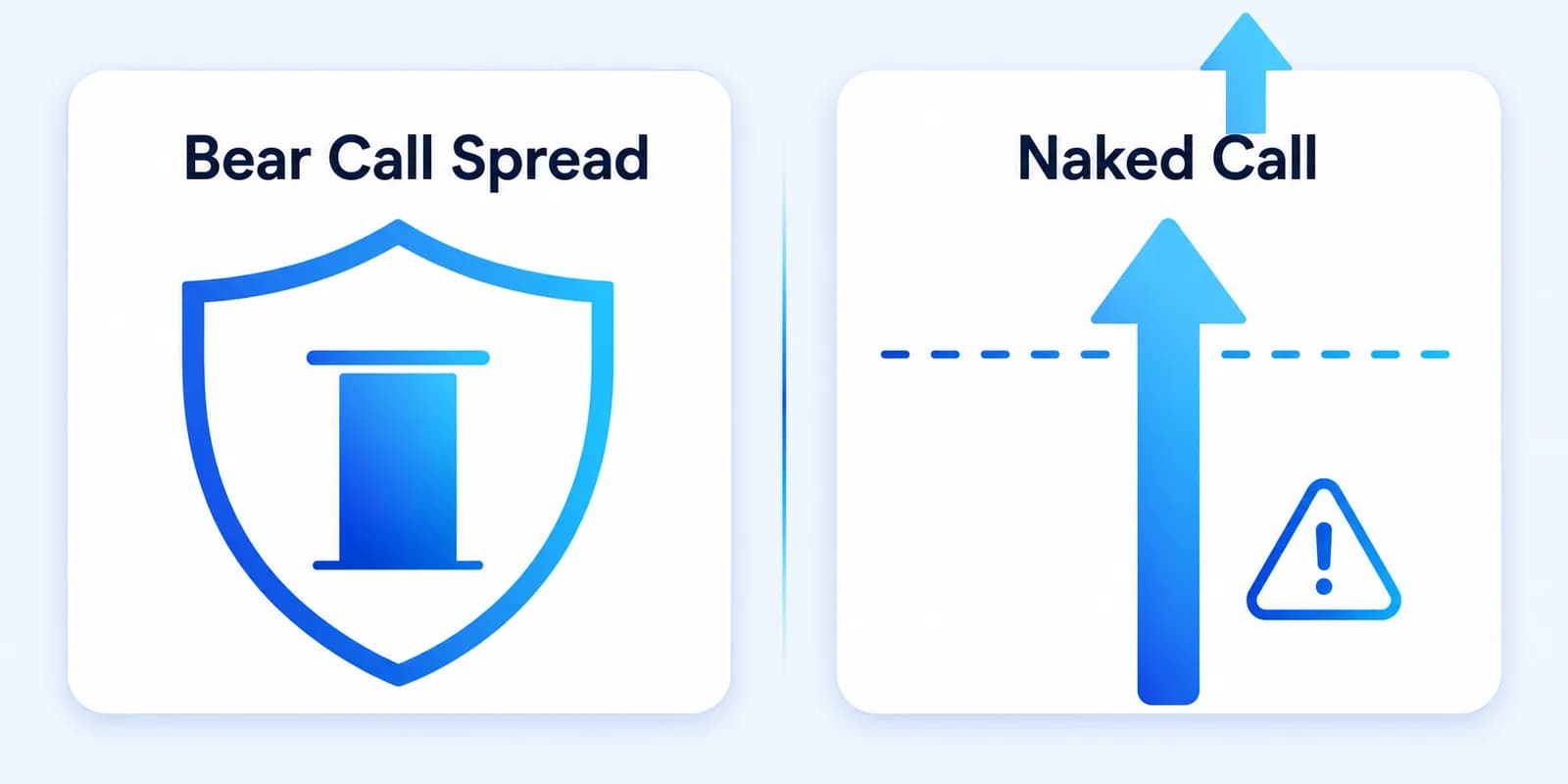
The premium seller collects a net credit. This credit is the maximum possible profit. The long call acts as insurance and caps the loss to the upside. Unlike a naked short call the risk is fully defined, which makes the Bear Call Spread a textbook defined-risk options strategy.
Bear Call Spreads are typically traded on liquid stocks, ETFs and indices. Cash-settled European-style index options like SPX or XSP are attractive because they avoid early assignment risk. On single stocks ex-dividend dates require caution, more on that in the risk section.
According to the public vertical-spread studies from tastylive, a credit spread sold at short delta 0.30 carries a theoretical probability of profit around 70 percent, matching the 0.30 delta as raw ITM probability. This delta-as-POP relationship is also documented by the Options Industry Council.
Bear Call Spread structure: short call and long call
A Bear Call Spread has exactly two legs. Both are calls on the same underlying with the same expiration. They differ in direction (short or long) and strike. The short strike sits closer to spot, the long strike sits above it. The strike difference is called spread width or wing.
| Leg | Type | Direction | Strike | Delta | Premium |
|---|---|---|---|---|---|
| 1 | Call | Short | 120 | +0,28 | +2,00 $ |
| 2 | Call | Long | 125 | +0,12 | −0,70 $ |
| Σ | Net | Credit | 5-pt spread | −0,16 | +1,30 $ |
The trader collects 1.30 USD per share net, which is a 130 USD credit per standard contract of 100 shares. The 5-point spread width sets the maximum risk: 5 USD per share minus 1.30 USD credit equals 3.70 USD per share, or 370 USD per contract.
Calculating max profit, max loss and break-even
For a Bear Call Spread, max profit, max loss and the break-even point are fully knowable at entry. All three values derive directly from net credit, spread width and short strike. That makes the strategy suitable for mechanical risk management.
- Max profit
- Netto-Credit · 100
- Max loss
- (Strike-Differenz − Netto-Credit) · 100
- Break-Even
- Short-Strike + Netto-Credit
Plugging the example from table 1: max profit 130 USD, max loss 370 USD, break-even 121.30 USD. Risk/reward is 1 to 2.85. Combined with a 0.28 short delta the theoretical probability of profit lands between 70 and 80 percent. The POP section below breaks down the math.
Worked example: Bear Call Spread with real numbers
The example below is intentionally entry-level to keep the math easy to follow. A hypothetical stock trades at 115 USD. The trader expects the price will not break above 120 USD over the next few weeks. Implied volatility is elevated, IV rank around 38.
| Metric | Value |
|---|---|
| Underlying | @ 115 $ |
| DTE | 35 |
| Short Call | 120 @ 2,00 $ (Delta 0,28) |
| Long Call | 125 @ 0,70 $ (Delta 0,12) |
| Net credit | 1,30 $ x 100 = 130 $ |
| Max loss | 370 $ |
| Break-even | 121,30 $ |
| Buying power Reg-T | 370 $ |
| Risk/Reward | 1 : 2,85 |
Three scenarios at expiration make the P/L mechanics concrete:
| Price at expiration | Result | Explanation |
|---|---|---|
| 115 $ | +130 $ | Both calls expire worthless, full credit stays in the account. |
| 122 $ | −70 $ | Short call 2 USD ITM, long call worthless. Loss = 200 − 130 = 70 USD. |
| 128 $ | −370 $ | Max loss reached. Long call caps loss above 125 USD. |
In the example case, meaning the underlying actually ends at or below 120 USD, that translates to a 35 percent return on the capital tied up: 130 USD profit on 370 USD buying power reduction. Such values only occur in this specific winning case. They are not an expectancy claim and must not be annualized.
Illustrative example derived from past trades. No guarantee of future results.
Bear call spread calculator
Max profit
+130 USD
Max loss
−370 USD
Break-even
121.30
Risk/reward
1 : 2.85
P&L at expiration, excluding fees and the path during the trade. A pure illustration of the defined structure, not a signal and not investment advice.
Bear Call Spread Greeks profile: delta, gamma, theta, vega
A Bear Call Spread is delta-negative, theta-positive, vega-negative and gamma-negative. This combination of option Greeks means: the position gains on falling or sideways prices, benefits from daily time decay, suffers when implied volatility rises and becomes price-sensitive close to expiration. The table below shows the sign per leg and the net.
| Leg | Delta | Gamma | Theta | Vega |
|---|---|---|---|---|
| Short Call 120 | − | − | + | − |
| Long Call 125 | + | + | − | + |
| Net | − | − | + | − |
The dominant Greek is theta. Every calm trading day shifts value away from the short leg. That is the strategy's primary income source. Negative vega means a mean-reversion of volatility after an IV spike helps the position. Gamma risk grows into expiration, visible in the chart below.
When to use a Bear Call Spread
A Bear Call Spread fits a neutral-to-bearish market view. The trader expects the underlying will not break above a specific level in the coming weeks. The short strike is placed at that level. Sideways or slightly falling expectations also work as a theta trade.
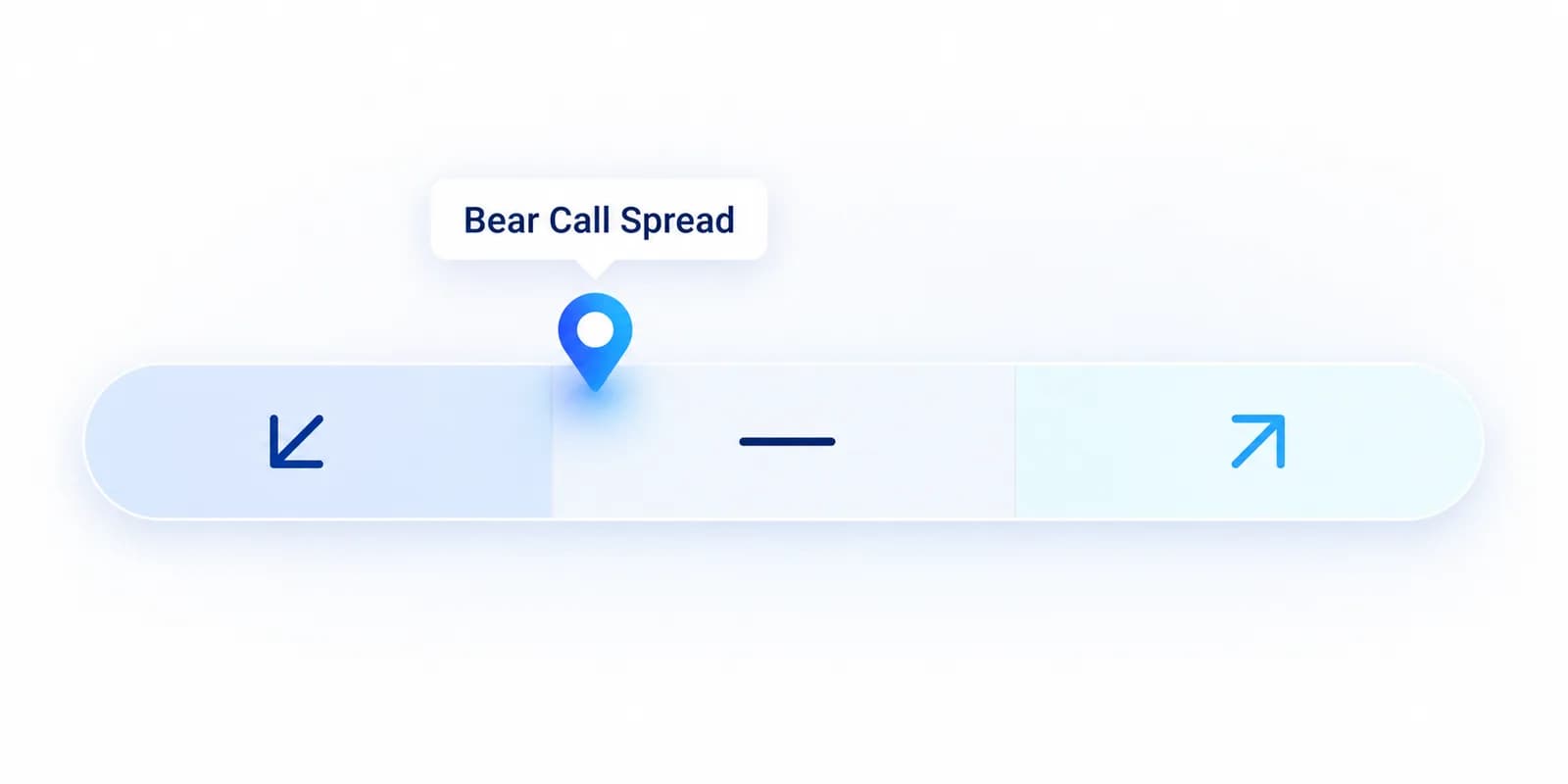
The strategy is particularly clean when implied volatility is elevated, making option premium look richer than its historical average. The community often discusses an IV rank above 30 as a threshold. That is an empirical value from tastylive and OptionAlpha data, not a natural law, and belongs in the individual rulebook.
Common discussion values are an entry window between roughly 30 and 45 DTE and a short delta between 0.20 and 0.30. This range balances theta, POP and gamma risk. Tighter strikes (short delta near 0.30) bring more credit but lower POP. Wider strikes (short delta around 0.15) bring less credit but higher POP.
Probability of profit (POP) and risk-reward of the Bear Call Spread
A quick POP heuristic uses the short call delta. A 0.28 delta translates to a 28 percent raw probability of the short ending ITM at expiration, so a 72 percent POP for the position (100 minus 28). The model is an approximation because it does not yet credit the premium received. With credit added the actual break-even shifts up to 121.30 USD and effective POP is correspondingly a touch higher.
Risk-reward in the example is 1 to 2.85: 130 USD potential profit against 370 USD potential loss. The credit-to-width ratio is 1.30 to 5.00, or 26 percent. A rough community rule of thumb: a credit between 25 and 35 percent of spread width is commonly discussed.
Mathematically the raw expectancy at 72 percent POP and 1:2.85 looks like: 0.72 x 130 − 0.28 x 370 = 93.60 − 103.60 = −10 USD before management. That looks unspectacular by design: active management with an early exit instead of holding to expiration can materially lift expectancy. Exact thresholds (profit target, DTE trigger) belong in the personal rulebook.
Risks, margin and early assignment of the Bear Call Spread
The Bear Call Spread is a defined-risk strategy, so maximum risk is capped at entry. Under Reg-T margin the buying power reduction (BPR) equals strike width times 100 minus net credit. In the example that is 5 x 100 − 130 = 370 USD per contract, equal to max loss. Portfolio margin can lower the capital tied up.
On American-style equity options there is early assignment risk before ex-dividend. If the short call is deep ITM and remaining premium drops below dividend value, the long holder can trigger exercise. Result: a short stock position in the account plus the risk of paying out the dividend. The long call still acts as a hedge but the spread should be cleaned up promptly.
Index options like SPX, NDX or XSP are cash-settled and European-style, so there is no early assignment. Pin risk, where the underlying lands exactly on a strike at expiration, is less dangerous on a Bear Call Spread than on a naked short call because the long call caps maximum risk.
Bear Call Spread vs. Bear Put Spread, Bull Put Spread, Iron Condor and Naked Call
Anyone considering a Bear Call Spread is moving in a field of closely related strategies. The table below compares five common constructions sharing a bearish or neutral outlook. Important caveat: a naked call has theoretically unlimited risk and is therefore not a direct substitute for the defined-risk variants.
| Strategy | Credit/Debit | Outlook | IV | Max profit | Max loss | Complexity |
|---|---|---|---|---|---|---|
| Bear Call Spread | Credit | neutral-bearish | elevated preferred | capped (credit) | capped | low |
| Bear Put Spread | Debit | clearly bearish | lower preferred | capped (spread − debit) | capped (debit) | low |
| Bull Put Spread | Credit | neutral-bullish | elevated preferred | capped (credit) | capped | low |
| Iron Condor | Credit | neutral / range | elevated preferred | capped (credit) | capped | medium |
| Naked Call | Credit | bearish | elevated preferred | capped (credit) | theoretically unlimited | high |
The table is for orientation. Which variant fits a given account depends on individual risk profile, experience and goals and must be decided individually. A naked call is not a direct alternative to defined-risk spreads because of its theoretically unlimited loss.
Pros and cons of the Bear Call Spread
Pros
- Max loss fully defined at entry; cash-settled index options carry no assignment risk (on US equities early assignment can briefly create a short position).
- Theta-positive. Time decay works for the position, every calm day adds profit.
- POP of 70 to 80 percent at short calls with delta 0.20 to 0.30 is mathematically attractive.
- Low capital requirement, fits Reg-T accounts and small portfolios.
Cons
- Risk-reward of 1:2.85 to 1:4 is asymmetric, one loss eats several winning trades.
- Vega-negative. Rising implied volatility after entry hurts the position regardless of price.
- Early-assignment risk before ex-dividend on US equity options, cash-settled index options avoid this.
- Manual execution introduces errors and breaks the discipline of the rule set.
Several of these weaknesses are not strategy issues but a side effect of manual execution. A consistent automated rule set can eliminate them systematically. See the guide on automated trading with rule sets.
Six common Bear Call Spread mistakes
| Mistake | Consequence | How to avoid |
|---|---|---|
| Strikes too close to spot | POP drops below 60 percent, every small move breaches the trade. | Lock the short-delta range in the rule set. |
| Spread too narrow | Commissions eat the credit, slippage hits disproportionately. | Choose spread width to match the underlying, typically at least 2-5 points depending on asset. |
| Earnings ignored | An earnings move can span multiple standard deviations, the position jumps straight to max loss. | Check earnings dates before entry or use deliberately as an IV-crush trade. |
| Liquidity ignored | Bid-ask spreads above 10 cents eat the theoretical edge. | Check open interest and volume in the option chain before entry. |
| Holding past profit target | Gamma risk explodes in the final weeks, one move destroys weeks of theta gains. | Define an early exit as a fixed part of the rule set. |
| Forgetting the long leg | Liquidating the long call before expiration leaves a naked short call with unlimited risk. | Always close both legs as a spread, never isolated. |
Adjustments: rolling or closing a Bear Call Spread
The following maneuvers are not recommendations but a description of common approaches, how a rule set could look. Which trigger fits the individual setup depends on context and belongs in the personal rulebook. In practice many traders combine three maneuvers.
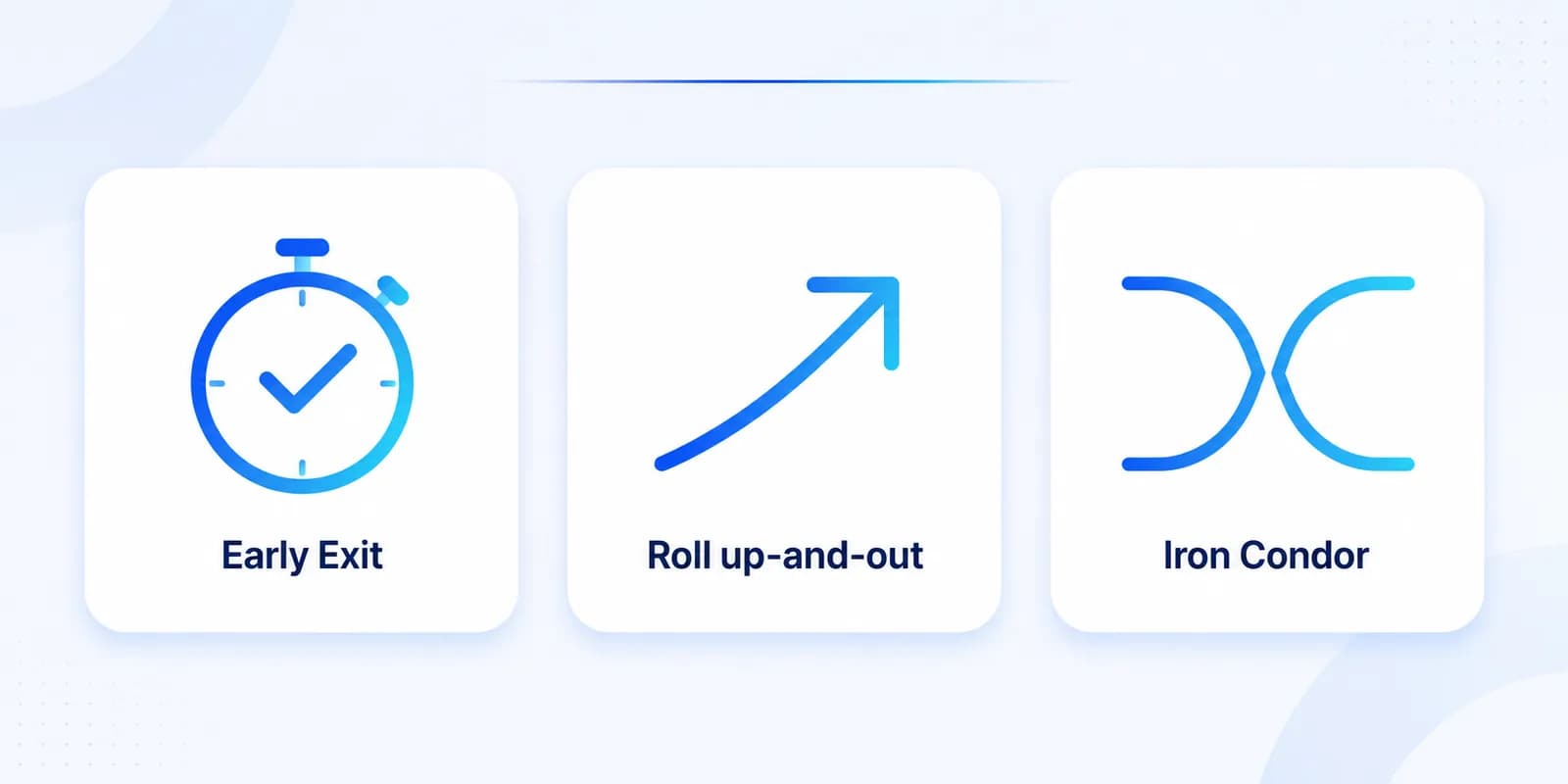
Early exit
A common approach is to close the position once a predefined share of max profit has been reached, instead of holding to expiration. This locks in theta gains before gamma risk rises disproportionately in the final weeks. The exact threshold (for example an early profit target of 50 percent of max gain, meaning 65 USD out of 130 USD in the example) is part of the individual rulebook.
Roll up-and-out
Another option is to roll the threatened spread out to a later expiration and up to higher strikes before the short strike is breached. Close the existing spread and open a new one 30 to 45 days further out for additional credit. This gives more time and more distance from spot.
Conversion into an Iron Condor
If the outlook shifts from bearish to neutral, adding a Bull Put Spread below converts the position into an Iron Condor. This collects additional credit and shifts the position delta toward neutral.
German tax treatment of the Bear Call Spread
Important note: Tax matters are always individual and depend on the personal situation of the taxpayer (tax class, church tax, residence, broker domicile, other income, loss carryforwards). The overview below is not tax advice. Before relevant trading decisions, individual clarification with a qualified tax advisor is strongly recommended.
In Germany Bear Call Spread gains are typically treated as capital income and taxed at 25 percent Abgeltungsteuer plus solidarity surcharge (5.5 percent of the tax) and church tax if applicable. Classification follows § 20 Abs. 2 Nr. 3 EStG (derivative). Premium received from the short call counts as capital income under § 20 Abs. 1 Nr. 11 EStG.
Losses flow into the special derivatives loss bucket under § 20 Abs. 6 Satz 5 EStG. A previously discussed annual offset cap against derivatives gains no longer applies. The 2024 Annual Tax Act (Jahressteuergesetz 2024) abolished this restriction in full, retroactive to 2020. Derivatives losses are therefore again fully deductible against derivatives gains.
Practical note: foreign brokers like Interactive Brokers and CapTrader do not withhold German Abgeltungsteuer. Income is declared via Anlage KAP. A spread rolled across year-end splits the buy-to-close into the old year and the new sell-to-open into the new year. Clean documentation is a prerequisite for correct offsetting.
This overview describes general tax conditions for German retail investors. It is neither tax advice nor a recommendation regarding any specific tax structure. Individual tax treatment can differ significantly depending on personal circumstances and should be discussed with a qualified tax advisor.
Bear Call Spreads in an automated rule set
In practice, Bear Call Spreads are traded both as a stand-alone setup on single equity options and as the call side of an SPX Iron Condor. Through a trade template in OptionsApp the logic runs mechanically: entry conditions check the underlying, IV level and earnings distance, the search criteria place strikes by delta target, the P&L actions watch the position and close or roll it before expiration. Only setup and sizing remain manual.
Three points are relevant for this setup. How a trader handles them individually depends on the personal rulebook:
- Clear sizing rule. A percentage cap of net liquidation value per trade can keep drawdowns bounded during volatility spikes, for example 1 to 3 percent of account value as bound risk per position.
- Profit target defined up front. A mechanically set threshold, often between 50 and 65 percent of max profit, moves the exit decision before the trade rather than under pressure.
- Earnings filter at entry. Filtering earnings dates carefully avoids the few trades per year that can become expensive in a spike; an earnings move often spans 8 to 12 percent.
Proprietary backtest returns are deliberately not published here. Glossary content should reference externally verifiable data only. The operational building blocks for a structured workflow are in the automated trading guide and in OptionsApp features.
When does a bear call spread fail?
Three market constellations regularly break a bear call spread.
1. Bullish breakout above the short call strike
If the underlying breaks the last swing high and runs through the short call strike, losses accelerate via negative delta plus negative gamma.
2. Squeeze rally with low IV rank
At IV rank under 20 the harvestable credit is thin while implied volatility is structurally underpriced. A short squeeze or FOMO rally can drive the underlying 4-6 percent in a session. Possible filter rule: no bear call below IV rank 20 without an intentional squeeze hedge.
3. Earnings pop or macro surprise
Bear call spreads on single stocks ahead of earnings are lottery tickets. Possible filter rule: no bear call spreads on single stocks in the earnings window, no index bear calls with FOMC or CPI inside the duration unless as deliberate vol-crush play.
Bear Call Spread FAQ
What is a Bear Call Spread in simple terms?
A Bear Call Spread is a bearish vertical credit spread made of 2 legs on the same underlying with identical expiration. You sell a call closer to the money and simultaneously buy a further out-of-the-money call. The difference is the net credit, which you keep in full as long as the underlying stays below the short strike at expiration.
What is the maximum profit on a Bear Call Spread?
Max profit equals the net credit times 100. With a 1.30 USD credit that is 130 USD per contract. The maximum is reached when the underlying expires at or below the short strike and both calls expire worthless.
What is the maximum loss on a Bear Call Spread?
Max loss equals strike width minus net credit, times 100. With a 5-point spread and a 1.30 USD credit that is 370 USD per contract. The full loss hits if the underlying expires at or above the long strike.
How do you calculate the break-even of a Bear Call Spread?
Break-even = short strike + net credit. In the example with short call 120 and a 1.30 USD credit, the break-even is 121.30 USD. If the underlying ends exactly on this value, the position is neither in profit nor in loss.
When is a Bear Call Spread a good trade?
A Bear Call Spread fits a neutral-to-bearish view: the underlying should not break above the short strike. Common discussion values are an entry window between roughly 30 and 45 DTE and a short delta of 0.20 to 0.30. The exact choice belongs in the individual rulebook.
What is the probability of profit of a Bear Call Spread?
With a short delta between 0.20 and 0.30 the theoretical POP (probability of profit) sits around 70 to 80 percent. Delta is used as a proxy. Active management with an early profit target can lift the effective win rate but reduces average profit per trade.
What is the difference between a Bear Call Spread and a Bear Put Spread?
Both are bearish but differ in cashflow direction. The Bear Call Spread is a credit spread with a theta-positive profile, the trader collects premium and benefits from time decay. The Bear Put Spread is a debit spread, the trader pays premium and profits primarily from a price drop.
How are Bear Call Spread gains taxed in Germany?
Gains typically fall under German Abgeltungsteuer at 25 percent plus solidarity surcharge and church tax if applicable. Losses enter the derivatives loss bucket under § 20 Abs. 6 EStG. The former 20,000 EUR annual cap was abolished by the 2024 Annual Tax Act (Jahressteuergesetz 2024), retroactive to 2020; derivatives losses are again fully deductible against derivatives gains. Individual treatment should be clarified with a qualified tax advisor.
How much margin does a Bear Call Spread require?
Under Reg-T margin the buying power reduction equals strike width times 100 minus net credit. In the example with a 5-point spread and 1.30 USD credit that is 370 USD per contract, which equals the max loss. Risk is fully bound up front.
What happens on early assignment of a Bear Call Spread?
If the short call is assigned early, a short stock position is opened. This typically happens before ex-dividend, when remaining premium falls below dividend value. The long call stays as hedge. Cash-settled index options (like SPX, XSP) do not have early assignment risk.
Sources
- Fidelity Learning Center, Bear Call Spread. fidelity.com
- The Options Industry Council (OIC), Bear Call Spread / Credit Call Spread. optionseducation.org
- Macroption, Bear Call Spread Payoff and Break-Even. macroption.com
- BVerfG, Beschluss zur Verlustverrechnungsbeschränkung für Termingeschäfte (2024), Anlage zu § 20 Abs. 6 EStG. BMF-Schreiben 2021, aktualisiert 2024.
- tastylive, Vertical Credit Spread Studies (public). tastylive.com
Risk disclaimer
Options are leveraged derivatives. A Bear Call Spread can lose up to strike width minus net credit. Worked examples, POP values and historical discussion values in this article are no promise of future gains. Always check capital, margin and tax situation before trading. This content is not individual investment advice.
Automate Bear Call Spreads with OptionsApp
Define rule set, connect broker, workflow runs. OptionsApp executes entry conditions, profit target, stop loss and rolls automatically based on your own configured values. Free 14-day trial.
More in automated trading guide or in the Credit Spread glossary entry.